English can be confusing, especially when two words look almost identical. One common example is Dysregulation vs Disregulation. Many people assume both words mean the same thing, but that is not true. In fact, one is a recognized term used in psychology, medicine, and biology, while the other is usually considered incorrect or extremely rare.
Understanding the difference matters because using the wrong word can completely change the meaning of your sentence. Whether you are writing an academic paper, a medical article, or simply trying to improve your vocabulary, knowing which term to use will help you communicate more clearly.
In this guide, you will learn the meanings, spelling differences, examples, pronunciation, and proper usage of these confusing terms in an easy-to-understand way.
What Does Dysregulation Mean?
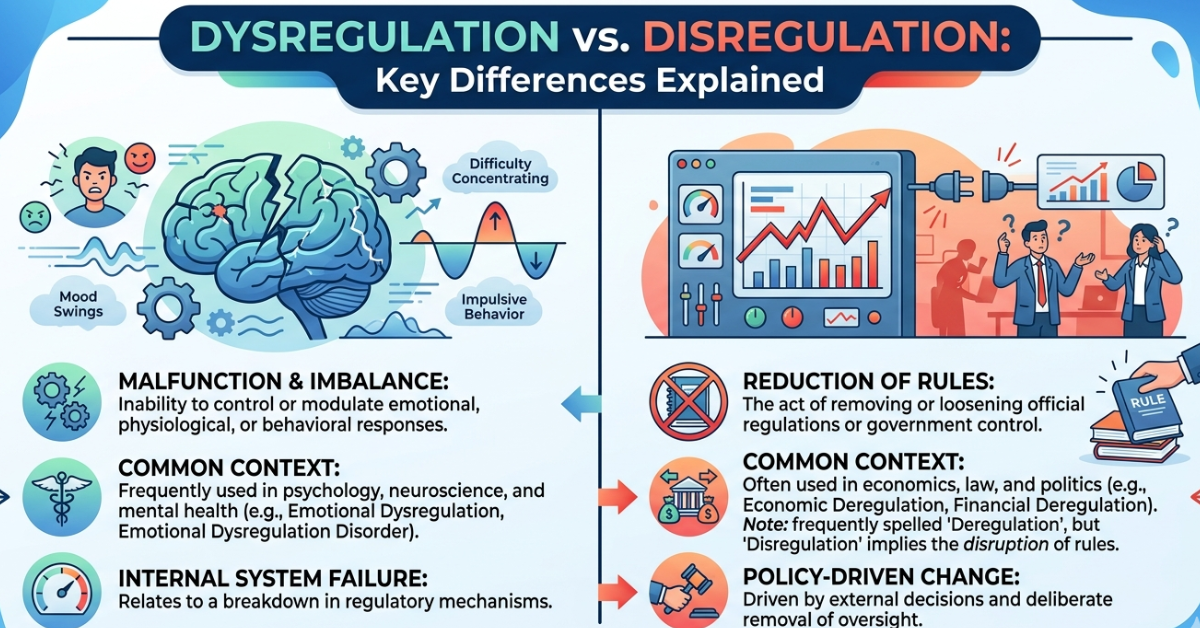
Dysregulation refers to the inability to properly regulate or control a system, emotion, behavior, or bodily function.
The prefix “dys-” comes from Greek and means “abnormal,” “difficult,” or “impaired.” Because of this, the word is commonly used in:
- Psychology
- Psychiatry
- Medicine
- Neuroscience
- Biology
It describes something functioning in an unhealthy or disordered way.
Common Examples of Dysregulation
Here are a few areas where the term is frequently used:
- Emotional dysregulation
- Immune system dysregulation
- Hormonal dysregulation
- Nervous system dysregulation
Example Sentences
- Emotional dysregulation can make stress harder to manage.
- Sleep problems may contribute to hormonal dysregulation.
- Researchers studied immune dysregulation in patients with chronic illness.
What Does Disregulation Mean?
Disregulation is much less common and is often considered a mistaken form of “dysregulation.”
Technically, the prefix “dis-” usually means:
- Lack of
- Removal of
- Opposite of
Although a few older or highly specialized texts may contain the word, it is rarely accepted in modern standard English. Most dictionaries and academic sources prefer “dysregulation.”
Why the Confusion Happens
People often confuse the two because:
- Both words look similar.
- The prefixes “dys-” and “dis-” sound alike.
- Autocorrect tools may not immediately flag the error.
In most situations, if you write “disregulation,” readers may assume you meant “dysregulation.”
Dysregulation vs Disregulation: Main Difference
Here is the simplest way to understand it.
| Term | Meaning | Correct Usage |
| Dysregulation | Impaired or abnormal regulation | Common and correct |
| Disregulation | Rare or usually incorrect variation | Generally avoided |
The key difference is that dysregulation is the medically and grammatically accepted word.
Why Dysregulation Is Common in Psychology
The term appears frequently in mental health discussions because emotions and behaviors depend heavily on regulation systems in the brain.
Emotional Dysregulation
This refers to difficulty managing emotional responses. A person may:
- React too intensely
- Struggle to calm down
- Experience mood swings
- Feel overwhelmed easily
Emotional dysregulation is associated with several mental health conditions, including:
- Anxiety disorders
- ADHD
- PTSD
- Borderline personality disorder
Behavioral Dysregulation
Behavioral dysregulation involves trouble controlling actions or impulses.
Examples include:
- Aggressive outbursts
- Impulsivity
- Risk-taking behavior
- Difficulty following routines
Dysregulation in Biology and Medicine
The word is not limited to psychology. It is also important in medicine and science.
Immune Dysregulation
When the immune system becomes overactive or underactive, it may attack healthy tissues or fail to protect the body properly.
Hormonal Dysregulation
Hormones control many body functions. An imbalance can affect:
- Sleep
- Mood
- Metabolism
- Reproduction
Nervous System Dysregulation
This can impact:
- Stress response
- Heart rate
- Digestion
- Energy levels
How to Remember the Correct Word
A simple memory trick can help.
Think of “Dys” as Dysfunction
The prefix “dys-” often relates to something abnormal or impaired.
Examples:
- Dysfunction
- Dyslexia
- Dysplasia
Since dysregulation refers to impaired regulation, the spelling makes sense.
Common Mistakes People Make
Many writers accidentally use the wrong spelling in:
- Blog posts
- Student assignments
- Social media captions
- Medical discussions
Incorrect Example
- The patient showed signs of disregulation.
Correct Example
- The patient showed signs of dysregulation.
Proofreading carefully can help you avoid this common error.
Is Disregulation Ever Correct?
In extremely rare cases, some older texts or niche writings may use “disregulation.” However, it is not widely accepted in modern English.
Most editors, teachers, and professionals will consider it a spelling mistake.
If you want your writing to sound credible and polished, it is safer to use “dysregulation.”
Pronunciation Guide
Dysregulation
Pronounced as:
dis-reg-yuh-LAY-shun
Disregulation
Pronounced similarly, which is one reason people mix them up.
When Should You Use Dysregulation?
Use the term when describing:
- Emotional imbalance
- Biological malfunction
- Difficulty controlling processes
- Abnormal regulation in the body or brain
It is especially appropriate in:
- Academic writing
- Medical discussions
- Psychology content
- Scientific research
Quick Summary
Here is a quick recap:
- “Dysregulation” is the correct and widely accepted term.
- It refers to impaired or abnormal regulation.
- “Disregulation” is rare and usually considered incorrect.
- The word is commonly used in psychology, medicine, and biology.
- Emotional dysregulation is one of the most searched topics related to the term.
FAQs
Is dysregulation a real word?
Yes. It is a recognized term used in psychology, medicine, neuroscience, and biology.
Is disregulation incorrect?
In most modern writing, yes. It is generally viewed as a misspelling or nonstandard variation.
What is emotional dysregulation?
It means difficulty controlling emotional reactions or returning to a calm emotional state.
Why do people confuse these words?
They look and sound very similar, especially because the prefixes “dys-” and “dis-” are easily mixed up.
Which spelling should I use in academic writing?
You should use “dysregulation” because it is the accepted professional and scientific term.
Is dysregulation related to mental health?
Yes. It is commonly discussed in relation to emotional control, stress response, and behavioral regulation.
Conclusion
Understanding Dysregulation vs Disregulation is important because only one of these terms is widely accepted in modern English. “Dysregulation” refers to impaired or abnormal regulation and is commonly used in psychology, medicine, and biology. On the other hand, “disregulation” is rare and usually treated as an error.
If you want your writing to sound accurate, professional, and clear, “dysregulation” is the safer and correct choice. Learning these subtle language differences can improve both your vocabulary and your confidence when writing academic or professional content