Have you ever typed a word so many times that it starts looking wrong—even when it might already be wrong? That’s exactly what happens with steer vs stear. Many people get confused between these two spellings, especially when talking about driving, guidance, or direction.
In reality, steer vs stear is not a debate between two words—it’s a common spelling mistake versus the correct form. In this article, you’ll learn what the correct spelling is, why the confusion happens, and how to use the word properly in real-life situations.
By the end, you’ll confidently understand the difference and never mix them up again.
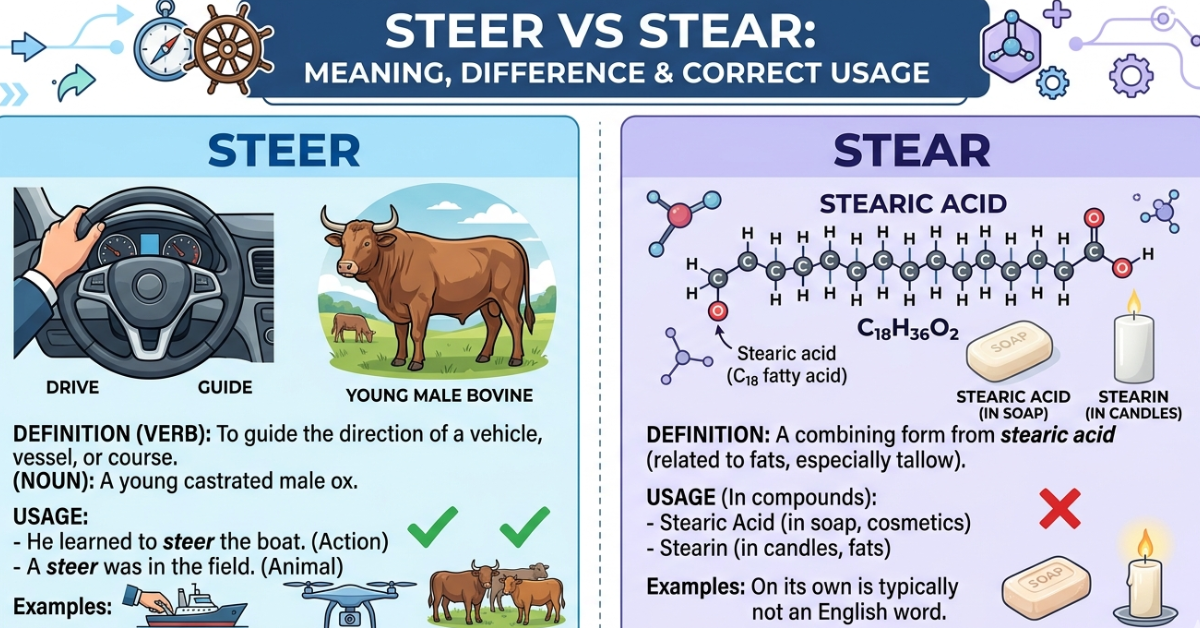
What Does “Steer” Mean?
The correct word is “steer.”
To steer means to guide, control, or direct something—especially a vehicle or movement.
Common meanings of “steer”:
- To control the direction of a car, ship, or bicycle
- To guide someone’s decisions or actions
- To influence a situation in a certain direction
Examples:
- She had to steer the car carefully through heavy traffic.
- His advice helped steer me in the right direction.
When people search for steer vs stear, they are almost always referring to this correct verb: steer.
Is “Stear” a Real Word?
Here’s the simple answer: No, “stear” is not a standard English word.
In almost all cases, stear is just a spelling error of “steer.” It often appears due to:
- Typing mistakes (missing double “e”)
- Fast texting or autocorrect errors
- Mishearing the pronunciation
So when comparing steer vs stear, only steer is correct in modern English usage.
Why People Get Confused Between Steer vs Stear
Even though the correct spelling is simple, confusion is still common. Here’s why:
1. Pronunciation trickiness
“Steer” sounds like a single smooth syllable, so the double “e” is easy to miss when writing.
2. Fast typing habits
On mobile keyboards, people often skip letters, leading to stear instead of steer.
3. Visual similarity
The word doesn’t look “wrong” at first glance, which makes steer vs stear confusion more frequent.
Real-Life Usage of “Steer”
Understanding usage helps lock in the correct spelling. Here are practical examples:
Driving context:
- You must steer slowly on slippery roads.
Decision-making context:
- Good mentors help steer your career path.
Emotional or metaphorical context:
- She tried to steer the conversation away from the argument.
Notice how in every case, steer vs stear clearly resolves in favor of steer.
Easy Trick to Remember the Correct Spelling
If you ever feel stuck, use this simple memory hack:
Think of “wheel” has two hands on it” → steer has two “e”s
Or even better:
- You need both hands to steer a wheel
- So you need both “e”s in the word steer
This makes remembering steer vs stear much easier in daily writing.
Common Mistakes People Make
When analyzing steer vs stear, here are frequent errors:
- Writing “stear the car” instead of “steer the car”
- Using “stear” in formal essays or emails
- Mixing spelling due to autocorrect suggestions
- Repeating the mistake in social media captions
Avoiding these will instantly improve your writing accuracy.
Key Takeaways
- “Steer” is the correct spelling and meaning
- “Stear” is a common misspelling
- The confusion comes from typing habits and pronunciation
- Always use steer in writing and communication
- Understanding steer vs stear improves grammar accuracy
FAQ: Steer vs Stear
1. What is the correct spelling: steer or stear?
The correct spelling is steer. “Stear” is not recognized in standard English.
2. Why do people write stear instead of steer?
Most people accidentally type “stear” due to fast typing or missing a letter while writing steer.
3. Does stear have any meaning in English?
No, stear is not a valid English word in modern usage. Only “steer” is correct.
4. Can steer be used in formal writing?
Yes, “steer” is widely used in academic, professional, and everyday writing.
5. How can I remember steer vs stear easily?
Remember that a steering wheel has two hands—just like “steer” has two “e”s.
6. Is steer only related to driving?
No, it also means guiding decisions, actions, or directions—not just driving.
Conclusion
The confusion around steer vs stear is common, but the answer is simple: only steer is correct. Whether you’re writing about driving, leadership, or guidance, the proper spelling ensures clarity and professionalism.
Once you understand the meaning and usage, you’ll never second-guess it again. Keep practicing, stay aware of common spelling traps, and your writing will instantly become more accurate and confident.