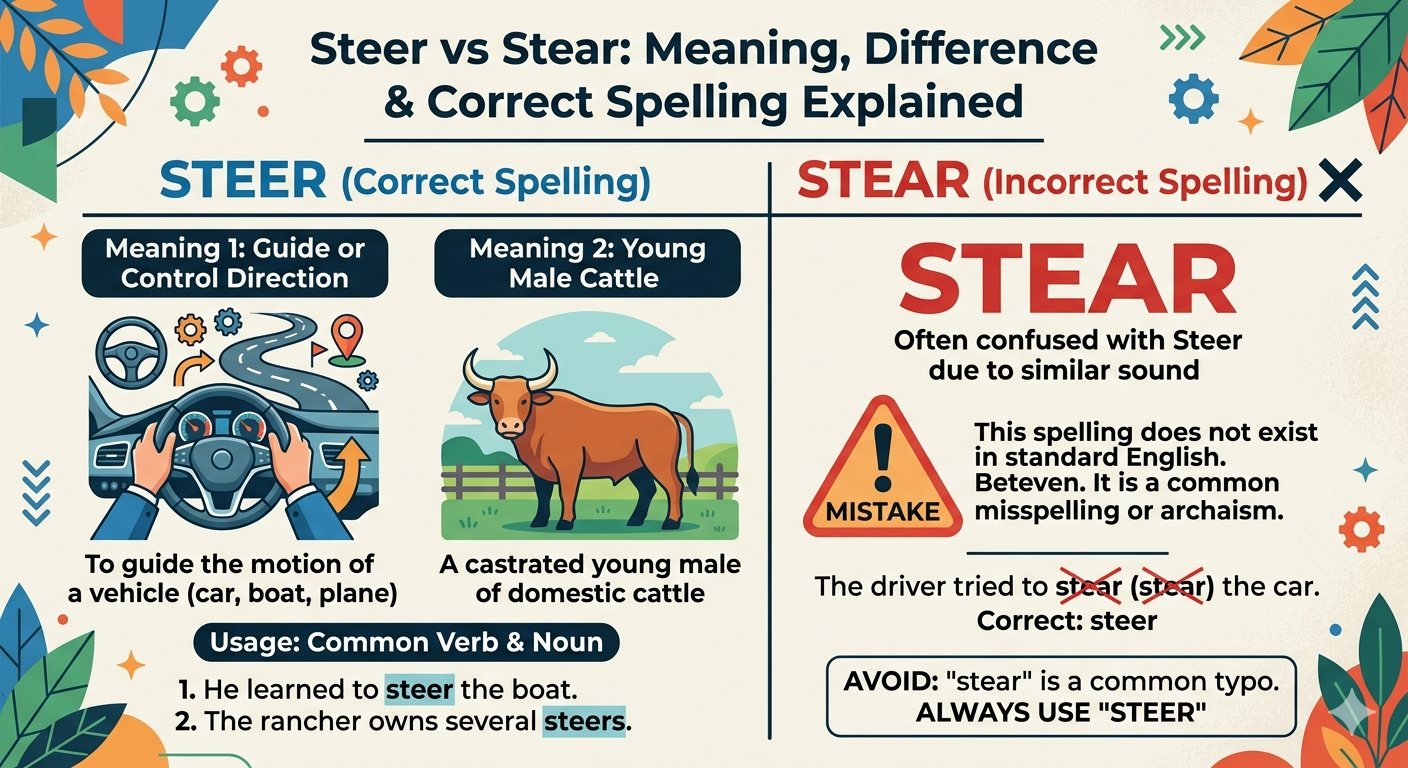
Have you ever typed a word and stopped for a second, wondering if it looks right or completely wrong? One of the most common spelling confusions in English is stear vs steer, and many writers accidentally mix the two.
The truth is simple: the confusion usually comes from a common spelling mistake rather than two valid English words. In this guide, we’ll break down the difference between stear vs steer, explain which one is correct, why people get confused, and how you can avoid this error in writing.
By the end, you’ll clearly understand the correct usage, meaning, and real-world examples so you never hesitate again.
What Does “Steer” Mean?
The correct word in English is “steer.”
It is both a verb and a noun with different meanings depending on context.
As a verb (most common use)
To “steer” means to control the direction of something.
Examples:
- Steer a car
- Steer a boat
- Steer a conversation
As a noun
It can also refer to a young castrated bull raised for beef.
Example:
- The farmer raised a healthy steer on the ranch.
So when you see steer used in writing, it is always grammatically correct and widely accepted in English.
What About “Stear”? Is It a Word?
This is where most confusion begins.
The spelling “stear” is not a standard English word in modern usage. It is generally considered:
- A spelling mistake for “steer”
- Occasionally confused due to pronunciation
- Sometimes seen in informal typing errors
So when comparing stear vs steer, only one is correct in standard English: steer.
Stear vs Steer: Why Do People Get Confused?
There are a few reasons why the confusion happens so often:
1. Sound similarity
When spoken quickly, “steer” can sound like “stear,” especially in certain accents.
2. Typing errors
On keyboards, the letters “a” and “e” are close, making mistakes easy.
3. Pattern confusion in English
English has words like:
- clear
- tear
- gear
So people assume “stear” might follow a similar pattern, even though it doesn’t.
Stear vs Steer: Quick Comparison Table
| Feature | Steer | Stear |
| Correct spelling | Yes | No |
| Meaning | To control direction / a bull | No standard meaning |
| Usage in English | Common | Incorrect / typo |
| Dictionary recognition | Yes | No |
This makes it clear that stear vs steer is not a debate of two words—it’s correct spelling vs mistake.
Real-World Usage Examples of “Steer”
Understanding usage helps solidify learning:
- She tried to steer the conversation away from politics.
- The driver had to steer carefully on the icy road.
- Teachers help students steer their careers in the right direction.
- The ranch had several strong young steers grazing in the field.
These examples show how flexible the word is in everyday English.
Practical Tips to Remember the Correct Spelling
If you often get confused between stear vs steer, here are simple memory tricks:
1. Think of “wheel steering”
A car has a “steering wheel,” not a “stearing wheel.”
2. Associate with direction
“Steer” always involves guiding or direction.
3. Remove the “A” rule
If you see “stear,” automatically remove the “a” and correct it to “steer.”
Key Takeaways
- “Steer” is the only correct spelling in English
- “Stear” is a common spelling mistake
- The word “steer” can mean to guide direction or a young bull
- Confusion comes from pronunciation and typing errors
- Context always confirms correct usage
FAQ: Stear vs Steer
1. Is “stear” a correct English word?
No, “stear” is not a standard English word. It is usually a misspelling of “steer.”
2. What is the correct spelling: stear vs steer?
The correct spelling is steer. It is used in both verb and noun forms.
3. Why do people write “stear” instead of “steer”?
It happens due to typing errors, pronunciation confusion, or misunderstanding of English spelling patterns.
4. What does “steer” mean in simple words?
It means to guide or control direction, like steering a car or boat.
5. Can “steer” be used in formal writing?
Yes, “steer” is fully correct and widely used in academic, professional, and everyday writing.
6. How can I avoid confusing stear vs steer?
Remember that only “steer” exists in correct English—if you see “stear,” it is always wrong.
Conclusion
The confusion between stear vs steer is common, but the answer is straightforward: only “steer” is correct in English. Whether you’re writing formally or casually, using the correct spelling improves clarity and credibility.
By understanding its meaning, usage, and common mistakes, you can confidently avoid this error in the future. Keep practicing, and soon the difference will feel natural every time you write.