Have you ever wondered whether you should say upcoming or incoming when talking about something that’s about to happen? Although these words may seem interchangeable, they have distinct meanings and are used in different contexts. Choosing the wrong one can make your writing sound unnatural or even change the intended meaning.
This guide explains the difference between upcoming or incoming, when to use each term, common mistakes to avoid, and practical examples from everyday life and professional communication. By the end, you’ll know exactly which word fits your sentence with confidence.
Understanding Upcoming and Incoming
At first glance, both words suggest something related to the future. However, they describe different kinds of events.
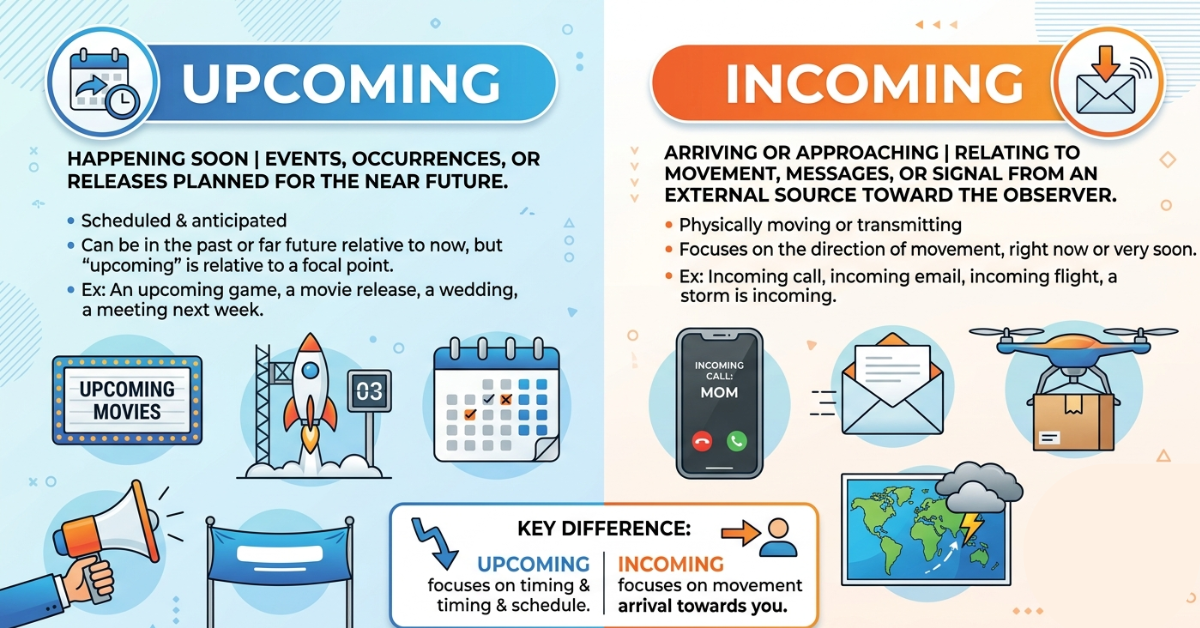
- Upcoming refers to something that is scheduled or expected to happen soon.
- Incoming refers to something that is currently arriving or on its way toward someone or something.
The distinction is subtle but important.
What Does “Upcoming” Mean?
Upcoming is an adjective used to describe future events, activities, appointments, releases, or occasions that have not happened yet but are expected soon.
Common Uses of Upcoming
People frequently use “upcoming” for:
- Upcoming events
- Upcoming meetings
- Upcoming holidays
- Upcoming exams
- Upcoming projects
- Upcoming product launches
- Upcoming movies
- Upcoming concerts
Examples
- Our upcoming meeting has been moved to Friday.
- She is preparing for her upcoming exam.
- The company announced its upcoming product launch.
- Everyone is excited about the upcoming festival.
In each example, the event is planned for the future.
What Does “Incoming” Mean?
Incoming describes something that is arriving, approaching, or being received.
It often relates to communication, transportation, people taking new positions, or objects moving toward a destination.
Common Uses of Incoming
You’ll often hear “incoming” with:
- Incoming calls
- Incoming messages
- Incoming flights
- Incoming students
- Incoming shipments
- Incoming email
- Incoming president
- Incoming storm
Examples
- I received an incoming call during lunch.
- The airport has delayed several incoming flights.
- The university welcomed its incoming freshmen.
- Please inspect all incoming packages.
Unlike “upcoming,” these things are actively arriving rather than simply scheduled.
Upcoming or Incoming: The Main Difference
| Upcoming | Incoming |
| Scheduled to happen soon | Arriving or approaching now |
| Focuses on future events | Focuses on arrival or reception |
| Often used with events and plans | Often used with calls, people, shipments, and communication |
| Indicates something expected | Indicates movement toward a destination |
The easiest way to remember the difference is:
- If something is planned, choose upcoming.
- If something is arriving, choose incoming.
When to Use Upcoming
Use upcoming whenever discussing something that is expected to happen in the near future.
Examples
- The upcoming conference will feature international speakers.
- We are planning our upcoming vacation.
- She is excited about her upcoming interview.
- Watch our upcoming webinar next week.
These situations involve future plans rather than arrival.
When to Use Incoming
Use incoming when referring to something currently moving toward you or about to be received.
Examples
- The receptionist answered the incoming call.
- Customs inspected all incoming cargo.
- Meteorologists warned of an incoming storm.
- The company introduced its incoming CEO.
Here, the emphasis is on arrival rather than scheduling.
Common Mistakes to Avoid
Many English learners mix these words because both relate to the future.
Incorrect
- The incoming meeting starts tomorrow.
Correct
- The upcoming meeting starts tomorrow.
Incorrect
- We are excited about the upcoming shipment.
Better
- We are waiting for the incoming shipment.
Incorrect
- Our incoming holiday begins next month.
Correct
- Our upcoming holiday begins next month.
Everyday Examples
At Work
Upcoming:
- upcoming presentation
- upcoming deadline
- upcoming conference
Incoming:
- incoming email
- incoming customer request
- incoming shipment
At School
Upcoming:
- upcoming exam
- upcoming assignment
- upcoming semester
Incoming:
- incoming students
- incoming applications
Technology
Upcoming:
- upcoming software update
- upcoming product announcement
Incoming:
- incoming notifications
- incoming phone calls
- incoming messages
Quick Memory Trick
A simple trick can help you remember:
Upcoming = Planned
Think of something on your calendar.
Incoming = Arriving
Think of your phone ringing or a package being delivered.
This mental shortcut works in most situations.
Practical Tips for Using the Right Word
- Ask yourself whether the thing is scheduled or arriving.
- Use upcoming for events, appointments, and plans.
- Use incoming for communication, deliveries, and people arriving.
- Read your sentence aloud. If “planned” fits, use upcoming. If “arriving” fits, use incoming.
- Pay attention to common collocations like “incoming call” and “upcoming event.”
Real-World Relevance
Using the correct word improves communication in both personal and professional settings.
For example:
- Businesses announce upcoming product launches.
- Customer service teams manage incoming calls.
- Universities welcome incoming students while advertising upcoming orientation events.
- Airlines track incoming flights while promoting upcoming travel deals.
Choosing the right term makes your writing more precise and natural.
Key Takeaways
- Upcoming refers to events or activities that are scheduled for the near future.
- Incoming refers to people, objects, messages, or events that are arriving.
- Use upcoming for plans and schedules.
- Use incoming for arrivals and reception.
- Although related to the future, the two words are not interchangeable.
Frequently Asked Questions
Is it upcoming or incoming meeting?
The correct phrase is upcoming meeting because meetings are scheduled events rather than things that arrive.
Can upcoming and incoming mean the same thing?
Not usually. While both involve the future, upcoming focuses on planned events, whereas incoming focuses on arrival or reception.
Is it incoming call or upcoming call?
The correct phrase is incoming call because the call is arriving at your phone.
Should I say upcoming students or incoming students?
Use incoming students when referring to newly admitted students arriving at a school or university. “Upcoming students” is not standard English.
What is an upcoming event?
An upcoming event is an activity or occasion scheduled to happen in the near future, such as a conference, concert, or meeting.
How can I remember the difference between upcoming or incoming?
Remember this simple rule: Upcoming means planned. Incoming means arriving. If something is on your calendar, it’s upcoming. If it’s on its way to you, it’s incoming.
Conclusion
Understanding the difference between upcoming or incoming helps you communicate more accurately in everyday conversations, business writing, education, and digital communication. While both words relate to future situations, upcoming refers to planned events, whereas incoming describes something actively arriving or being received. Keeping this distinction in mind will make your English sound more natural, professional, and precise. The next time you’re unsure which word to use, simply ask yourself: Is it planned, or is it arriving? The answer will guide you to the correct choice every time.