Have you ever seen the words dialog and dialogue used interchangeably and wondered whether one of them is wrong? You’re not alone. These two spellings often create confusion among writers, students, editors, software developers, and even native English speakers.
The debate around dialog vs dialogue is less about correctness and more about context. While both words refer to a conversation between two or more people, their usage varies depending on industry, region, and style preferences.
In this article, you’ll learn the meaning of each term, the key differences between them, where they’re commonly used, and which spelling is most appropriate in different situations. By the end, you’ll be able to choose the right word with confidence.
What Does Dialog Mean?
The word dialog is a shortened spelling of dialogue. It refers to a conversation or exchange of ideas between two or more individuals.
Historically, dialog emerged as a simplified American spelling, particularly in technical and computing contexts. Over time, it became widely accepted in software development, user interface design, and certain business environments.
Examples of Dialog
- The customer service team maintained an open dialog with clients.
- The software displays a confirmation dialog before deleting files.
- The conference encouraged dialog between experts from different fields.
Although grammatically acceptable, dialog is less common in general writing than dialogue.
What Does Dialogue Mean?
Dialogue is the traditional and more widely recognized spelling. It refers to a conversation between people, whether spoken, written, or imagined in literature.
The term originates from the Greek word dialogos, meaning “conversation” or “discussion.”
Examples of Dialogue
- The novel contains realistic dialogue between characters.
- Effective dialogue helps resolve conflicts.
- International dialogue can strengthen diplomatic relations.
In literature, journalism, education, and formal writing, dialogue is generally the preferred spelling.
Dialog vs Dialogue: The Main Difference
At their core, both words mean the same thing: a conversation or exchange of ideas.
The difference lies primarily in usage and audience expectations.
| Feature | Dialog | Dialogue |
| Meaning | Conversation or discussion | Conversation or discussion |
| Traditional Spelling | No | Yes |
| Common in Literature | Rare | Very common |
| Common in Software Industry | Very common | Less common |
| Preferred in Formal Writing | Usually not | Yes |
| Dictionary Recognition | Yes | Yes |
The choice often depends on the context rather than the meaning.
Why Are There Two Spellings?
English contains many words with alternative spellings that evolved over time. Similar examples include:
- Catalog vs Catalogue
- Analog vs Analogue
- Program vs Programme
In American English, shorter forms often became popular because they were viewed as more efficient and straightforward.
As technology developed, software engineers adopted spellings like dialog and catalog because shorter names fit programming conventions and interface labels.
Meanwhile, publishers, educators, and literary professionals continued using dialogue.
When Should You Use Dialogue?
In most situations, dialogue is the safest and most widely accepted choice.
Use Dialogue For:
- Academic papers
- Essays
- Books and novels
- Journalism
- Professional communication
- Creative writing
- Historical and literary discussions
Example
In fiction writing, strong dialogue helps reveal character personality and move the plot forward.
Most style guides favor this spelling because readers instantly recognize it.
When Should You Use Dialog?
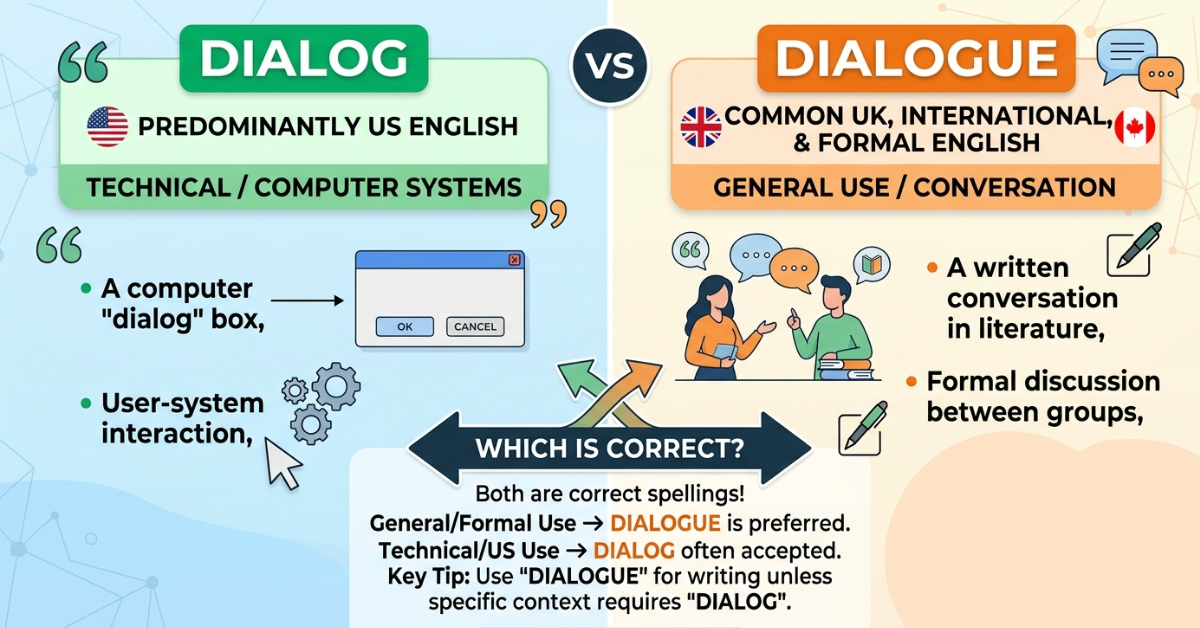
The spelling dialog is commonly used in technical fields.
Use Dialog For:
- Software documentation
- Programming interfaces
- Computer applications
- UX and UI design
- Technical manuals
Example
The application opens a dialog box asking users to confirm their action.
In technology, phrases such as:
- Dialog box
- Dialog window
- Dialog manager
are often more common than their dialogue counterparts.
Dialog Box vs Dialogue Box
One of the most common places people encounter this spelling difference is in computing.
Dialog Box
A dialog box is a small window that appears on a computer screen to request information or display messages.
Examples include:
- Save File dialog
- Print dialog
- Settings dialog
Dialogue Box
Although technically understandable, dialogue box is less common in software terminology.
Most technology companies, developers, and documentation teams prefer dialog box.
Which Spelling Is More Popular?
Across books, newspapers, academic publications, and general online content, dialogue remains significantly more common.
However, within software development and technology-related content, dialog enjoys strong usage.
A simple rule is:
- General English → Dialogue
- Technical English → Dialog
This distinction reflects decades of industry-specific conventions.
Dialog vs Dialogue in Writing
Writers frequently ask which version they should use in manuscripts, articles, or essays.
For Fiction Writers
Always use dialogue when discussing conversations between characters.
Example:
“Her dialogue felt natural and believable throughout the novel.”
For Bloggers and Content Creators
Use dialogue unless your content specifically focuses on software or technology.
For Technical Writers
Follow your organization’s style guide. Many technology companies standardize on dialog.
Common Mistakes to Avoid
1. Mixing Spellings in the Same Document
Choose one version and remain consistent.
Incorrect:
“The dialogue was engaging. The dialog continued for several pages.”
2. Using Dialog in Literary Analysis
Most readers expect dialogue in discussions about books, plays, and storytelling.
3. Assuming Dialog Is Incorrect
Both spellings are recognized and accepted. The difference is contextual rather than grammatical.
Tips for Remembering the Difference
A simple memory trick can help:
Think of “Dialogue” as Literature
The longer spelling looks more formal and traditional, making it easier to associate with books and writing.
Think of “Dialog” as Technology
The shorter spelling aligns with technical terminology and software interfaces.
Remember:
- Novels → Dialogue
- Programming → Dialog
Real-World Examples
Literature
A novelist carefully crafts dialogue to make characters sound authentic.
Diplomacy
Political leaders engage in dialogue to resolve disagreements peacefully.
Software
A user clicks a button and a dialog box appears requesting confirmation.
These examples demonstrate how context determines the preferred spelling.
Key Takeaways
- Both dialog and dialogue mean a conversation or exchange of ideas.
- Dialogue is the traditional and more common spelling.
- Dialog is frequently used in software and technical fields.
- Neither spelling is inherently wrong.
- Context determines which version is most appropriate.
- For general writing, dialogue is usually the best choice.
Frequently Asked Questions
Is dialog or dialogue correct?
Both are correct. Dialogue is preferred in general writing and literature, while dialog is commonly used in technology and software contexts.
Why do software developers use dialog instead of dialogue?
Many software developers prefer dialog because it is shorter and has become an industry standard for terms such as “dialog box.”
Is dialog an American spelling?
Yes, dialog is often considered a simplified American variant of dialogue, although both spellings are recognized internationally.
Should I use dialogue in academic writing?
Yes. Most academic institutions, publishers, and style guides recommend using dialogue.
What is a dialog box?
A dialog box is a small computer window that displays information or asks users to provide input before proceeding.
Which spelling is more common today?
Overall, dialogue is far more common in books, journalism, education, and everyday English, while dialog remains popular in technical environments.
Conclusion
Understanding dialog vs dialogue becomes much easier once you recognize that the difference is largely contextual. Both words describe a conversation or exchange of ideas, but they serve different audiences.
If you’re writing a novel, essay, article, or academic paper, dialogue is almost always the preferred choice. If you’re working in software development, user interface design, or technical documentation, dialog may be the standard spelling.
Rather than asking which word is correct, the better question is: which word is correct for your audience? Choose the spelling that fits the context, stay consistent, and your writing will appear polished and professional.