Bareable or Bearable: Correct Spelling Explained

Have you ever typed “bareable or bearable” and paused, unsure which one is actually correct? You’re not alone—this is one of the most common spelling confusions in English writing.
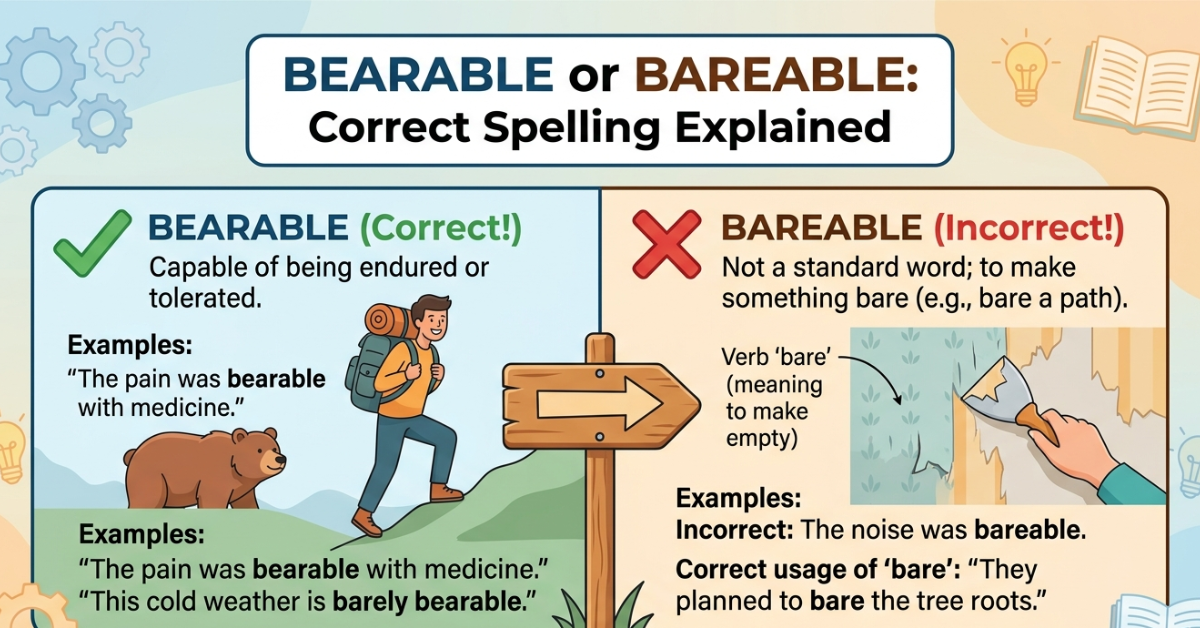
The correct word is bearable, not bareable. In this guide on bareable or bearable, you’ll learn the correct spelling, meaning, pronunciation, and why so many people get it wrong. We’ll also explore real examples so you never mix it up again.
Bareable or Bearable: The Correct Answer
Let’s clear it up right away:
- Bareable → Incorrect spelling
- Bearable → Correct spelling
The confusion in bareable or bearable happens because both “bare” and “bear” are real English words, but only one forms the correct adjective.
Why “bareable” is wrong
“Bareable” looks logical because “bare” means uncovered or empty. However, it is not used in this context. English spelling rules often come from word origins, not pronunciation alone.
Meaning of Bearable
The word bearable means:
Something that can be tolerated or endured.
It comes from the verb “to bear”, which means to carry, withstand, or tolerate.
Simple examples:
- The pain was bearable after medication.
- The heat became more bearable in the evening.
- Life without Wi-Fi was surprisingly bearable.
So when people ask bareable or bearable, the meaning clearly belongs to bearable.
Why People Confuse Bareable or Bearable
This spelling mistake is more common than you might think. Here’s why:
1. Sound similarity
“Bare” and “bear” sound identical in most accents, especially in casual speech.
2. Logical assumption
People link “bare” (simple or minimal) with discomfort, leading to bareable.
3. Typing errors
Fast typing often replaces “bear” with “bare” automatically.
4. Lack of exposure
Many learners see the word in writing less often, so confusion grows.
Easy Trick to Remember the Correct Spelling
Here’s a simple memory hack:
Think of “bear” as in to bear pain or stress.
So:
- You bear discomfort → It becomes bearable
If you can “bear it,” it is bearable, not bareable.
This small trick eliminates the bareable or bearable confusion instantly.
Common Usage Examples of Bearable
Let’s look at real-world usage so the word sticks better:
- The long journey was bearable with good music.
- The loss became more bearable over time.
- The noise was just about bearable.
- With support, even hard situations feel bearable.
Notice how naturally “bearable” fits into emotional and physical contexts.
Bearable vs Similar Words
Understanding related words helps strengthen clarity:
- Tolerable → Acceptable, but not pleasant
- Endurable → Can be suffered for a long time
- Manageable → Can be controlled or handled
- Bearable → Can be endured without extreme difficulty
Each word is close in meaning, but bearable is the most commonly used in everyday English.
Key Takeaways
- The correct spelling is bearable, not bareable
- “Bearable” comes from “to bear” meaning to tolerate
- “Bareable or bearable” confusion is caused by pronunciation similarity
- A simple trick: if you can “bear it,” it is bearable
FAQs About Bareable or Bearable
1. Is it bareable or bearable?
The correct spelling is bearable. “Bareable” is a common spelling mistake.
2. What does bearable mean?
Bearable means something that can be endured or tolerated without too much difficulty.
3. Why do people write bareable instead of bearable?
Because “bare” and “bear” sound the same, many people mistakenly write bareable or bearable interchangeably.
4. Is bareable a real English word?
No, bareable is not a correct English word in standard usage.
5. How can I remember the correct spelling?
Think of the word “bear” (to carry or endure). If you can bear it, it is bearable.
6. Can bearable be used in formal writing?
Yes, bearable is commonly used in both formal and informal English writing.
Conclusion
The confusion is understandable, but once you know the rule, it becomes simple: only bearable is correct. It comes from the idea of “bearing” or tolerating something.
By remembering this small distinction, you can avoid one of the most common spelling mistakes in English. Whether you’re writing essays, emails, or social posts, using the correct form will instantly improve your clarity and confidence.
If you found this guide helpful, keep practicing similar tricky words—small improvements like this make your English much more polished over time.