Envelope vs Wrapper: Key Differences Explained Simply

Have you ever wondered about Envelope vs Wrapper and why they look similar but are used differently? At first glance, both seem like simple coverings, but they actually serve completely different purposes in communication and packaging.
In this guide, we clearly explain the difference between an envelope and a wrapper. Moreover, we explore their uses, materials, and real-life applications so you never confuse them again. Let’s dive in and understand how each one plays a unique role in daily life.
What is an Envelope?
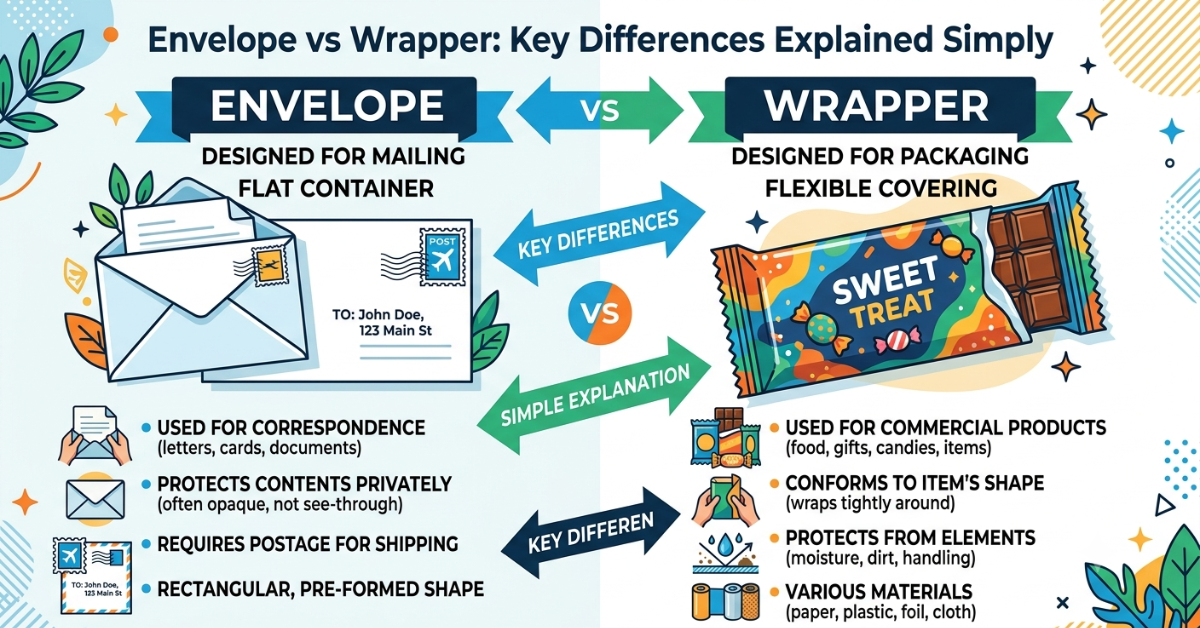
An envelope is a flat paper container that people use to store and send documents. It plays a key role in formal communication because it protects written content and keeps it private.
Key Features of an Envelope
- It holds letters, documents, and cards securely
- It uses a flap for sealing and protection
- It keeps content clean and organized
- It supports official communication like letters and notices
In addition, envelopes help maintain privacy, especially when people send important or personal information.
What is a Wrapper?
A wrapper is a flexible covering material that people use to pack or protect items. Unlike envelopes, wrappers adapt easily to different shapes and sizes, which makes them highly versatile.
Key Features of a Wrapper
- It covers food, gifts, and products
- It bends and folds around objects easily
- It uses materials like plastic, foil, or paper
- It enhances product protection and presentation
Furthermore, wrappers play a major role in the packaging industry because they improve both safety and appearance.
Envelope vs Wrapper: Key Differences Explained
When we compare Envelope vs Wrapper, we notice clear differences in purpose, structure, and usage. Although both protect items, they serve completely different functions.
Main Differences
- Purpose: Envelopes carry documents, whereas wrappers protect products
- Shape: Envelopes stay flat, while wrappers remain flexible
- Usage: Envelopes support formal communication, but wrappers support packaging
- Material: Envelopes use thicker paper, while wrappers use mixed materials
As a result, envelopes suit official needs, while wrappers suit commercial and everyday packaging.
Types of Envelopes and Wrappers
Both envelopes and wrappers come in different forms, depending on their use. Therefore, understanding their types helps you choose the right one.
Common Types of Envelopes
- Business envelopes
- Invitation envelopes
- Security envelopes
- Window envelopes
Common Types of Wrappers
- Food wrappers (chocolate, snacks, candies)
- Gift wrappers
- Plastic product wrappers
- Foil wrappers
Moreover, each type serves a specific purpose in communication or packaging.
Materials Used in Envelopes and Wrappers
Materials also show a major difference in Envelope vs Wrapper usage. While envelopes focus on structure, wrappers focus on flexibility and protection.
Envelope Materials
- Bond paper
- Kraft paper
- Cardstock
- Recycled paper
Wrapper Materials
- Plastic films
- Aluminum foil
- Wax paper
- Biodegradable materials
In addition, modern wrappers often use eco-friendly materials to reduce environmental impact.
When Should You Use an Envelope or Wrapper?
Choosing between an envelope and a wrapper depends on your purpose. Therefore, it is important to understand when each one works best.
- Use an envelope when you send letters, documents, or official papers
- Use a wrapper when you package food, gifts, or retail items
- Use envelopes for privacy and formal communication
- Use wrappers for protection and visual appeal
Consequently, selecting the right option improves both safety and presentation.
Common Mistakes People Make
People often confuse Envelope vs Wrapper, especially when they focus only on appearance. However, their functions are very different.
Frequent Mistakes
- Using wrappers for important documents
- Using envelopes for food packaging
- Treating both as interchangeable
- Ignoring material suitability
Therefore, understanding their purpose prevents improper usage.
FAQs
1. What is the main difference between envelope and wrapper?
The main difference in Envelope vs Wrapper is that envelopes carry documents, while wrappers cover products or food items.
2. Can wrappers be used instead of envelopes?
No, wrappers cannot replace envelopes because they do not provide proper document protection.
3. Are envelopes and wrappers made from the same materials?
Not always. Envelopes usually use paper, while wrappers use plastic, foil, or mixed materials.
4. Which one is more eco-friendly?
Paper envelopes are generally more eco-friendly. However, some modern wrappers use biodegradable materials.
Conclusion
To sum up, understanding Envelope vs Wrapper helps you choose the right material for communication and packaging. Envelopes work best for formal document handling, while wrappers excel in product packaging and protection.
In conclusion, both serve important but different purposes. Therefore, using them correctly improves organization, safety, and presentation in everyday life.