Have you ever read a sentence and wondered whether it should be miner or minor? You’re not alone. These two words sound exactly alike, making them a common source of confusion in writing and conversation.
The distinction between miner vs minor is simple once you understand their meanings. While they are homophones—words that sound the same but have different meanings—they are used in completely different contexts. In this guide, you’ll learn what each word means, when to use it, common examples, memory tricks, and how to avoid one of the most frequent English language mistakes.
What Is the Difference Between Miner and Minor?
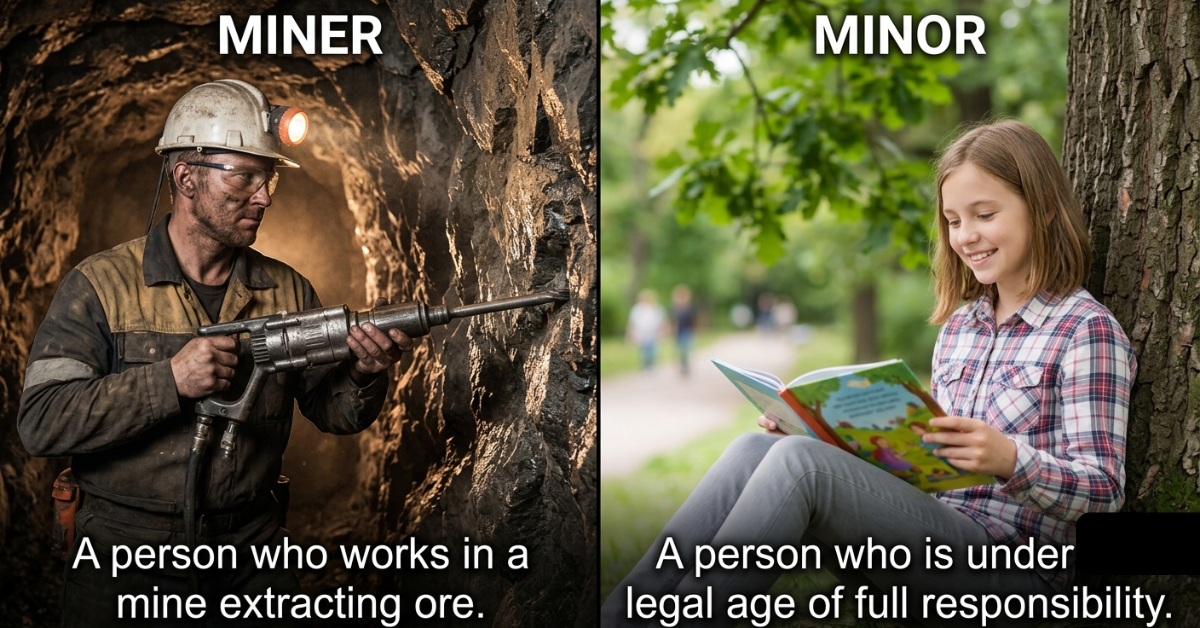
The primary difference is that miner refers to a person who works in mining, while minor generally refers to something smaller, less important, or a person under the legal age of adulthood.
Here’s a quick overview:
| Word | Meaning | Example |
| Miner | A person who extracts minerals, coal, or other resources from the earth | The miner worked underground for eight hours. |
| Minor | Something less important, smaller, or a person under legal age | She is still a minor and cannot vote. |
Although they sound identical when spoken, their meanings are entirely unrelated.
What Does Miner Mean?
A miner is someone who works in a mine, extracting valuable materials such as:
- Coal
- Gold
- Silver
- Copper
- Iron ore
- Diamonds
- Rare earth minerals
Mining has been an essential industry for thousands of years, supporting infrastructure, manufacturing, and technological development.
Examples of Miner in Sentences
- The miner descended deep into the coal shaft.
- Experienced miners follow strict safety regulations.
- The miner discovered a rich vein of gold.
- Many miners work in challenging environmental conditions.
Modern Uses of Miner
The word has evolved beyond traditional mining.
Cryptocurrency Miner
In the digital world, a miner can also refer to a person or computer system that validates blockchain transactions.
Examples:
- Bitcoin miners use powerful computers to solve complex mathematical problems.
- Crypto miners earn rewards for securing the network.
This modern meaning has become increasingly common with the growth of cryptocurrencies.
What Does Minor Mean?
The word minor has several meanings depending on the context.
Minor as “Less Important”
Perhaps the most common usage refers to something small or not particularly significant.
Examples:
- The accident caused only minor damage.
- There was a minor delay in the project schedule.
- She made a few minor corrections to the report.
Minor as a Legal Term
A minor is a person who has not yet reached the legal age of adulthood.
In many countries, adulthood begins at age 18, though laws vary.
Examples:
- The movie is not suitable for minors.
- A minor cannot sign certain legal contracts independently.
- Parents are generally responsible for a minor’s welfare.
Minor in Education
In colleges and universities, a minor is a secondary area of study that complements a student’s major.
Examples:
- She majored in Biology and minored in Psychology.
- His minor helped broaden his career opportunities.
Minor in Music
In music theory, minor refers to a specific scale, key, or chord that often sounds more emotional or melancholic than a major key.
Examples:
- The song is written in A minor.
- Minor chords create a more dramatic mood.
Miner vs Minor: Side-by-Side Comparison
Meaning
Miner
- A worker in mining
- A person or system involved in cryptocurrency mining
Minor
- Less important
- Smaller in degree
- Under legal age
- Secondary academic specialization
- A musical key or chord type
Part of Speech
Both words are typically nouns, though minor can also function as an adjective.
Examples:
- Noun: He is a miner.
- Noun: She is a minor.
- Adjective: It was a minor issue.
Context
Miner appears in:
- Mining industry
- Natural resources
- Cryptocurrency
Minor appears in:
- Law
- Education
- Music
- Everyday conversation
- Business and professional writing
Common Mistakes People Make
Because these words are pronounced identically, writers often choose the wrong spelling.
Incorrect Usage
The company hired several experienced minors to work underground.
Correct Usage
The company hired several experienced miners to work underground.
Incorrect: The court determined that the teenager was a miner.
Correct Usage
The court determined that the teenager was a minor.
Context is the key to choosing the correct word.
Easy Memory Tricks
If you struggle to remember the difference, these simple tricks can help.
Remember “Mine” in Miner
The word miner contains the word mine.
- Miner = Works in a mine
Example:
- Miner → Mine → Mining
Remember “Mini” in Minor
The beginning of minor resembles mini, which means small.
- Minor = Smaller or less significant
Example:
- Minor issue = Small issue
These associations make it easier to choose the correct spelling quickly.
Real-World Examples
Example 1: News Article
“The miner was rescued after spending two days underground.”
Here, the word clearly refers to someone working in a mine.
Example 2: Legal Document
“The individual was considered a minor under state law.”
Here, the word refers to someone below the legal age of adulthood.
Example 3: Business Report
“The project encountered only minor setbacks.”
The word means small or insignificant.
Example 4: Cryptocurrency Discussion
“Bitcoin miners compete to validate transactions.”
The word refers to blockchain participants.
Why Are Miner and Minor Confused?
English contains many homophones that create confusion because they sound alike but have different spellings and meanings.
Other examples include:
- Their vs There
- Principal vs Principle
- Affect vs Effect
- Stationary vs Stationery
- Complement vs Compliment
Miner and minor belong to this same category, making them easy to mix up in writing.
How to Choose the Correct Word
Ask yourself one simple question:
Is it related to mining or extracting resources?
If yes, use miner.
Examples:
- Coal miner
- Gold miner
- Crypto miner
Is it related to age, importance, education, or music?
If yes, use minor.
Examples:
- Minor child
- Minor problem
- Minor degree
- Minor key
This quick check will help you avoid mistakes almost every time.
Key Takeaways
- Miner refers to a person who works in mining or participates in cryptocurrency mining.
- Minor refers to something less important, smaller, or a person under legal adulthood.
- Miner contains the word mine, making it easy to associate with mining.
- Minor often means small or underage.
- Despite sounding identical, the two words have completely different meanings and uses.
Frequently Asked Questions
Is a miner the same as a minor?
No. A miner is someone involved in mining, while a minor is typically a person under the legal age of adulthood or something of lesser importance.
What is the meaning of miner?
A miner is a person who extracts minerals, coal, metals, or other resources from the earth. The term can also refer to cryptocurrency participants who validate blockchain transactions.
What does minor mean in legal terms?
A minor is an individual who has not reached the age of legal adulthood, which is often 18 years old, depending on local laws.
How do I remember miner vs minor?
Remember that miner contains the word mine, while minor can be associated with mini or something small.
Can minor be an adjective?
Yes. Minor frequently functions as an adjective meaning less important, smaller, or insignificant.
Example: “The report contained a minor error.”
Is a cryptocurrency miner the same as a traditional miner?
Not exactly. A traditional miner extracts physical resources from the earth, while a cryptocurrency miner uses computing power to verify blockchain transactions.
Conclusion
Understanding miner vs minor is easier than it first appears. A miner is connected to mines, mining, and resource extraction, while a minor refers to something smaller, less important, or a person below the legal age of adulthood. Although the words sound identical, their meanings are entirely different.
By remembering the simple associations—mine for miner and mini for minor—you can confidently choose the correct word every time. Whether you’re writing an academic paper, a business report, or a casual email, mastering this distinction will make your communication clearer and more professional.