Have you ever paused while writing someone elses, wondering whether it should be someone else’s instead? Or searched questions like can you drive someone elses car, is it illegal to open someone elses mail, or how to find someone elses iPhone?
You’re not alone. The word elses often creates confusion because it appears in both grammatical discussions and everyday legal or practical situations involving another person’s belongings. Understanding how it works can help you avoid common writing mistakes and better understand questions involving ownership and responsibility.
In this guide, you’ll learn the correct grammar behind elses, when to use apostrophes, and answers to some of the most commonly searched questions related to someone else’s property.
What Does “Elses” Mean?
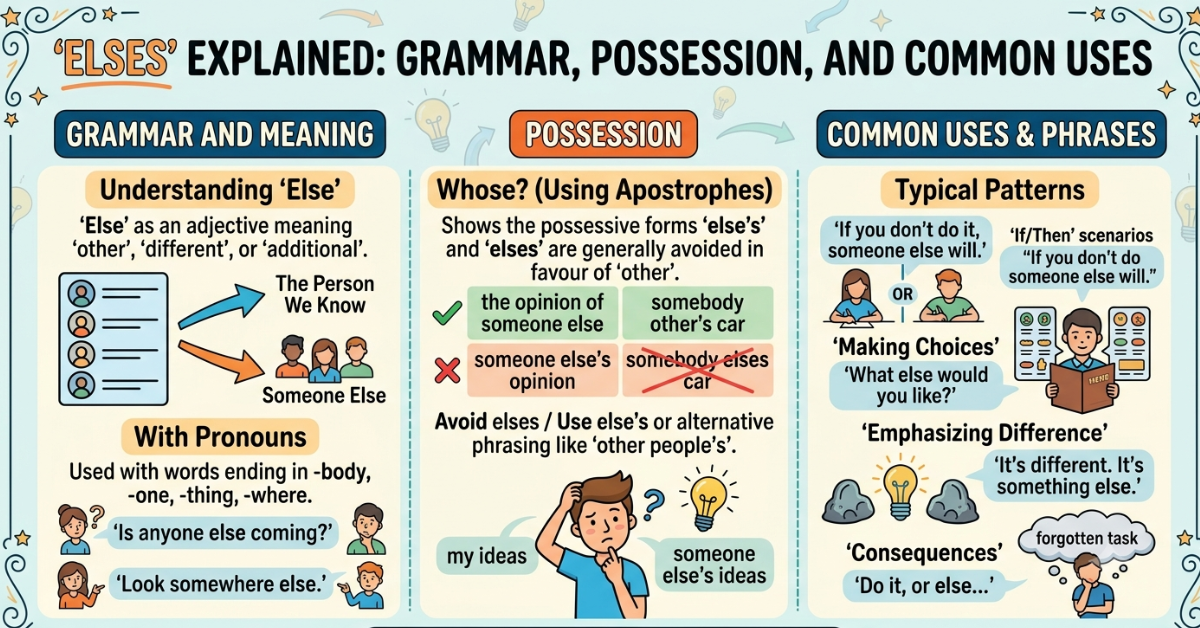
The term elses is connected to the word else, which means “other” or “different.”
However, in modern English, elses by itself is rarely used as a standalone word. Most often, it appears in possessive constructions such as:
- Someone else’s
- Anybody else’s
- Nobody else’s
- Everyone else’s
These phrases indicate ownership by another person.
Examples
Correct:
- That’s someone else’s book.
- We parked in somebody else’s spot.
- I accidentally picked up someone else’s bag.
Incorrect:
- That’s someone elses book.
- We parked in somebody elses spot.
The apostrophe is essential because it shows possession.
Elses or Else’s: Which Is Correct?
One of the most common grammar questions is elses or else’s.
The answer depends on context.
Use “Else’s” for Possession
When indicating ownership, use else’s.
Examples:
- Someone else’s phone
- Anybody else’s opinion
- Nobody else’s responsibility
In these cases, the apostrophe comes before the “s” because the phrase is possessive.
When Is “Elses” Used?
The form elses without an apostrophe is uncommon in modern English and is generally not used when showing possession.
For everyday writing, you’ll almost always need else’s, not elses.
Understanding “Someone Else’s”
The phrase someone else’s simply means something belongs to another person.
Examples include:
- Someone else’s car
- Someone else’s story
- Someone else’s house
- Someone else’s account
This construction is widely used in both spoken and written English.
Common Sentence Examples
- Don’t take someone else’s lunch from the refrigerator.
- I accidentally grabbed someone else’s umbrella.
- You should respect someone else’s privacy.
- That idea was inspired by someone else’s experience.
Someone Else’s Story: Why Context Matters
The phrase someone elses story often appears in conversations about experiences, creativity, and personal narratives.
The correct version is:
Someone else’s story
It refers to experiences, memories, or events belonging to another person.
Examples:
- The movie was based on someone else’s story.
- Avoid claiming someone else’s story as your own.
- Listening to someone else’s story can build empathy.
In writing and storytelling, acknowledging ownership of experiences is important for both ethics and credibility.
Can You Drive Someone Else’s Car?
A frequently searched question is:
Can you drive someone elses car?
In many situations, the answer is yes, but several factors matter.
These may include:
- The owner’s permission
- Insurance coverage
- Local laws
- Driver licensing requirements
Important Considerations
- The owner should generally permit you to use the vehicle.
- Insurance policies differ by provider and country.
- Some policies cover occasional drivers.
- Others may require named drivers.
Before driving another person’s vehicle, verify both permission and insurance coverage.
Driving Someone Else’s Car Safely
If you’re borrowing a vehicle:
- Carry a valid driver’s license.
- Understand insurance limitations.
- Follow local traffic laws.
- Return the vehicle in good condition.
Is It Illegal to Open Someone Else’s Mail?
Another common question is:
Is it illegal to open someone elses mail?
In many countries, opening mail addressed to another person without authorization can violate privacy laws and postal regulations.
Why Mail Is Protected
Mail is generally considered private correspondence. Unauthorized access may lead to legal consequences depending on jurisdiction.
If you receive mail intended for someone else:
- Do not open it.
- Return it to the postal service if possible.
- Notify the sender when appropriate.
Respecting another person’s mail helps protect privacy and avoid legal issues.
How to Find Someone Else’s iPhone
People often search:
- find someone elses iphone
- how to find someone elses iphone
The answer depends on whether you have permission and access.
Legitimate Situations
You may help locate another person’s iPhone when:
- They have given permission.
- You are part of a family-sharing group.
- They share their location with you.
Common Methods
Possible options include:
- Location-sharing services
- Family sharing features
- Device-tracking tools authorized by the owner
Without permission, tracking another person’s device raises significant privacy concerns and may violate laws or platform policies.
Can You Use Someone Else’s EZPass?
Another popular question is:
Can you use someone elses EZPass?
The answer depends on the toll authority’s rules and the account settings.
Things to Consider
Some systems:
- Allow multiple vehicles under one account.
- Require vehicle registration updates.
- Charge fees for improper usage.
Using another person’s toll account without authorization can lead to penalties, billing issues, or account violations.
Always check the specific toll program’s regulations before using a transponder linked to someone else’s account.
Why People Confuse “Else’s” and “Elses”
There are several reasons for this common mistake.
1. Spoken English
When people speak quickly, the apostrophe is invisible, making both forms sound similar.
2. Autocorrect Errors
Some devices fail to recognize possessive constructions properly.
3. Grammar Uncertainty
Many writers aren’t sure where the apostrophe belongs in phrases like:
- Somebody else’s
- Nobody else’s
- Anyone else’s
Quick Rule
If ownership is involved, use else’s.
Examples:
- Someone else’s idea
- Anybody else’s opinion
- Nobody else’s fault
Practical Tips for Using Else’s Correctly
Remember these simple guidelines:
Ask Yourself a Question
Does the item belong to another person?
If yes, use else’s.
Look for Ownership
Examples:
- Someone else’s phone
- Someone else’s jacket
- Somebody else’s account
Avoid Common Mistakes
Incorrect:
- someone elses phone
- anybody elses car
Correct:
- someone else’s phone
- anybody else’s car
Key Takeaways
- Else’s is the correct possessive form.
- Someone else’s means belonging to another person.
- The form elses is rarely used alone in modern English.
- Driving someone else’s car often requires permission and appropriate insurance coverage.
- Opening someone else’s mail may violate privacy or postal laws.
- Finding someone else’s iPhone should only be done with authorization.
- Using someone else’s EZPass depends on account rules and local regulations.
Frequently Asked Questions
Is it elses or else’s?
For possession, else’s is correct. Example: “someone else’s phone.”
How do you write someone else’s correctly?
Use an apostrophe before the final “s.” The correct form is someone else’s.
Can you drive someone else’s car legally?
Often yes, provided you have the owner’s permission and comply with insurance and local legal requirements.
Is it illegal to open someone else’s mail?
In many jurisdictions, opening another person’s mail without permission may violate privacy or postal laws.
How can I find someone else’s iPhone?
Only with their permission through authorized location-sharing or family-sharing features.
Can you use someone else’s EZPass?
It depends on the toll authority’s policies and account setup. Unauthorized use may create fees or penalties.
Conclusion
Understanding elses and else’s is easier once you remember one simple rule: when ownership is involved, else’s is usually the correct choice. Whether you’re writing about someone else’s story, borrowing someone else’s car, handling someone else’s mail, or discussing device tracking and toll accounts, the possessive form helps communicate ownership clearly.
Mastering this small grammar detail can make your writing more accurate and professional while helping you navigate common real-world situations involving another person’s property. The next time you’re tempted to write someone elses, you’ll know exactly which form belongs there.