Faring vs Fairing: Meaning, Differences, and Usage

English has many confusing word pairs, and faring vs fairing is one of them. These two words sound exactly alike, but they have completely different meanings and uses. That is why many people accidentally use the wrong one in writing.
If you have ever wondered whether to write faring or fairing, you are not alone. The good news is that the distinction is actually simple once you understand the context behind each word.
In this guide, you will learn:
- The meaning of each word
- The grammatical difference
- Real-life examples
- Easy memory tricks
- Common mistakes to avoid
By the end, you will know exactly when to use each term confidently.
What Does “Faring” Mean?
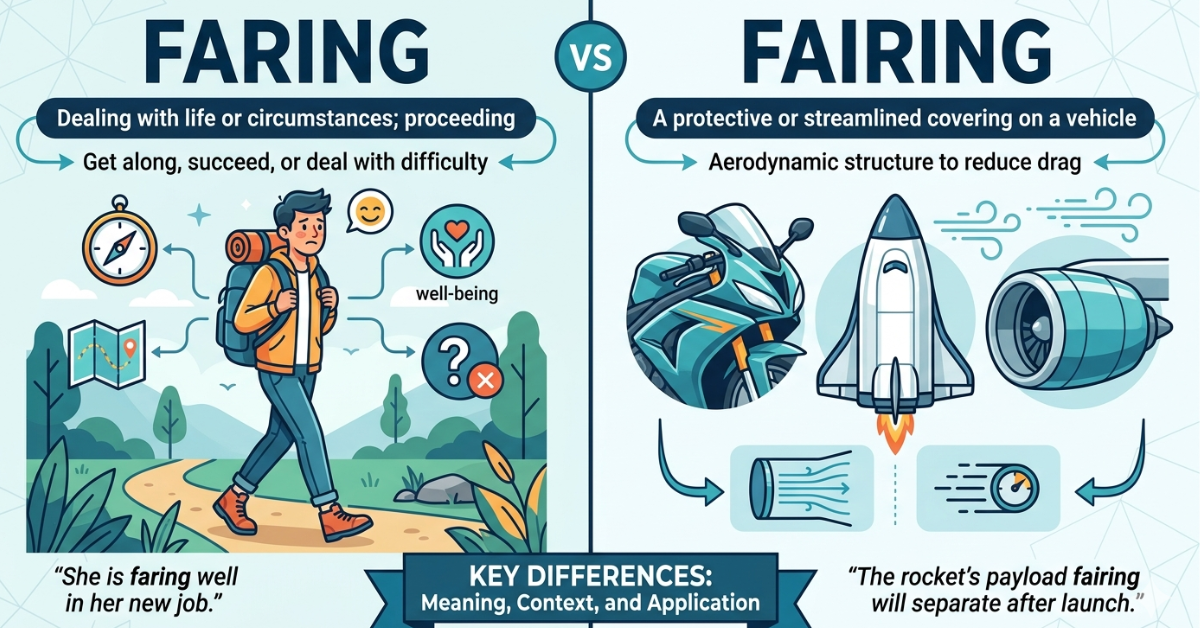
The word faring comes from the verb fare, which means:
- To get along
- To perform
- To progress in a situation
It is commonly used when talking about how someone or something is doing.
Examples of Faring
- How are you faring after the exams?
- The business is faring well this year.
- She was faring better after her treatment.
In all these examples, the word relates to performance, progress, or condition.
Common Expressions With Faring
You may often hear phrases like:
- “How are you faring?”
- “The team is faring poorly.”
- “Farmers are faring better this season.”
These expressions usually describe success, survival, or general condition.
What Does “Fairing” Mean?
Fairing is a noun mostly used in engineering, transportation, and design. It refers to a structure added to improve appearance or reduce air or water resistance.
You will often see fairings on:
- Motorcycles
- Airplanes
- Rockets
- Boats
- Bicycles
Examples of Fairing
- The motorcycle’s fairing reduced wind resistance.
- Engineers redesigned the aircraft fairing.
- The damaged fairing needed replacement.
Unlike faring, this word has nothing to do with progress or performance.
Faring vs Fairing: The Main Difference
Here is the simplest way to remember the distinction:
| Word | Meaning | Part of Speech |
| Faring | Doing or progressing | Verb form |
| Fairing | Protective or aerodynamic structure | Noun |
So if you are talking about how someone is doing, use faring.
If you are discussing vehicles or engineering parts, use fairing.
Why People Confuse These Words
The confusion happens because both words are pronounced the same way. These are known as homophones — words that sound alike but have different meanings and spellings.
English contains many similar pairs, such as:
- Their vs there
- Affect vs effect
- Stationary vs stationery
Because pronunciation does not help, writers must rely on context.
Easy Trick to Remember the Difference
A quick memory trick can help you avoid mistakes.
Remember This:
- Faring = related to how things are going
- Fairing = related to vehicles or gear
Notice that fairing contains the word “air,” which can remind you of aerodynamics and transportation.
Common Mistakes in Writing
Many people accidentally swap these words in sentences. Here are a few incorrect and corrected examples.
Incorrect:
- The rider replaced the motorcycle faring.
Correct:
- The rider replaced the motorcycle fairing.
Incorrect:
- She is fairing much better now.
Correct:
- She is faring much better now.
These errors are common in blogs, social media posts, and even professional writing.
When to Use Faring in Daily Conversation
You are more likely to encounter faring in everyday English because people frequently discuss performance and well-being.
Typical Situations
- School performance
- Health updates
- Financial condition
- Career progress
- Emotional state
Examples
- Students are faring better with online resources.
- How is your project faring?
- The company is faring worse than expected.
Where You Usually See Fairing
The word fairing appears more often in technical industries.
Industries That Use This Term
- Automotive engineering
- Aerospace engineering
- Marine design
- Cycling technology
- Motorsport manufacturing
Types of Fairings
- Motorcycle fairings
- Wheel fairings
- Aircraft fairings
- Rocket fairings
These structures help improve speed, efficiency, and protection.
Grammar and Word Forms
Understanding the grammar behind these words also makes things clearer.
Faring
- Root verb: Fare
- Present participle: Faring
Example:
- The economy is faring well.
Fairing
- Singular noun: Fairing
- Plural noun: Fairings
Example:
- The bike has custom fairings.
How Context Changes Everything
Context is the easiest way to identify the correct spelling.
If the sentence discusses:
- Progress
- Condition
- Success
- Survival
Use faring.
If the sentence discusses:
- Vehicles
- Engineering
- Aerodynamics
- Protective coverings
Use fairing.
Examples Side by Side
Here are some direct comparisons to make the difference crystal clear.
| Sentence | Correct Word |
| The patients are ___ much better now. | Faring |
| The airplane’s nose ___ reduced drag. | Fairing |
| How is your business ___ this year? | Faring |
| The mechanic repaired the cracked ___. | Fairing |
Frequently Asked Questions
Is faring a real word?
Yes, faring is the present participle of the verb fare, meaning to perform or get along in a certain way.
What is a fairing on a motorcycle?
A fairing is a protective outer shell placed on motorcycles to improve aerodynamics and reduce wind resistance.
Why do people confuse these words?
They sound identical when spoken, making them easy to mix up in writing.
Can fairing be used as a verb?
In modern English, fairing is mainly used as a noun rather than a verb.
Which word relates to performance?
The word connected to performance or progress is faring.
Conclusion
Understanding faring vs fairing becomes much easier once you focus on context. One word relates to progress and performance, while the other belongs to the world of engineering and vehicle design.
To quickly remember:
- Faring = how someone or something is doing
- Fairing = a structural covering on vehicles or machines
Small spelling differences can completely change a sentence’s meaning, so learning these distinctions improves both your writing accuracy and confidence.
If you enjoy learning confusing English word pairs, consider exploring other commonly mixed-up terms to strengthen your grammar and vocabulary skills even further.