Have you ever paused while writing a sentence and wondered whether you should use loan or lend? You’re not alone. Many English speakers—even native ones—mix up these two words because they are closely related and often appear in the same situations.
Understanding loan vs lend is important for clear communication, whether you’re discussing money, borrowing a book, or writing professional emails. While both words involve giving something temporarily to another person, they serve different grammatical functions and are used in different contexts.
In this guide, you’ll learn the exact difference between loan and lend, when to use each one, common mistakes to avoid, practical examples, and simple grammar rules that make choosing the correct word easy.
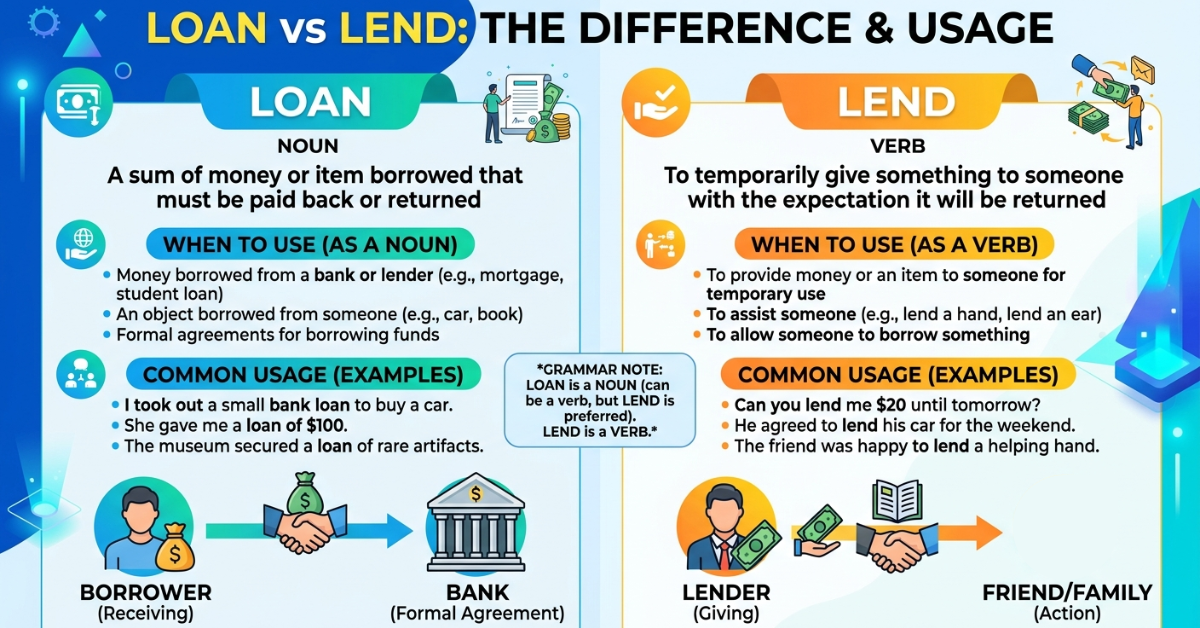
What Is the Difference Between Loan and Lend?
The primary difference is simple:
- Lend is usually a verb.
- Loan is primarily a noun, though it can sometimes be used as a verb in certain varieties of English.
Quick Comparison
| Word | Part of Speech | Meaning |
| Lend | Verb | To give something temporarily |
| Loan | Noun | Something that is borrowed or provided temporarily |
Examples
Lend (Verb):
- Can you lend me your pen?
- She lent her friend some money.
- The library lends books to students.
Loan (Noun):
- I applied for a home loan.
- The bank approved my loan.
- He repaid the loan within three years.
The easiest way to remember this distinction is that people lend things, while loans are the things being given.
What Does “Lend” Mean?
The word lend refers to the action of temporarily giving something to another person with the expectation that it will be returned.
Structure of Lend
The typical sentence pattern is:
Subject + lend + object + to someone
Examples:
- I lend my notes to classmates.
- Sarah lent her car to her sister.
- Could you lend me a charger?
Verb Forms of Lend
| Tense | Form |
| Present | lend |
| Past | lent |
| Past Participle | lent |
| Present Participle | lending |
Examples:
- I lend money occasionally.
- I lent him $20 yesterday.
- She has lent her laptop before.
- They are lending equipment to volunteers.
What Does “Loan” Mean?
A loan is something that is borrowed, most commonly money provided by a financial institution or individual that must be repaid.
Common Types of Loans
- Personal loans
- Home loans
- Mortgage loans
- Auto loans
- Student loans
- Business loans
Examples:
- The company secured a business loan.
- She received a student loan for college.
- They took out a mortgage loan to buy a house.
In financial contexts, loan is one of the most frequently used terms because it refers to the actual agreement or amount borrowed.
Can Loan Be Used as a Verb?
This is where many learners become confused.
In American English, loan is sometimes used as a verb.
Examples:
- Can you loan me your calculator?
- He loaned me some money.
However, many grammar experts still prefer lend when referring to the action.
Preferred Usage
More widely accepted:
- Can you lend me your calculator?
Common in American English:
- Can you loan me your calculator?
For formal writing and international communication, using lend as the verb is generally the safest choice.
Loan vs Lend in Banking and Finance
Financial discussions often involve both terms together.
Consider this example:
A bank lends money to customers through loans.
Here:
- Lends describes the action.
- Loans describe the financial products.
Example Breakdown
Sentence:
“The bank lends home loans to qualified applicants.”
- Lends = action performed by the bank.
- Home loans = products offered by the bank.
This distinction is especially useful when reading contracts, financial documents, or loan agreements.
Common Examples of Loan vs Lend
Everyday Situations
Borrowing a Book
Correct:
- Could you lend me that book?
Less common:
- Could you loan me that book?
Lending Money
Correct:
- She lent me $50.
Incorrect:
- She loan me $50.
Bank Financing
Correct:
- I applied for a loan.
- The bank approved the loan.
Workplace Examples
- Can you lend me your presentation notes?
- The company obtained a business loan for expansion.
- Our department lends equipment to remote workers.
Common Mistakes People Make
Using Loan Instead of Lend
Incorrect:
- Can you loan me a hand?
Correct:
- Can you lend me a hand?
The phrase “lend a hand” is a fixed expression and should always use lend.
Confusing the Past Tense
Incorrect:
- She lended me her phone.
Correct:
- She lent me her phone.
The correct past tense of lend is lent.
Treating Loan as a Verb Everywhere
While acceptable in some regions, using loan as a verb universally can sound awkward or informal.
Safer choice:
- Lend me your notebook.
How to Remember the Difference
A simple memory trick:
LEND = Action
Think of lend as something you do.
Examples:
- Lend money
- Lend support
- Lend assistance
LOAN = Thing
Think of loan as something you have.
Examples:
- A car loan
- A student loan
- A personal loan
If the word describes an action, choose lend. If it describes the item or agreement, choose loan.
Loan vs Lend: Side-by-Side Examples
| Correct Usage of Lend | Correct Usage of Loan |
| Please lend me your pen. | I need a loan for my business. |
| She lent me her jacket. | The loan was approved quickly. |
| They lend books at the library. | He paid off his loan early. |
| Could you lend me some money? | She applied for a student loan. |
Why the Difference Matters
Using the correct word improves:
- Professional communication
- Academic writing
- Business correspondence
- Financial literacy
- English fluency
In legal and financial documents, precision is especially important because loan and lend perform distinct grammatical roles.
Practical Tips for Using Loan and Lend Correctly
- Use lend when describing an action.
- Use loan when referring to money or items borrowed.
- Remember that the past tense of lend is lent, not lended.
- In formal writing, prefer lend over using loan as a verb.
- Check whether the word functions as an action or a thing before choosing.
Frequently Asked Questions
Is it correct to say “loan me money”?
Yes, particularly in American English. However, many style guides and grammar experts prefer “lend me money,” especially in formal writing.
Which is grammatically correct: loan or lend?
Both can be correct depending on context. Lend is generally the verb, while loan is usually the noun.
What is the past tense of lend?
The past tense of lend is lent.
Example:
- She lent me her laptop yesterday.
Is loan always a noun?
No. In some forms of English, loan can function as a verb. However, its primary and most widely accepted role is as a noun.
How do banks use loan and lend?
Banks lend money by providing loans. The action is lending, and the financial product is the loan.
Which word should I use in professional writing?
Use lend for actions and loan for financial products or borrowed items. This approach is clear, professional, and universally understood.
Conclusion
Understanding loan vs lend is easier once you recognize their basic roles. Lend is typically the action of temporarily giving something to someone, while loan is the thing being borrowed, especially money. Although loan can sometimes function as a verb in American English, lend remains the preferred choice in most formal and professional situations.
By remembering that people lend and institutions provide loans, you’ll avoid common grammar mistakes and communicate with greater confidence. Whether you’re discussing personal favors, business financing, or everyday borrowing, using the right word helps ensure your message is clear and accurate.