Seemless vs Seamless: Correct Spelling Guide

Have you ever typed a word you swear looks right, only to see it flagged as incorrect? One of the most common spelling confusions in English is seemless vs seamless. At first glance, both versions look almost identical, which is exactly why so many people get them mixed up.
In this guide on seemless vs seamless, you’ll learn which spelling is correct, why the confusion happens, what the word actually means, and how to use it confidently in writing. By the end, you’ll never second-guess it again.
What is the Correct Spelling: Seemless vs Seamless?
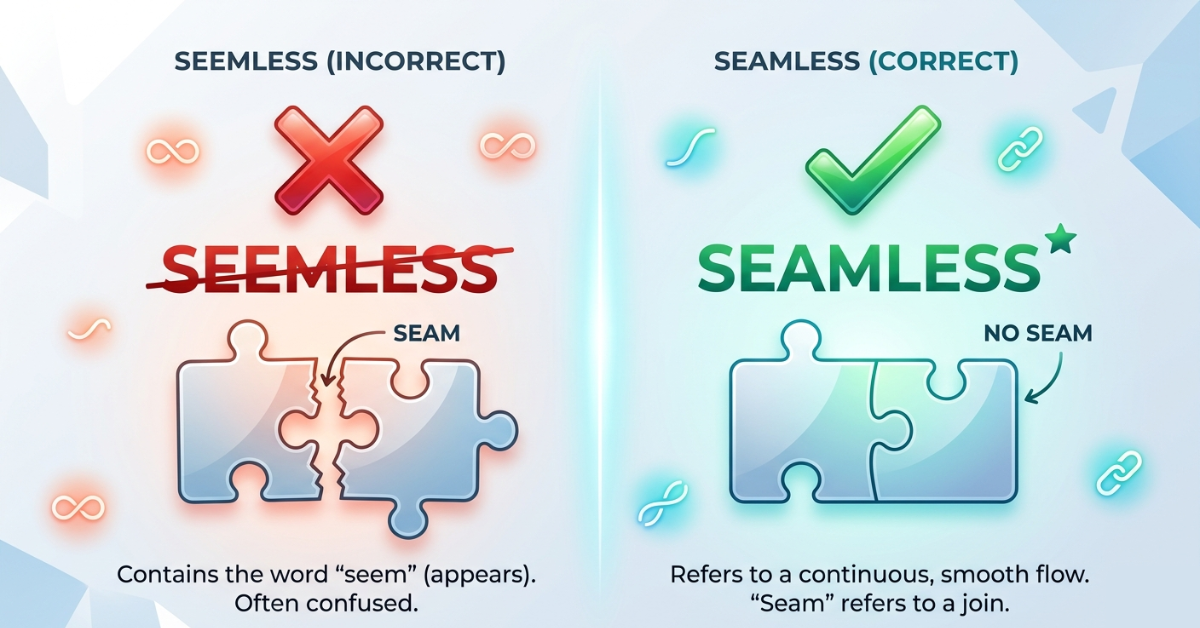
Let’s clear it up right away: “seamless” is the correct spelling, while “seemless” is incorrect.
The correct word is built from “seam” + “less”, meaning “without seams” or “smooth and continuous.”
- Correct: seamless
- Incorrect: seemless
Even though “seemless” might look logical because of the word “seem,” it does not exist in standard English.
So, whenever you come across seemless vs seamless, remember that only seamless is valid in dictionaries and professional writing.
Why Do People Confuse Seemless vs Seamless?
The confusion between seemless vs seamless happens for a few natural reasons:
1. Pronunciation Trickery
When spoken quickly, “seamless” can sound like “seem-less,” leading people to assume it includes “seem.”
2. Influence of the Word “Seem”
Since “seem” is a common English verb, many assume the adjective must be formed from it.
3. Typing Errors and Autocorrect
Keyboard slips often turn “seamless” into “seemless,” and autocorrect doesn’t always catch it.
4. Lack of Visual Memory
Many people learn the word by sound rather than spelling, which strengthens the confusion in seemless vs seamless usage.
Meaning of “Seamless” (The Correct Word)
To fully understand the debate around seemless vs seamless, it helps to know what “seamless” actually means.
The word “seamless” is an adjective that describes something smooth, continuous, or without interruptions.
Common meanings include:
- Without visible joins or gaps
- Smooth and uninterrupted
- Effortless or perfectly coordinated
Examples:
- A seamless transition between scenes in a movie
- A seamless user experience in an app
- A seamless fabric design with no visible stitching
In modern usage, especially in technology and business, “seamless” often refers to processes that feel effortless to the user.
Is “Seemless” a Real Word?
No — “seemless” is not recognized in standard English dictionaries.
When comparing seemless vs seamless, only one has linguistic and historical validity. “Seamless” comes from textile terminology, where “seams” are the stitched lines in fabric.
Over time, the word evolved beyond clothing and became widely used in:
- Technology (seamless integration)
- Customer service (seamless support)
- Design (seamless interface)
- Communication (seamless collaboration)
“Seemless,” on the other hand, is simply a spelling error that has no formal meaning.
Real-Life Usage of “Seamless”
Understanding seemless vs seamless becomes easier when you see how “seamless” is used in real-world contexts.
Technology
- Cloud systems provide a seamless experience across devices.
Business
- Companies aim for seamless customer onboarding.
Daily Life
- A well-planned trip feels completely seamless.
Design & UX
- Apps like modern streaming platforms focus on seamless navigation.
In all these examples, replacing the word with “seemless” would be incorrect and look unprofessional.
Common Writing Mistakes Related to Seemless vs Seamless
Even strong writers sometimes slip up. Here are common mistakes to avoid:
- Writing “seemless integration” instead of “seamless integration”
- Assuming it relates to “seem” (it doesn’t)
- Using “seemless” in resumes or business writing
- Relying on autocorrect without proofreading
A simple spelling mistake in seemless vs seamless can affect how professional your writing appears.
How to Remember the Correct Spelling
If you struggle with seemless vs seamless, here’s a simple trick:
Think of fabric seams
“Seamless” = without seams = smooth and connected.
Memory shortcut:
- “SEAM” = stitching in clothes
- “LESS” = without
Seamless = without stitching = smooth
This visual association makes it much easier to remember the correct form.
Why “Seamless” Matters in Modern Language
Today, “seamless” has become more than just a grammar word — it’s a quality standard.
Businesses, apps, and services often advertise “seamless experiences” because it suggests:
- Ease of use
- Professional quality
- No friction or interruptions
This makes understanding seemless vs seamless especially important in professional communication, marketing, and digital writing.
Key Takeaways
- “Seamless” is the only correct spelling
- “Seemless” is a common but incorrect variation
- The word comes from “seam” + “less”
- It describes smooth, uninterrupted experiences
- It is widely used in tech, business, and everyday English
FAQ: Seemless vs Seamless
1. Is “seemless” ever correct?
No, “seemless” is not a recognized English word. The correct spelling is always “seamless.”
2. Why do people write seemless vs seamless incorrectly?
It usually happens due to pronunciation confusion and typing errors influenced by the word “seem.”
3. What does seamless mean in simple terms?
It means smooth, continuous, or without interruptions or visible joins.
4. Can I use seamless in business writing?
Yes, “seamless” is commonly used in professional and business contexts to describe smooth processes or experiences.
5. Is seamless only used for fabrics?
No, while it originally came from textiles, it is now widely used in technology, design, and everyday language.
6. How can I avoid spelling it wrong?
Remember: “seam” (like stitching) + “less” = seamless. There is no relation to “seem.”
Conclusion
The confusion between the words are common, but the answer is simple: only “seamless” is correct. It describes smooth, uninterrupted experiences and is widely used across industries, from technology to business and everyday communication.
Once you understand its origin and meaning, the spelling becomes much easier to remember. So next time you write it, you’ll know exactly which version is right — and your writing will instantly look more polished and professional.
If you want clearer, more confident writing, start by mastering small details like this — they make a big difference.