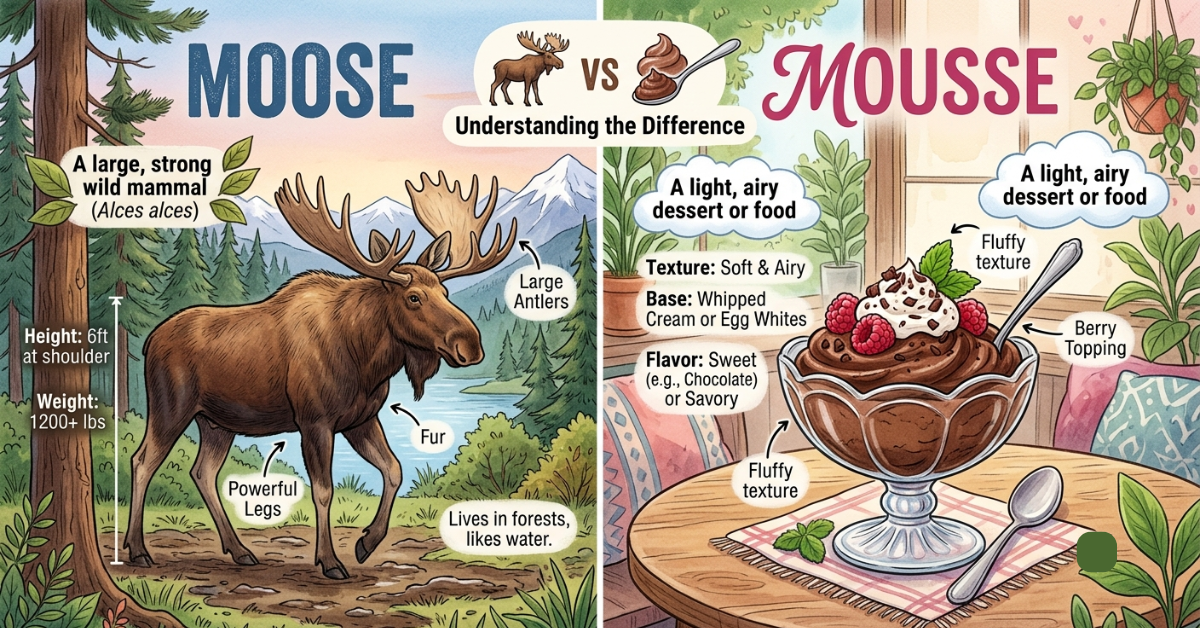
Have you ever read the words moose and mousse and wondered whether they were related? You’re not alone. Despite looking remarkably similar, these two words have completely different meanings, origins, and uses. The confusion surrounding moose vs mousse is common, especially among English learners, writers, and even native speakers who encounter the terms outside their usual contexts.
In this guide, you’ll learn exactly what moose and mousse mean, how to pronounce them correctly, where each word is used, and how to avoid mixing them up. By the end, you’ll never confuse these two words again.
What Is the Difference Between Moose and Mousse?
At the most basic level:
- Moose is a large animal found in northern regions.
- Mousse is either a light, airy dessert or a hair styling product.
Although only one extra letter separates them, their meanings belong to entirely different categories.
| Word | Meaning | Category |
| Moose | A large deer species | Animal |
| Mousse | A whipped dessert or styling foam | Food/Beauty |
| Pronunciation | /muːs/ | /muːs/ |
| Origin | Indigenous North American languages | French |
Interestingly, both words are pronounced almost identically in English, which contributes to the confusion.
What Is a Moose?
Definition of Moose
A moose is the largest member of the deer family. Known for its impressive size, long legs, and broad antlers, the moose inhabits forests and cold regions across North America, Europe, and Asia.
Characteristics of a Moose
Some distinguishing features include:
- Height up to 7 feet at the shoulder
- Weight exceeding 1,500 pounds
- Broad, flattened antlers on males
- Long snout and distinctive dewlap beneath the neck
- Adaptation to cold climates
Where Are Moose Found?
Moose commonly live in:
- Canada
- Alaska
- Northern United States
- Scandinavia
- Russia
They prefer areas with dense forests, wetlands, and abundant vegetation.
Example Sentences
- We spotted a moose while hiking in Alaska.
- The moose crossed the road just before sunset.
- A bull moose can have antlers spanning over six feet.
What Is Mousse?
Definition of Mousse
The word mousse comes from French and means “foam.” In English, it commonly refers to either a culinary dish or a cosmetic product.
Mousse as a Dessert
Dessert mousse is a light, airy dish made by folding whipped cream, egg whites, or similar ingredients into a flavored base.
Popular varieties include:
- Chocolate mousse
- Strawberry mousse
- Lemon mousse
- Coffee mousse
- Vanilla mousse
Example Sentences
- The chocolate mousse was the highlight of dinner.
- She prepared a fresh raspberry mousse for the party.
Mousse as a Hair Product
In the beauty industry, mousse refers to a foam styling product used to add:
- Volume
- Texture
- Shine
- Curl definition
Hair mousse remains popular among people with curly, wavy, and fine hair.
Example Sentences
- She applied mousse before blow-drying her hair.
- The stylist recommended volumizing mousse for extra lift.
Why Do People Confuse Moose and Mousse?
Several factors contribute to the confusion.
Similar Spelling
The words differ by only one letter:
- Moose
- Mousse
At a quick glance, they can appear nearly identical.
Similar Pronunciation
In standard English pronunciation, both words sound like:
“Moos”
Because the spoken forms are virtually the same, listeners often rely on context to determine which word is intended.
Different Contexts
Most confusion occurs in writing rather than speech.
For example:
- “I saw a moose in the forest.”
- “I ate chocolate mousse after dinner.”
The surrounding words immediately clarify the intended meaning.
Moose vs Mousse: Side-by-Side Comparison
Meaning
Moose
- Large wild animal
- Member of the deer family
Mousse
- Whipped dessert
- Hair styling foam
Industry Usage
Moose
- Wildlife
- Zoology
- Ecology
- Outdoor recreation
Mousse
- Culinary arts
- Baking
- Haircare
- Beauty industry
Origin
Moose
- Derived from Algonquian languages spoken by Indigenous peoples of North America.
Mousse
- Borrowed from French, where it means foam.
How to Remember the Difference
A simple memory trick can help.
Think About the Extra “S”
The extra “s” in mousse can remind you of:
- Sweet dessert
- Styling product
Both start with “S.”
Meanwhile, moose refers exclusively to the animal.
Visual Association
Imagine:
- A giant antlered animal = moose
- A bowl of chocolate dessert or hair foam = mousse
Creating a mental image often improves long-term recall.
Common Mistakes in Writing
Incorrect Usage
I ordered a chocolate moose for dessert.
She used moose to style her hair.
Correct Usage
I ordered a chocolate mousse for dessert.
She used mousse to style her hair.
Another Example
Incorrect: We photographed a mousse near the lake.
Correct: photographed a moose near the lake.
These examples demonstrate how one misplaced letter can completely change a sentence’s meaning.
The Origins of Moose and Mousse
Etymology of Moose
The word moose originated from Eastern Algonquian languages, where terms similar to “moos” referred to large browsing animals. English speakers adopted the word during early exploration of North America.
Etymology of Mousse
Mousse entered English from French cuisine. Since the French word means “foam,” it naturally became associated with airy desserts and later foam-based beauty products.
The separate origins explain why the two words have no linguistic relationship despite their similarity.
Real-World Examples of Moose and Mousse
In Travel and Wildlife
Visitors to Canada often hope to see a moose in national parks and wilderness areas.
In Restaurants
Many upscale restaurants feature chocolate mousse as a signature dessert.
In Beauty Salons
Hair professionals frequently recommend mousse for adding body and hold without excessive stiffness.
These examples highlight how the words operate in entirely different contexts.
Quick Reference Guide
When you encounter these words, remember:
Use “Moose” When Talking About:
- Wildlife
- Animals
- Forests
- Deer species
- Nature
Use “Mousse” When Talking About:
- Desserts
- French cuisine
- Hair styling products
- Beauty products
- Foams
Key Takeaways
- Moose is a large member of the deer family.
- Mousse refers to a whipped dessert or a hair styling foam.
- Both words are pronounced almost identically.
- Their meanings are completely unrelated.
- Context usually makes the intended word clear.
- Remember: dessert and styling foam are mousse; the animal is moose.
Frequently Asked Questions
Is moose or mousse the animal?
Moose is the animal. It is the largest species in the deer family and is commonly found in northern forests.
What does mousse mean?
Mousse typically refers to a light, airy dessert or a foam-based hair styling product.
Why do moose and mousse sound the same?
Both words are pronounced similarly in English, despite having different origins and meanings. This similarity often causes confusion in writing.
Is chocolate moose correct?
No. The correct term is chocolate mousse. Using “moose” would refer to the animal, creating an unintended meaning.
Can mousse be used for hair?
Yes. Hair mousse is a popular styling product designed to add volume, texture, and hold.
How can I remember moose vs mousse?
Think of the extra “s” in mousse as standing for sweet dessert or styling foam. Moose refers only to the animal.
Conclusion
Understanding moose vs mousse is easier once you recognize that these words belong to completely different worlds. A moose is a majestic wild animal roaming northern forests, while mousse is either a delicious airy dessert or a versatile hair styling product. Although they share nearly identical pronunciation, their meanings, origins, and uses are entirely separate.
The next time you encounter either word, use the context to guide you—and you’ll know instantly whether you’re talking about wildlife, dessert, or beauty products.