Have you ever been comparing two choices and suddenly thought, “Wait, which one is the latter?” That confusion is more common than you might think. The latter of the two is a simple phrase, but it often gets misused because people mix it up with “former” or forget that it only refers to two things.
In this article, you will learn the latter of the two meaning, how to use the phrase correctly, common mistakes to avoid, and practical examples that make it easy to understand in everyday writing and speech.
What Does “The Latter of the Two” Mean?
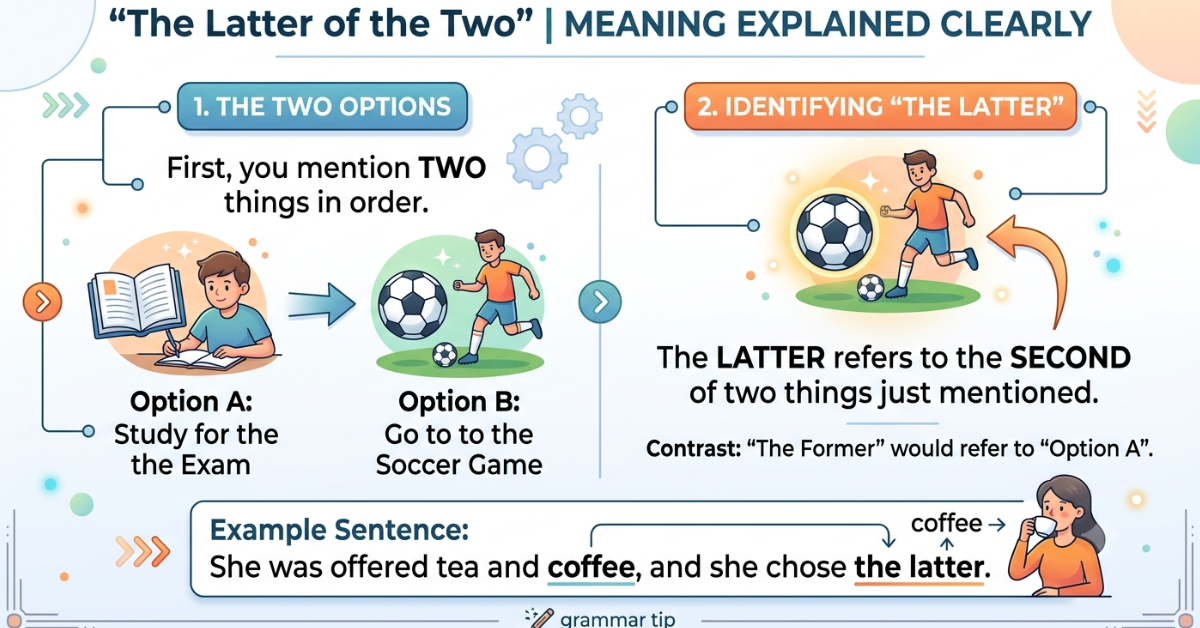
The latter of the two means the second one of two people, things, ideas, or options being compared.
If you have two items, the “former” refers to the first one, and the “latter” refers to the second one. That is the core rule.
For example:
- If you compare tea and coffee, tea is the former and coffee is the latter.
- If you mention honesty and kindness, honesty is the former and kindness is the latter.
So when someone asks, what does the latter of the two mean, the easiest answer is: it points to the second item in a pair.
Understanding “Former” and “Latter” Together
To really understand the phrase, it helps to look at the pair:
Former
The former means the first of two things.
Latter
The latter means the second of two things.
These two words are usually used together because they create a clear comparison without repeating the full item names again and again.
Example:
I had two options: working from home and commuting daily. The former saved time, while the latter was more expensive.
This sentence sounds smooth and avoids repetition.
How to Use “The Latter of the Two” Correctly
This phrase is useful when you are talking about exactly two choices or subjects. It should not be used for three or more items.
Correct usage
- Between pizza and pasta, the latter is my favorite.
- She had two goals: saving money and traveling more. She chose the latter.
Incorrect usage
- Among apples, oranges, and bananas, the latter is my favorite.
That is wrong because there are three items, and “latter” should only be used for two. In a group of three or more, you should say “the last one” or identify the item directly.
Why People Get Confused by the Phrase
The phrase sounds formal, so many people hesitate when they use it. Some also assume “latter” means “the last one” in any situation, but that is not always true.
The confusion usually comes from these issues:
- Mixing up former and latter
- Using latter for more than two items
- Forgetting which item was mentioned first
- Trying to sound formal but using the phrase incorrectly
A simple memory trick is this:
- Former = first
- Latter = last of two
That rule works almost every time.
Examples of “The Latter of the Two” in Sentences
Seeing the phrase in context makes it much easier to remember.
Everyday examples
- Between reading a book and watching a movie, I prefer the latter.
- She had two career options: teaching and graphic design. She chose the latter.
- He offered two explanations, and I believed the latter.
- The store sells both plain and flavored yogurt, but I always buy the latter.
More formal examples
- The proposal presented two solutions, and the latter proved more practical.
- Of the two methods, the latter is more efficient.
- Between privacy and convenience, the latter often wins in digital life.
These examples show that the phrase works best when the listener already knows there are only two options.
When to Use It in Writing
The latter of the two is especially useful in formal writing, academic writing, business communication, and professional speaking. It helps you avoid repeating long names, titles, or concepts.
Good situations to use it
- Essays
- Reports
- Business emails
- Comparative analysis
- Formal explanations
Less ideal situations
In casual conversation, it may sound a little stiff. People often prefer simpler wording like:
- “the second one”
- “the last one”
- “the other one”
Still, the phrase is correct and useful when you want to sound polished.
The Latter of the Two Meaning in Real Life
This phrase appears in many real-world situations, not just grammar lessons.
In education
A student may compare two subjects, such as science and art. If they say they enjoy the latter more, they mean art.
In shopping
A person comparing two phones, one with a better camera and one with a bigger battery, may choose the latter if battery life matters more.
In work decisions
A manager might compare remote work and office work. If they prefer the latter, they are choosing the office.
In each case, the phrase makes a comparison cleaner and more concise.
Common Mistakes to Avoid
Even though the phrase is simple, people still make mistakes with it.
1. Using it for more than two items
This is the most common error.
Wrong:
- I like apples, oranges, and grapes. The latter is my favorite.
Correct:
- I like apples, oranges, and grapes. Grapes are my favorite.
2. Forgetting the order
The latter always depends on the order in which the two things were mentioned.
Wrong:
- Between chocolate and vanilla, the latter is chocolate.
Correct:
- Between chocolate and vanilla, the latter is vanilla.
3. Overusing it
Using the phrase too often can make writing sound overly formal or repetitive. Use it only when it genuinely improves clarity.
4. Using it when the sentence is already clear
Sometimes plain language is better.
Instead of:
- The latter of the two options is preferable.
You could say:
- The second option is preferable.
Both are correct, but the second version is simpler.
Simple Trick to Remember the Phrase
Here is the easiest way to remember it:
- Former comes first.
- Latter comes later.
That little pattern can help you avoid mistakes quickly.
Another way to think about it:
- If there are two choices, use former/latter.
- If there are more than two choices, name the item directly or say “the last one.”
Key Takeaways
- The latter of the two refers to the second of two items.
- It is the opposite of former, which means the first of two.
- The phrase should only be used when comparing two things.
- It is common in formal, academic, and professional writing.
- Clear ordering matters because the meaning depends on what was mentioned first.
FAQ: The Latter of the Two
1. What does the latter of the two mean?
It means the second item in a pair of two things. The phrase is used when comparing exactly two options, ideas, or people.
2. Is “latter” always the second one?
Yes, but only when you are talking about two things. If there are more than two items, “latter” is usually not the right choice.
3. What is the difference between former and latter?
The former is the first of two, and the latter is the second of two. They are used together to compare two items clearly.
4. Can I use the latter of the two in casual conversation?
Yes, but it may sound formal. In casual speech, many people simply say “the second one” or “the other one.”
5. Is it wrong to say latter for three items?
Yes, that is usually incorrect. The word “latter” is meant for two items, not three or more.
6. How do I remember the latter of the two meaning?
A simple trick is to remember: former = first and latter = later. That helps you keep the order straight.
Conclusion
The latter of the two is a small phrase with a very specific meaning: it refers to the second item in a pair. Once you understand the difference between former and latter, the phrase becomes easy to use in writing and speech.
Whether you are writing an essay, giving a comparison, or just trying to speak more clearly, knowing what does the latter of the two mean can help you communicate with precision and confidence. Use it correctly, keep the number of items to two, and your writing will sound sharper and more polished.