Have you ever paused while writing because you weren’t sure whether to type persue or pursue? You’re not alone. Thousands of people search for this spelling question every month because the two words look surprisingly similar.
If you’ve been wondering about persue or pursue, this guide will clear up the confusion once and for all. You’ll learn the correct spelling, why people commonly make this mistake, simple memory tricks, practical examples, and tips to avoid the error in your everyday writing.
Is It Persue or Pursue?
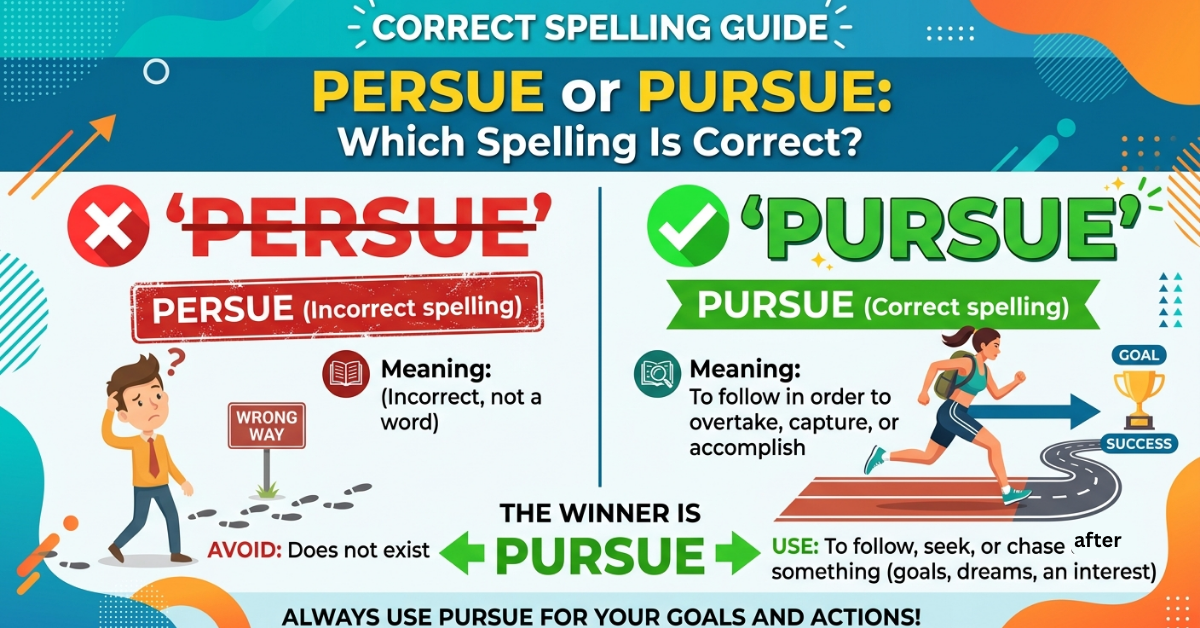
The correct spelling is pursue.
Persue is not a standard English word. It is simply a common misspelling of pursue.
Correct: pursue
Incorrect: persue
Whether you’re writing an email, school assignment, resume, or social media post, you should always use pursue.
What Does “Pursue” Mean?
The verb pursue has several related meanings, all involving the idea of following, continuing, or working toward something.
It can mean to:
- Follow someone or something
- Work toward a goal
- Continue an activity or course of action
- Seek to achieve or obtain something
Examples
- She decided to pursue a career in architecture.
- Police continued to pursue the suspect.
- They want to pursue higher education abroad.
- We should pursue every opportunity for growth.
In each example, pursue means actively moving toward a goal, objective, or person.
Why Do People Write “Persue”?
The confusion happens because English spelling isn’t always predictable.
Several factors contribute to this common mistake.
1. Pronunciation
When spoken quickly, the beginning sound of pursue may resemble “per.”
Many writers spell words according to how they hear them, resulting in persue.
2. Similar English Words
English contains many words beginning with “per-“:
- Perfect
- Perhaps
- Person
- Personal
- Permission
Because these are familiar, some people naturally assume persue follows the same pattern.
3. Typing Quickly
Fast typing often causes small spelling errors, especially when writing without spell-check.
How to Remember the Correct Spelling
A simple memory trick makes this easy.
Think of the word as:
Pur + Sue = Pursue
Imagine someone named Sue is chasing her dreams with purity of purpose.
Another easy reminder:
You PURsue your goals—not PERsue them.
The “pur” beginning stays consistent every time.
Examples of Pursue in Everyday Sentences
Here are practical examples showing the correct usage.
Career
- I want to pursue a degree in interior design.
- She chose to pursue medicine after graduation.
Education
- Many students pursue postgraduate studies.
- He plans to pursue research in renewable energy.
Business
- The company will pursue new market opportunities.
- Investors continue to pursue profitable ventures.
Personal Goals
- Never stop pursuing your dreams.
- She decided to pursue her passion for painting.
Incorrect vs Correct Usage
| Incorrect | Correct |
| I will persue my dream. | I will pursue my dream. |
| They want to persue success. | They want to pursue success. |
| She will persue a new career. | She will pursue a new career. |
| We should persue excellence. | We should pursue excellence. |
Notice that every correct sentence uses pursue.
Forms of the Word “Pursue”
Like many English verbs, pursue changes depending on tense.
| Form | Example |
| Pursue | I pursue excellence. |
| Pursues | She pursues her passion. |
| Pursued | They pursued their goal. |
| Pursuing | We are pursuing new opportunities. |
All forms keep the same spelling pattern.
Common Phrases Using Pursue
You’ll frequently encounter pursue in these expressions:
- Pursue your dreams
- Pursue excellence
- Pursue happiness
- Pursue justice
- Pursue legal action
- Pursue higher education
- Pursue a career
- Pursue opportunities
- Pursue innovation
- Pursue success
These phrases appear regularly in academic, professional, and everyday English.
Synonyms of Pursue
Depending on context, pursue can be replaced with:
When Following Someone
- Chase
- Follow
- Track
- Hunt
When Working Toward a Goal
- Seek
- Strive for
- Aim for
- Work toward
- Go after
- Aspire to
- Attempt
- Endeavor
Choosing the right synonym depends on the sentence and level of formality.
Pursue in Professional Writing
The word frequently appears in resumes, cover letters, business communication, and academic writing.
Examples include:
- I wish to pursue a leadership position.
- Our organization continues to pursue innovation.
- The research team will pursue further investigation.
- She plans to pursue graduate studies next year.
Because it is commonly used in formal writing, spelling it correctly leaves a stronger impression.
How Spell Check Helps
Modern writing tools usually recognize persue as an error.
Popular spell-checkers automatically suggest:
- pursue
Even so, it’s worth learning the correct spelling rather than relying entirely on software.
Easy Tips to Avoid This Mistake
Here are a few habits that help:
- Remember that pursue begins with pur.
- Read your writing before submitting it.
- Use spell-check as a final review, not your only safeguard.
- Practice writing the word several times.
- Learn the word in common phrases like “pursue your goals.”
Small habits make spelling mistakes much less likely.
Persue vs Pursue at a Glance
| Feature | Persue | Pursue |
| Correct English word | No | Yes |
| Dictionary entry | No | Yes |
| Accepted in formal writing | No | Yes |
| Use in essays and emails | Never | Always |
| Standard spelling | Incorrect | Correct |
The comparison is simple: pursue is always the correct choice.
Common Mistakes Related to Pursue
People often confuse pursue with other similar-looking words.
Examples include:
- Persue
- Persuing
- Persued
Correct versions:
- Pursue
- Pursuing
- Pursued
Learning one correct spelling helps you avoid all related errors.
Key Takeaways
- Pursue is the correct spelling.
- Persue is a misspelling and should not be used.
- Pursue means to follow, seek, continue, or work toward something.
- The word is commonly used in education, careers, business, and personal goals.
- Remember the simple trick: Pur + Sue = Pursue.
Frequently Asked Questions
Is persue a real word?
No. Persue is not recognized as a standard English word. It is simply a spelling mistake of pursue.
Why do people spell pursue as persue?
Most people spell it incorrectly because they write the word the way it sounds. Fast typing and familiarity with words beginning with “per-” also contribute to the mistake.
How do you spell pursue correctly?
The correct spelling is p-u-r-s-u-e. It always begins with pur, not per.
What does pursue mean?
Pursue means to follow, continue, or actively work toward something, such as a goal, career, education, or opportunity.
Is pursue formal or informal?
It works in both formal and informal English. You’ll often see it in business documents, academic writing, professional emails, and everyday conversations.
How can I remember the spelling of pursue?
A useful trick is to think: Pur + Sue = Pursue. Associating the word with this simple pattern makes it much easier to remember.
Conclusion
When comparing persue or pursue, the answer is straightforward: pursue is the only correct spelling. Although persue is a common mistake, it isn’t accepted in standard English and should be avoided in every type of writing.
Understanding the meaning, recognizing common spelling errors, and using simple memory techniques will help you write with greater confidence. The next time you write about following your dreams, pursuing a career, or seeking new opportunities, you’ll know exactly which spelling to use.