Have you ever paused while writing an email or business document, wondering whether you should write “vender” or “vendor”? You’re not alone. Many people confuse these two words because they sound almost identical, yet they have different meanings and uses.
If you’ve searched for vender or vendor, is it vender or vendor, or vender or vendor meaning, this guide will clear up the confusion. You’ll discover which spelling is correct in different situations, understand the meanings behind each word, see practical examples, and learn how to avoid one of the most common English vocabulary mistakes.
The Short Answer: Is It Vender or Vendor?
The answer depends on what you’re trying to say.
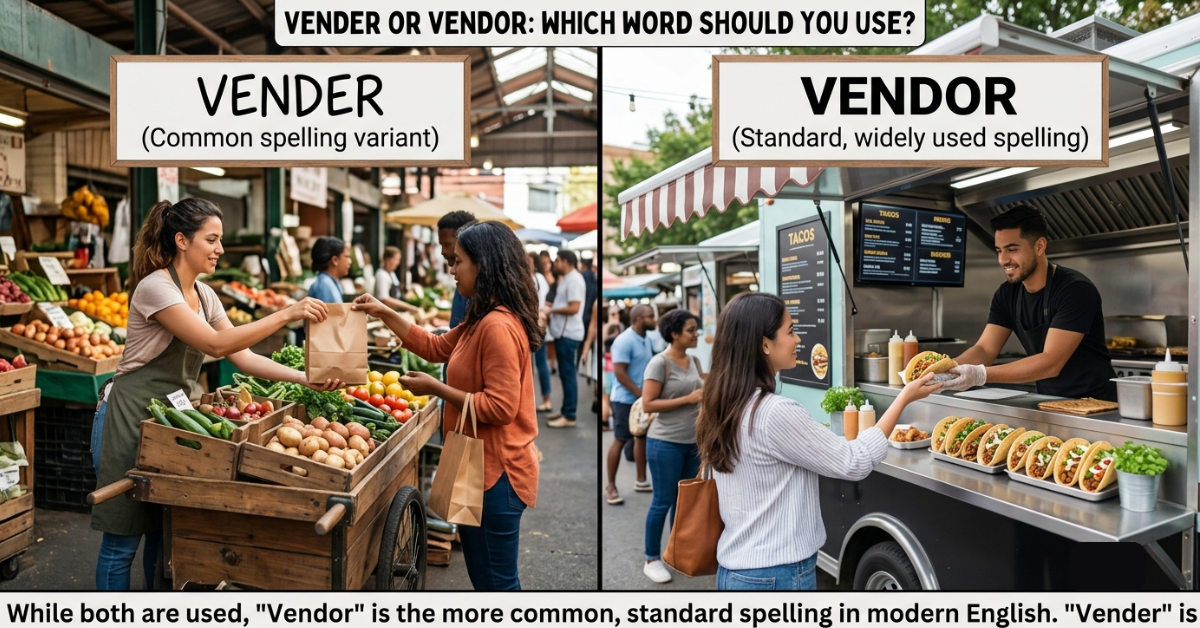
- Vendor is the standard and most commonly used word for a person or business that sells goods or services.
- Vender is a less common spelling that traditionally refers to someone who sells something but is rarely used in modern English.
In everyday writing, business communication, contracts, technology, and commerce, vendor is almost always the correct choice.
Vender or Vendor Meaning
Although the words share similar origins, their modern usage differs significantly.
| Word | Meaning | Common Usage |
| Vendor | A person, company, or organization that sells products or services | Very common |
| Vender | An alternative spelling of seller; now considered uncommon | Rare |
Today, if someone asks is it vender or vendor, the safest and most accurate answer is vendor.
What Does Vendor Mean?
A vendor is an individual or organization that provides goods or services to customers or businesses.
The term appears frequently in:
- Business contracts
- Procurement
- Supply chain management
- Technology
- Retail
- Government purchasing
- Events and trade shows
Examples
- The company selected a new vendor for office furniture.
- We compared prices from several software vendors.
- Every food vendor at the festival needed a permit.
- Our IT vendor provides technical support around the clock.
In nearly every professional setting, vendor is the preferred spelling.
What Does Vender Mean?
Vender is an older or alternative spelling derived from the verb vend, meaning “to sell.”
Although dictionaries still recognize it, modern English speakers rarely use it. In most cases, replacing vender with vendor improves clarity and aligns with current usage.
Examples
Less common:
- The property was transferred from the vender to the buyer.
Modern alternative:
- The property was transferred from the vendor to the buyer.
Unless you’re quoting historical texts or following specific legal terminology, choose vendor.
Why Is Vendor More Common?
Language evolves over time.
While both spellings existed centuries ago, vendor gradually became the accepted standard across English-speaking countries.
Today, you’ll see vendor used in:
- Business documents
- Accounting
- Software systems
- Online marketplaces
- Government forms
- Purchasing departments
- Educational materials
Meanwhile, vender survives mainly in older legal documents or historical writing.
Vendor in Business
One reason people frequently search vender or vendor meaning is because they encounter the word in business.
A vendor supplies products or services to another company or directly to consumers.
Examples include:
- Software vendors
- Furniture vendors
- Clothing vendors
- Food vendors
- Construction vendors
- Office supply vendors
- Wholesale vendors
Businesses often evaluate multiple vendors before selecting one that offers the best combination of quality, pricing, and reliability.
Vendor in Technology
The technology industry relies heavily on the word vendor.
Examples include:
- Software vendor
- Hardware vendor
- Cloud service vendor
- Network equipment vendor
- Security vendor
Example:
“Our organization switched to a different cloud vendor to improve system performance.”
Using vender here would generally be considered incorrect.
Vendor in Retail
Retail businesses work with many different vendors.
These vendors may provide:
- Clothing
- Electronics
- Groceries
- Cosmetics
- Furniture
- Packaging
- Seasonal merchandise
Retailers depend on trusted vendors to maintain inventory and meet customer demand.
Common Examples of Vendor
Here are situations where vendor is the correct choice.
Business
“Our company approved a new office furniture vendor.”
Technology
“The software vendor released an important update.”
Events
“Every vendor must register before the exhibition.”
Government
“The vendor submitted the winning bid.”
Retail
“Our vendor delivers products every Monday.”
Why People Confuse Vender and Vendor
There are several reasons behind the confusion.
Similar Pronunciation
Both words sound nearly identical.
Shared Origin
Both come from the verb vend, meaning “to sell.”
Spell-Checking Errors
Some writing tools recognize both words, making it easy to choose the wrong one accidentally.
Rare Exposure
Most people rarely encounter vender, so they assume it’s simply another spelling of vendor.
Easy Trick to Remember
Here’s a simple memory tip.
Think about:
Vendor = Business
Both words contain the letter o, making it easier to associate vendor with organizations, offices, and commerce.
Whenever you’re talking about a seller, supplier, or company, use vendor.
Vender vs Vendor Comparison
| Feature | Vendor | Vender |
| Modern English | Yes | Rare |
| Business writing | Yes | No |
| Technology | Yes | No |
| Procurement | Yes | No |
| Legal historical texts | Sometimes | Occasionally |
| Everyday communication | Yes | Rare |
Common Mistakes to Avoid
Many writers make these mistakes:
Incorrect: Our software vender provides updates.
Correct: Our software vendor provides updates.
Incorrect: The food vender arrived early.
Correct: The food vendor arrived early.
Incorrect: We hired a furniture vender.
Correct: We hired a furniture vendor.
Practical Tips for Using the Correct Word
To avoid confusion:
- Use vendor for business writing.
- Use vendor in emails and reports.
- Use vendor for contracts and invoices.
- Reserve vender only when quoting older texts or specialized legal documents.
- When in doubt, choose vendor.
Key Takeaways
- Vendor is the standard modern spelling.
- Vender is rare and largely outdated.
- Businesses, organizations, and professionals almost always use vendor.
- Technology, procurement, retail, and commerce all favor vendor.
- If you’re unsure whether it’s vender or vendor, choose vendor.
Frequently Asked Questions
Is it vender or vendor?
For modern English, business writing, and everyday communication, vendor is the correct and preferred spelling. Vender is an older alternative that is rarely used today.
What is the difference between vender and vendor?
The primary difference is usage. Vendor is the modern standard term for someone who sells goods or services, while vender is an uncommon historical variant.
What does vendor mean?
A vendor is a person, company, or organization that sells products or services to customers, businesses, or government agencies.
Is vender an incorrect word?
Not entirely. Vender is recognized in some dictionaries, but it is considered uncommon and outdated in most modern writing.
Why do businesses use vendor instead of vender?
Business, technology, finance, and procurement industries have adopted vendor as the standard spelling because it is widely recognized and understood.
Can I use vender in professional writing?
It’s generally best not to. Unless you’re quoting historical or legal material, using vendor ensures your writing matches modern English standards and avoids confusion.
Conclusion
Understanding vender or vendor is simpler than it first appears. While both words have historical roots connected to selling, vendor has become the accepted spelling across business, technology, retail, and everyday English. Vender still exists but is rarely used outside historical or specialized contexts.
The next time you wonder is it vender or vendor, remember this simple rule: if you’re referring to someone or a company that sells products or services, vendor is almost always the correct choice. Using the standard spelling makes your writing clearer, more professional, and easier for readers to understand.