Right vs Rite: Meaning, Differences, and Examples

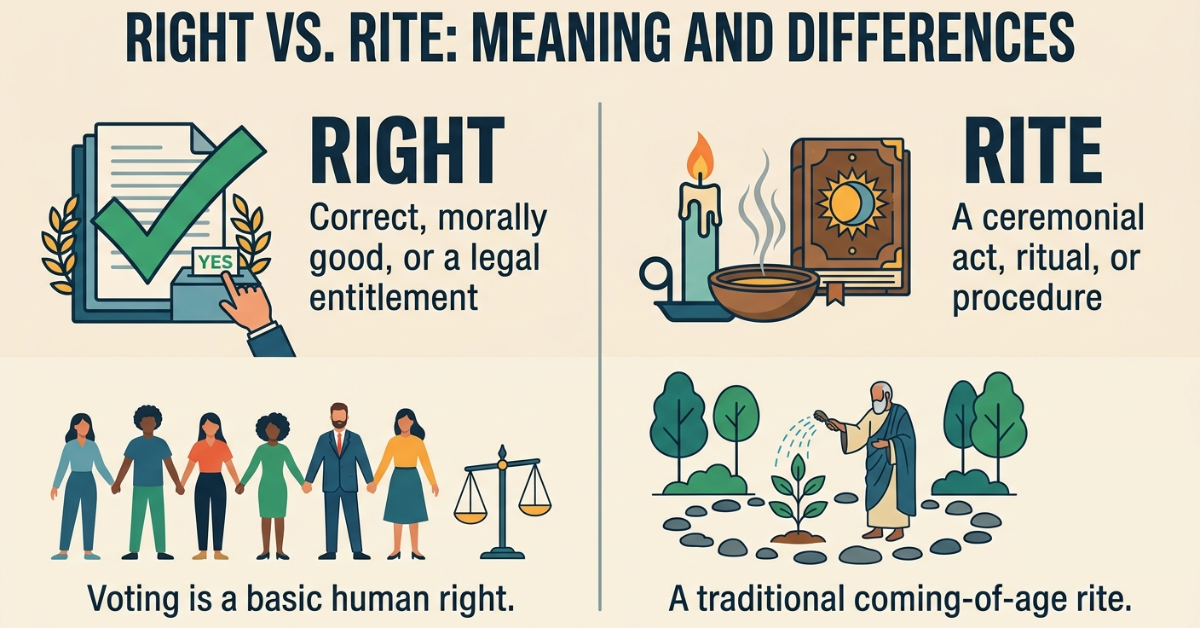
Have you ever read a sentence and wondered whether the correct word is right or rite? You’re not alone. These two words sound exactly the same, yet they have completely different meanings and uses.
Understanding right vs rite is important for clear communication, whether you’re writing an academic paper, a professional email, or simply improving your English skills. In this guide, you’ll learn the meanings of both words, their origins, practical examples, common mistakes, and easy tricks to remember which one to use.
Understanding Homophones: Why Right and Rite Cause Confusion
Before diving into the differences, it’s helpful to understand why people mix these words up.
Right and rite are homophones. A homophone is a word that sounds the same as another word but has a different spelling and meaning.
Other examples include:
- Their, there, and they’re
- Flower and flour
- Pair and pear
- Sea and see
Since right and rite share the same pronunciation, writers often confuse them when relying on sound rather than meaning.
What Does “Right” Mean?
The word right is one of the most versatile words in the English language. It can function as a noun, adjective, adverb, or verb depending on the context.
Right as Correct
The most common meaning of right is correct or accurate.
Examples:
- You gave the right answer.
- She was right about the weather forecast.
- The calculations are right.
Right as a Direction
Right can also refer to the opposite of left.
Examples:
- Turn right at the traffic signal.
- The bookstore is on the right side of the street.
Right as a Legal or Moral Entitlement
A right may refer to something a person is entitled to have or do.
Examples:
- Everyone has the right to education.
- Freedom of speech is a fundamental right.
Right as Morally Good
It can describe something ethical or just.
Examples:
- Helping others is the right thing to do.
- She chose what she believed was right.
Common Uses of Right
- Right answer
- Right decision
- Human rights
- Right side
- Right now
- Right away
Because it has multiple meanings, right appears far more frequently in everyday English than rite.
What Does “Rite” Mean?
A rite is a formal ceremony, ritual, or religious practice performed according to tradition or custom.
Unlike right, rite is a specialized word used in cultural, religious, and ceremonial contexts.
Rite as a Religious Ceremony
Many faiths include rites that mark important spiritual events.
Examples:
- The baptismal rite was conducted at the church.
- The priest performed a sacred rite.
Rite as a Traditional Ritual
A rite may also refer to a ceremonial action within a community or culture.
Examples:
- The tribe observed an ancient rite before the harvest.
- Marriage ceremonies often include traditional rites.
Rite of Passage
One of the most common phrases containing rite is rite of passage.
A rite of passage marks an important transition in a person’s life.
Examples:
- Graduating from college is often considered a rite of passage.
- Learning to drive is a rite of passage for many teenagers.
Right vs Rite: Key Differences
| Feature | Right | Rite |
| Meaning | Correct, proper, entitlement, direction | Ceremony, ritual, tradition |
| Part of Speech | Noun, adjective, adverb, verb | Noun |
| Usage Frequency | Very common | Less common |
| Context | Everyday language | Religious, cultural, ceremonial |
| Example | You are right. | The rite was performed at dawn. |
The simplest distinction is this:
- Right = correct, proper, justified, or a direction
- Rite = ceremony or ritual
Examples of Right and Rite in Sentences
Seeing words in context makes them easier to remember.
Sentences with Right
- You made the right choice.
- Is this the right address?
- She exercised her right to vote.
- Turn right after the bridge.
- He knew the right answer immediately.
Sentences with Rite
- The community celebrated an annual rite.
- The initiation rite lasted several days.
- The wedding rite included traditional prayers.
- The ceremony served as a rite of passage.
- Ancient civilizations practiced sacred rites.
How to Remember the Difference
Memory tricks can help eliminate confusion between right and rite.
Trick #1: Rite Contains “Rit”
The word rite closely resembles the beginning of the word ritual.
Think:
Rite = Ritual
If the sentence involves a ceremony or tradition, rite is likely correct.
Trick #2: Right Means Correct
When you think of being “right,” you usually think of being correct.
Think:
Right = Correct
If the sentence refers to correctness, morality, direction, or entitlement, choose right.
Trick #3: Check the Context
Ask yourself:
- Is this about a ceremony or tradition? → Rite
- Is this about correctness or direction? → Right
The context almost always reveals the correct choice.
Common Mistakes People Make
Incorrect
- Graduation is an important right of passage.
Correct
- Graduation is an important rite of passage.
Incorrect
- You were rite about the meeting time.
Correct
- You were right about the meeting time.
Incorrect
- Everyone has the rite to express their opinion.
Correct
- Everyone has the right to express their opinion.
These examples show how changing one letter completely changes the meaning.
The Origins of Right and Rite
Understanding a word’s history often helps clarify its meaning.
Origin of Right
The word right comes from Old English roots meaning:
- Straight
- Correct
- Just
- Proper
Over time, it expanded to include ideas of morality, law, and direction.
Origin of Rite
Rite comes from Latin and refers to:
- Religious observance
- Ceremony
- Traditional practice
Its connection to rituals remains largely unchanged today.
When to Use Right
Use right when discussing:
- Correct answers
- Directions
- Human rights
- Moral choices
- Proper actions
- Legal entitlements
Examples:
- That’s the right solution.
- Take the right lane.
- Citizens have voting rights.
When to Use Rite
Use rite when discussing:
- Religious ceremonies
- Cultural traditions
- Ritual practices
- Ceremonial events
- Initiation ceremonies
- Rites of passage
Examples:
- The rite was performed annually.
- The initiation rite welcomed new members.
Quick Reference Guide
Choose right if you mean:
- Correct
- Opposite of left
- Fair or moral
- Legal entitlement
Choose rite if you mean:
- Ritual
- Ceremony
- Religious observance
- Cultural tradition
Key Takeaways
- Right and rite are homophones with different meanings.
- Right refers to correctness, direction, morality, or entitlement.
- Rite refers to ceremonies, rituals, and traditions.
- The phrase rite of passage is a common expression involving rite.
- Remember: rite = ritual, right = correct.
- Context is the easiest way to determine which word is appropriate.
Frequently Asked Questions
Is it right or rite of passage?
The correct phrase is rite of passage because it refers to a ceremonial or symbolic transition from one stage of life to another.
What is the difference between right and rite?
In the right vs rite comparison, right means correct, proper, or entitled, while rite refers to a ceremony, ritual, or traditional observance.
Can rite mean correct?
No. Rite never means correct. If you’re talking about accuracy or correctness, the correct word is right.
Why do people confuse right and rite?
People confuse them because they are homophones, meaning they sound identical when spoken but have different spellings and meanings.
Is baptism a rite?
Yes. In many Christian traditions, baptism is considered a religious rite because it is a formal ceremonial practice.
How can I remember right vs rite?
A simple trick is to remember that rite begins similarly to ritual, while right is associated with being correct or proper.
Conclusion
The distinction between right vs rite is straightforward once you understand their meanings. Right relates to correctness, direction, morality, and legal entitlements, while rite refers to ceremonies, rituals, and traditional practices. Although they sound identical, their contexts are entirely different.
By focusing on the meaning of the sentence and using simple memory tricks like “rite equals ritual,” you’ll be able to choose the correct word confidently every time. The next time you encounter these commonly confused words, you’ll know exactly which one belongs in your writing.