Mark Your Calendar: Meaning, Usage, and Best Examples

Have you ever seen an invite, announcement, or social post that says mark your calendar and wondered whether it sounds formal, casual, or even a little old-fashioned? It is actually one of the most practical phrases in everyday English, and people use it to draw attention to an important date, event, or deadline.
In this guide, we will explore the meaning of, how to use it correctly, when to say mark your calendars instead, and why this phrase appears so often in event promotions, reminders, and design assets like calendar graphics and clipart.
What Does “Mark Your Calendar” Mean?
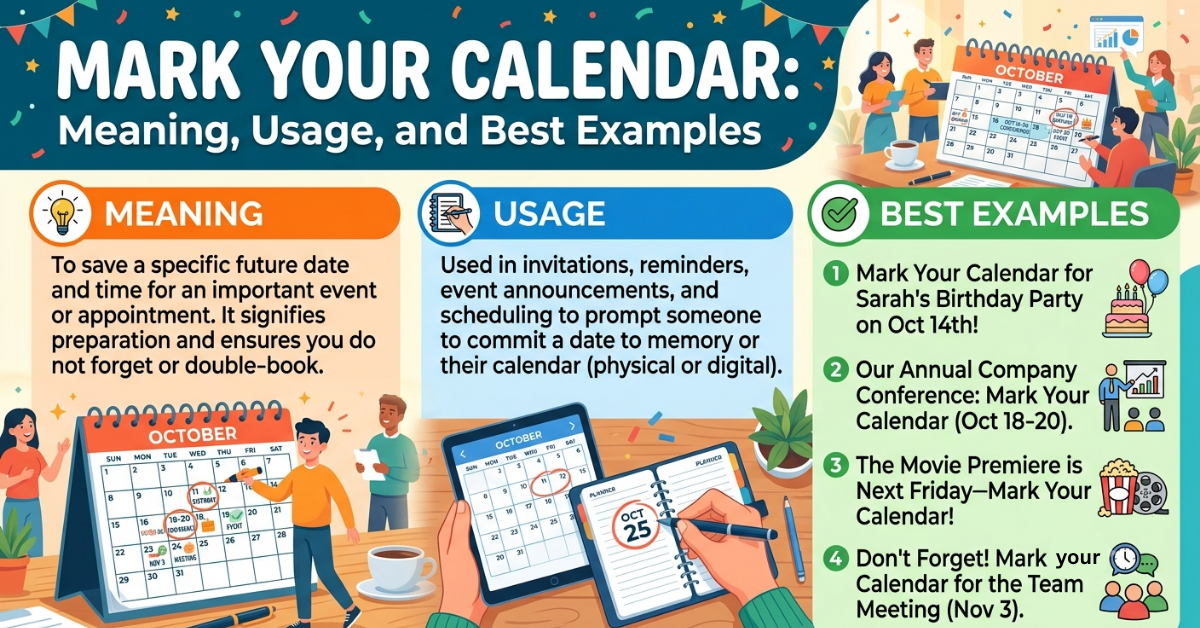
The phrase means to note an important date so you do not forget it. It is a simple way of saying, “Save this date” or “Remember this event.”
People use it when they want others to pay attention to something coming up soon, such as:
- a meeting
- a birthday
- a product launch
- a wedding
- a holiday sale
- a school event
In everyday communication, the phrase creates urgency without sounding too forceful. It is friendly, clear, and widely understood.
Why This Phrase Is So Common
The reason is so popular is that it works in both personal and professional settings. It is short, memorable, and easy to understand.
You will often see it in:
- email invitations
- social media captions
- event posters
- marketing campaigns
- school notices
- workplace announcements
It is especially effective because it tells the reader that the date matters. In other words, it is not just information — it is a reminder to act.
Mark Your Calendar or Mark Your Calendars?
This is one of the most common grammar questions around the phrase.
Use “mark your calendar” when speaking to one person or using a general instruction
Example:
- Please mark your calendar for Friday at 6 p.m.
Use “mark your calendars” when addressing a group
Example:
- Everyone, mark your calendars for the annual conference.
The plural form is often used in event announcements because the message is meant for many people. Both forms are correct; the choice depends on who you are addressing.
When to Use the Phrase
You can use mark your calendar in many situations, especially when a date matters and you want the other person to remember it.
Common uses include:
- Event invitations
“Mark your calendar for our grand opening.” - Work deadlines
“Mark your calendar for the final submission date.” - School and university notices
“Mark your calendar for orientation day.” - Personal reminders
“Mark your calendar for your appointment next Tuesday.” - Holiday promotions
“Mark your calendar for our biggest sale of the year.”
This phrase is useful because it saves space while still making the message feel important.
Mark Your Calendar Meaning in Everyday Language
The meaning is simple, but the tone can change depending on context.
Friendly and casual
A friend might say:
- “Mark your calendar — we are finally having dinner this Saturday.”
Professional and formal
A company might write:
- “Please mark your calendar for the annual shareholder meeting.”
Promotional and exciting
A brand might say:
- “Mark your calendar for the new product release.”
So the phrase can be adapted for almost any audience. That flexibility is one reason it remains so common in English writing.
How to Use It Naturally in Sentences
If you want your writing to sound polished, the phrase should fit smoothly into the sentence. Here are a few natural examples:
- Mark your calendar for June 15.
- Please mark your calendar for this important meeting.
- Everyone should mark their calendars for the festival.
- Be sure to mark your calendar so you do not miss the deadline.
- We hope you will mark your calendars for our annual event.
A useful tip: when writing professionally, keep the sentence short and direct. That makes the message stronger.
Mark Your Calendar Images, Graphics, and Clipart
Because the phrase is so common in promotions and announcements, it often appears in visual content too. Searches for mark your calendar images, mark your calendar graphic, mark your calendar clipart, and mark your calendar clip art are popular because people want design elements for:
- flyers
- invitations
- posters
- social media posts
- digital banners
- school newsletters
These visuals usually include calendars, check marks, pins, highlighted dates, or bold typography. A strong graphic helps the message stand out immediately.
Why visuals matter
When the phrase appears in a design, it becomes more attention-grabbing. The reader does not just see a reminder — they see a visual cue that something important is coming.
Best places to use these visuals
- event invitations
- church announcements
- business promotions
- conference posters
- online campaign banners
If the goal is to create urgency or excitement, a calendar-themed design is often more effective than plain text alone.
“Please Mark Your Calendar” in Formal Writing
Adding the word please makes the phrase softer and more polite. This is especially useful in business, academic, and customer-facing communication.
Examples:
- Please mark your calendar for the training session on Monday.
- Please mark your calendars for the launch event next week.
This version sounds courteous while still being direct. It is a great choice for emails, event reminders, and announcements where professionalism matters.
Common Mistakes to Avoid
Even though the phrase is easy to use, a few mistakes show up often.
1. Using it too many times in one text
If you repeat mark your calendar too often, the writing can feel forced. Use it once or twice and vary the wording after that.
2. Confusing singular and plural
Use “calendar” for one person and “calendars” for a group.
3. Making the sentence too long
The phrase works best when the date is clear and easy to notice. Avoid burying it inside a long paragraph.
4. Overloading the message with reminders
A single strong reminder is usually more effective than multiple repeated ones.
Practical Tips for Using the Phrase Well
If you are writing an invitation, post, or reminder, these tips can help:
- Put the date near the phrase.
- Keep the event name clear.
- Add a sense of urgency if needed.
- Use bold text in digital content.
- Pair it with a visual calendar icon or image.
- Keep the tone appropriate for the audience.
For example, a polished event line might look like this:
Mark your calendar for Saturday, August 10, at 3:00 p.m.
It is short, specific, and easy to remember.
Why This Phrase Works So Well in Marketing
Marketers use this phrase because it creates anticipation. It signals that something is worth remembering, which can improve engagement and attendance.
It works especially well for:
- launches
- limited-time offers
- seasonal events
- webinars
- product releases
- community gatherings
Compared with a plain announcement, it feels more personal and action-oriented. It nudges the audience to mentally save the date.
Key Takeaways
- Mark your calendar means to note an important date.
- It is commonly used in invitations, reminders, and promotions.
- Use mark your calendars when speaking to a group.
- The phrase works well in both casual and professional writing.
- Visuals like calendar graphics, clipart, and images can make the message stronger.
FAQ: Mark Your Calendar Meaning and Usage
1. What does “mark your calendar” mean?
It means to remember or note an important date so you do not forget it. People use it for events, deadlines, and special occasions.
2. Is it correct to say “mark your calendars”?
Yes, it is correct when you are speaking to a group. Use “mark your calendar” for one person and “mark your calendars” for many people.
3. Can I say “please mark your calendar”?
Yes, that is a polite and natural way to ask someone to remember a date. It is commonly used in formal invitations and announcements.
4. What is the difference between “mark your calendar” and “save the date”?
Both phrases are used to remind people about an event. “Save the date” is often used for weddings or formal occasions, while “mark your calendar” works in more everyday situations.
5. Why do people search for mark your calendar images or clipart?
They are usually looking for visual design elements to use in posters, invitations, or social media graphics. Calendar-themed visuals help make reminders more eye-catching.
6. Is “mark your calendar or mark your calendars” better?
Both are correct. The better choice depends on whether you are addressing one person or a group.
Conclusion
The phrase may be simple, but it carries real power in communication. It helps people remember important dates, creates anticipation, and works beautifully in both personal and professional settings. Whether you are writing an invitation, designing a flyer, or sharing a reminder online, this phrase gives your message clarity and impact.
Use it thoughtfully, pair it with a clear date, and it will do exactly what it is meant to do: help people remember what matters.