What Does the Prefix Dis Mean? Simple Grammar Guide

Have you ever wondered why words like disagree, disconnect, and dishonest all seem negative or opposite in meaning? That’s because they share the same prefix: dis-. Understanding prefixes is one of the easiest ways to improve your vocabulary, spelling, and reading comprehension.
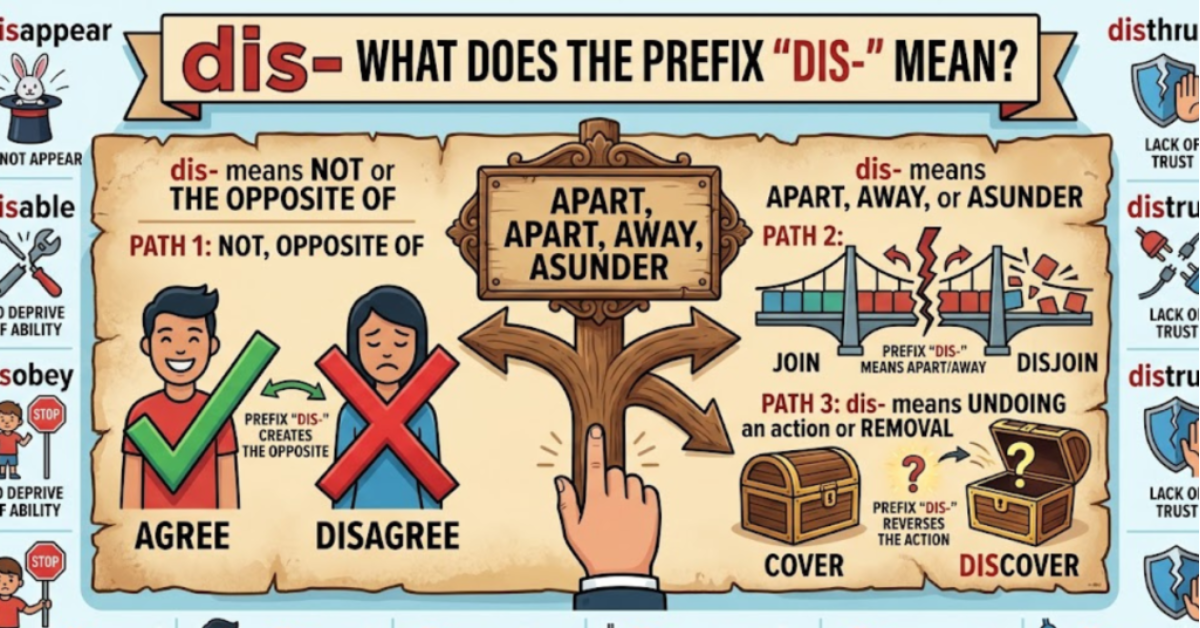
So, what does the prefix dis mean? In simple terms, the prefix dis- usually means not, opposite of, remove, or reverse. It changes the meaning of the word it appears before and often creates a negative or opposite version of that word.
In this guide, you’ll learn the meaning of the prefix dis-, where it comes from, common examples, grammar rules, and how to use it correctly in everyday English.
Understanding the Prefix Dis-
The prefix dis- is added to the beginning of a word to change its meaning. It is one of the most commonly used prefixes in the English language.
Main Meanings of the Prefix Dis-
The prefix generally has four common meanings:
- Not or opposite of
- Lack of
- Remove
- Reverse an action
For example:
| Word | Meaning |
| Disagree | To not agree |
| Disconnect | To remove a connection |
| Dishonest | Not honest |
| Disappear | To vanish or go away |
The prefix transforms the original word into something negative, opposite, or reversed.
Origin of the Prefix Dis-
The prefix comes from Latin. In Latin, dis- meant “apart,” “away,” or “not.” Over time, English adopted the prefix and began using it in thousands of words.
Today, it appears in both formal and everyday vocabulary, making it an important part of English grammar and word formation.
What Does the Prefix Dis Mean in Different Contexts?
The meaning can slightly change depending on the word it joins.
1. Dis- Meaning “Not”
This is the most common use.
Examples:
- Dishonest = not honest
- Disloyal = not loyal
- Disrespectful = not respectful
In these words, the prefix creates a negative form of the adjective.
2. Dis- Meaning “Opposite Of”
Sometimes the prefix creates the opposite action or condition.
Examples:
- Disagree = opposite of agree
- Disapprove = opposite of approve
These words often describe conflicting opinions or reactions.
3. Dis- Meaning “Remove”
In some words, the prefix means taking something away.
Examples:
- Disconnect = remove a connection
- Disarm = remove weapons
- Disengage = separate or remove involvement
This usage is common in technical and mechanical language.
4. Dis- Meaning “Reverse an Action”
The prefix can also indicate undoing something.
Examples:
- Disassemble = take apart
- Discontinue = stop continuing
- Disinfect = remove infection-causing germs
Here, the action is reversed or canceled.
Common Words With the Prefix Dis-
Here are some frequently used English words that include the prefix:
Everyday Examples
- Dislike
- Disappear
- Discomfort
- Disability
- Disbelief
- Disobedient
- Disorder
- Dissatisfied
Academic or Formal Examples
- Discrimination
- Disconnection
- Disapproval
- Disruption
- Disqualification
Learning these words can significantly improve your vocabulary.
Why Learning Prefixes Matters
Understanding prefixes helps you figure out unfamiliar words without checking a dictionary every time.
For example:
If you know:
- “Respect” means admiration
- And “dis-” means opposite or lack of
Then you can quickly understand:
- Disrespect = lack of respect
This skill improves:
- Reading comprehension
- Writing ability
- Vocabulary growth
- Spelling accuracy
It’s especially useful for students, language learners, and competitive exam preparation.
Difference Between Dis- and Other Negative Prefixes
English has several negative prefixes, and they can sometimes be confusing.
| Prefix | Meaning | Example |
| Dis- | Opposite or not | Disagree |
| Un- | Not | Unhappy |
| In- | Not | Incorrect |
| Non- | Absence of | Nonfiction |
Although they all create negative meanings, they are not always interchangeable.
For example:
- “Unhonest” is incorrect
- “Dishonest” is correct
That’s why learning common usage matters.
Grammar Tips for Using the Prefix Dis-
Here are some quick grammar tips:
Use Dis- With Correct Base Words
Not every word can take the prefix naturally. English has standard forms that sound correct to native speakers.
Correct:
- Dislike
- Disapprove
Incorrect:
- Dishappy
- Disgood
Watch Double Letters
Sometimes adding the prefix creates double letters.
Examples:
- Dissatisfy
- Dissolve
This happens because of spelling rules and pronunciation patterns.
Understand Context
Some words with the prefix do not always sound strongly negative.
For example:
- Discuss does not mean “not cuss”
- Distance is unrelated to negative meaning
English contains exceptions, so context always matters.
Easy Way to Teach Kids the Prefix Dis-
Teaching prefixes to children becomes easier with relatable examples.
Simple Teaching Method
- Start with a base word
- Add the prefix
- Compare meanings
Example:
- Agree → Disagree
- Connect → Disconnect
You can also use:
- Flashcards
- Word games
- Matching exercises
- Story reading activities
This makes vocabulary learning interactive and memorable.
Common Mistakes People Make
Many learners confuse the prefix with similar-looking word parts.
Mistake 1: Assuming Every “Dis” Word Is Negative
Not all words beginning with “dis” contain the prefix meaning.
Examples:
- Distance
- Disk
- Disease
These words developed differently and don’t follow the same rule.
Mistake 2: Using the Wrong Negative Prefix
People sometimes write:
- “Unrespectful” instead of “disrespectful”
- “Inagree” instead of “disagree”
The correct prefix depends on standard English usage.
FAQs
What does the prefix dis mean?
The prefix generally means “not,” “opposite of,” “remove,” or “reverse.” It changes the meaning of the root word.
Is dis- a negative prefix?
Yes, in most cases it creates a negative or opposite meaning.
What are examples of words with dis-?
Common examples include:
- Disagree
- Disconnect
- Dishonest
- Dislike
- Disappear
Does every word starting with dis contain the prefix?
No. Some words simply begin with those letters but are not formed using the prefix.
What language does the prefix dis- come from?
It comes from Latin, where it originally meant “apart” or “away.”
Conclusion
Understanding prefixes can make English vocabulary much easier, and the prefix dis- is one of the most useful to learn. Now that you know the answer to what does the prefix dis mean, you can recognize how it changes words to express opposites, negatives, removal, or reversal.
From everyday terms like disagree and disconnect to more advanced vocabulary, this small prefix plays a big role in communication. The more you practice identifying prefixes, the stronger your reading and writing skills will become.
If you enjoy learning about word meanings, grammar, and vocabulary patterns, explore more language guides to continue improving your English naturally.