Borrow vs Barrow: Meaning, Difference & Examples Explained

The confusion between borrow vs barrow is more common than you might think. These two words look almost identical, but their meanings are completely different. If you’ve ever paused while writing and wondered which one is correct, you’re not alone.
In this article, we’ll break down the difference between borrow vs barrow, explain their meanings, and show you simple examples so you never mix them up again. Understanding this will instantly improve your spelling accuracy and writing confidence.
What Does “Borrow” Mean?
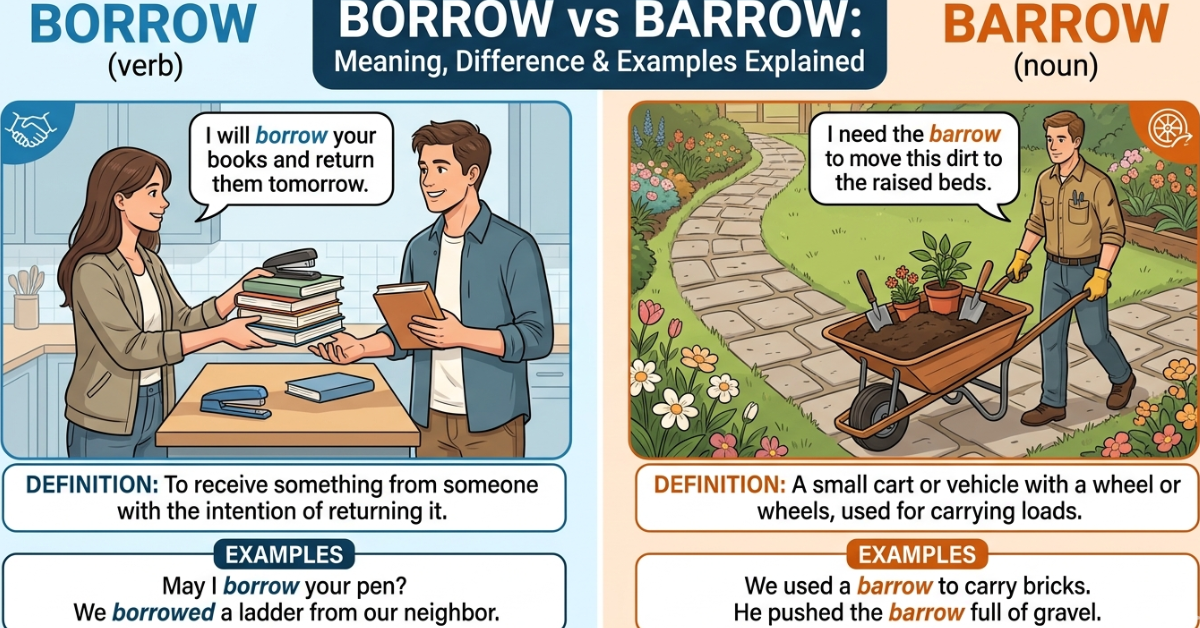
The word borrow is a verb, and it means to take something from someone temporarily with the intention of returning it later.
Simple definition:
- To take something for a short time
- To use something and give it back
Examples of “borrow”:
- Can I borrow your pen for a minute?
- She borrowed a book from the library.
- I often borrow money from my friend when needed.
Tip: Think of “borrow” as taking with permission and returning later.
What Does “Barrow” Mean?
The word barrow is a noun, and it refers to a type of object or place, not an action.
Common meanings of “barrow”:
- A wheelbarrow (a small cart used for carrying loads)
- A burial mound (an ancient grave or hill-shaped tomb)
Examples of “barrow”:
- He pushed a barrow full of soil in the garden.
- Archaeologists discovered an ancient burial barrow.
Tip: “Barrow” is something physical, not something you do.
Borrow vs Barrow: Key Differences
Understanding borrow vs barrow becomes easy when you compare them side by side.
1. Part of Speech
- Borrow → Verb (action)
- Barrow → Noun (thing/place)
2. Meaning
- Borrow → To take and return
- Barrow → A cart or burial mound
3. Usage Context
- Borrow → Daily conversation, education, finance
- Barrow → Gardening, archaeology, historical references
Why Do People Confuse Borrow vs Barrow?
The confusion happens because:
- They are spelled almost the same
- They sound similar in some accents
- Typing mistakes are common
But once you remember the meaning difference, borrow vs barrow becomes easy to separate.
Easy Trick to Remember
Here’s a simple memory trick:
- Borrow = “return later”
- Barrow = “wheelbarrow or mound”
You can also think:
- Borrow has “ow” like “owe something back”
- Barrow has “arrow” hidden inside (something physical)
Common Mistakes to Avoid
Many learners accidentally mix the words in writing. Here are mistakes to watch out for:
- I will barrow your book (In correct)
- I will borrow your book (Correct)
- He borrowed soil in a barrow (wrong context confusion) (In correct)
- He used a barrow to carry soil (Correct)
Pay attention to whether you are talking about an action or an object.
Quick Comparison Table
| Feature | Borrow | Barrow |
| Type | Verb | Noun |
| Meaning | To take temporarily | Cart or burial mound |
| Usage | Everyday speech | Specific contexts |
FAQs about Borrow vs Barrow
1. What is the main difference between borrow and barrow?
The main difference is that borrow is an action (taking temporarily), while barrow is a thing (like a wheelbarrow or mound).
2. Is barrow ever used as a verb?
No, barrow is not used as a verb in modern English. It is always a noun.
3. Can borrow and barrow be used in the same sentence?
Yes, but only if the context is correct. For example:
- I will borrow a barrow to move soil.
4. Why do people confuse borrow vs barrow so often?
Because they are spelled similarly and sound alike, especially in fast speech or typing.
5. What is an easy way to remember borrow?
Remember: borrow means you will return it later, just like borrowing a book or money.
Conclusion
The confusion between borrow vs barrow is simple to clear once you understand their meanings. Borrow is all about taking something temporarily, while barrow refers to a physical object or historical structure.
Next time you write, just pause and ask yourself: Am I talking about an action or a thing? That small step will help you avoid mistakes and write more confidently.
If you found this helpful, you can explore more grammar differences to sharpen your English even further.