Have you ever seen the words vender and vendor used interchangeably and wondered whether they’re both correct? You’re not alone. The confusion between vender vs vendor is surprisingly common because both words relate to selling something, and they even sound almost identical.
However, they aren’t always interchangeable. One is the standard spelling used in modern English, while the other has a more limited and specialized meaning. In this guide, you’ll learn the difference between these two words, when to use each one, common mistakes to avoid, and practical examples that make the distinction easy to remember.
Understanding Vender vs Vendor
At first glance, these words appear to be simple spelling variations. In reality, they serve different purposes.
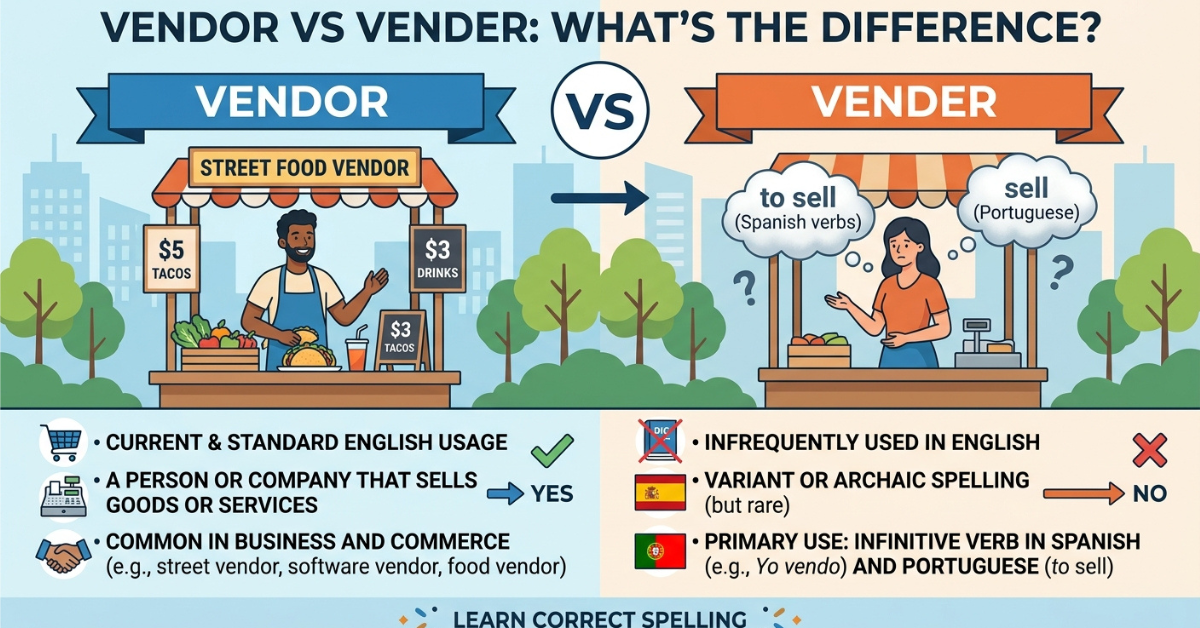
- Vendor is the standard and widely accepted term for a person or business that sells goods or services.
- Vender is a legitimate English word but is much less common. It is primarily used in legal or property-related contexts to refer to someone who sells property.
For nearly all business, retail, technology, and commercial writing, vendor is the correct choice.
What Does “Vendor” Mean?
A vendor is an individual, company, or organization that sells products or services to customers or other businesses.
The word is commonly used in:
- Business contracts
- Procurement
- Retail
- E-commerce
- Software licensing
- Supply chain management
- Event management
Examples
- The company selected a new vendor for office supplies.
- Food vendors lined both sides of the festival.
- We compared several software vendors before making a purchase.
- The event organizers invited over 100 local vendors.
In modern English, vendor is by far the preferred spelling.
What Does “Vender” Mean?
The word vender is much less common.
Traditionally, it refers to a person who transfers ownership of property or land to another person. Because of this, it appears mainly in legal documents involving real estate or property transactions.
Outside legal writing, most English speakers rarely encounter this word.
Examples
- The vender agreed to transfer ownership once payment was complete.
- The contract outlined the responsibilities of the vender and purchaser.
Unless you’re writing about property law or reading older legal documents, you probably won’t need this spelling.
Vender vs Vendor: Side-by-Side Comparison
| Feature | Vendor | Vender |
| Common in modern English | Yes | Rare |
| Used in business | Yes | No |
| Used in retail | Yes | Rare |
| Used in technology | Yes | No |
| Used in procurement | Yes | No |
| Used in legal property sales | Sometimes | Yes |
| Recommended for everyday writing | Yes | No |
Why Do People Confuse Vendor and Vender?
Several factors contribute to the confusion.
Similar Pronunciation
Both words are pronounced almost identically, making them easy to mix up in writing.
Similar Meanings
Since both involve selling, many people assume they are interchangeable.
Spell Check Doesn’t Always Help
Because vender is a real English word, grammar tools may not flag it as incorrect—even when vendor is the intended word.
Which Word Should You Use?
For almost every situation, use vendor.
Choose vendor when writing about:
- Businesses
- Suppliers
- Online marketplaces
- Service providers
- Retail stores
- Technology companies
- Event booths
- Procurement departments
Use vender only when referring to someone selling property in a legal context.
Examples in Everyday English
Correct
- Our vendor delivered the equipment on time.
- Every street vendor had a unique menu.
- The software vendor released a security update.
- The conference featured over 300 vendors.
Legal Context
- The vender transferred ownership after all contractual conditions were met.
Vendor in Business and Technology
Today, the word vendor appears across nearly every industry.
Examples include:
Retail
Retail vendors supply products to supermarkets, department stores, and online shops.
Information Technology
Technology vendors develop software, cloud services, cybersecurity solutions, and hardware.
Examples include:
- Software vendors
- Cloud service vendors
- Hardware vendors
- Database vendors
Procurement
Businesses evaluate vendors based on:
- Price
- Reliability
- Product quality
- Customer support
- Delivery speed
Choosing the right vendor is an essential part of supply chain management.
Common Expressions Using “Vendor”
You’ll often hear phrases like:
- Approved vendor
- Preferred vendor
- Local vendor
- Third-party vendor
- Vendor agreement
- Vendor management
- Vendor registration
- Vendor portal
- Vendor payment
- Vendor selection
Notice that all of these use vendor, not vender.
Common Mistakes to Avoid
Using “vender” in business writing
Incorrect: We hired a new software vender.
Correct: We hired a new software vendor.
Assuming They’re Always Interchangeable
Although both words relate to selling, vendor is the accepted word in nearly all modern contexts.
Misspelling Procurement Documents
Business contracts, invoices, purchase orders, and supplier agreements almost always use vendor.
Easy Trick to Remember
Here’s a simple memory tip:
Vendor = Business selling goods or services.
Think of:
- Vendor management
- Vendor portal
- Street vendor
- Software vendor
Since these phrases are common, you’ll naturally remember the correct spelling.
Reserve vender for legal property transactions.
When Is “Vender” Still Used?
Although uncommon, you may encounter vender in:
- Property law textbooks
- Real estate contracts
- Legal case reports
- Historical legal documents
Even in legal writing, many jurisdictions now prefer clearer language such as “seller.”
Key Takeaways
- Vendor is the standard spelling in modern English.
- Vendors sell goods or services.
- Businesses almost always use vendor.
- Vender is a legitimate but uncommon legal term.
- Unless discussing property law, choose vendor.
Frequently Asked Questions
Is vendor or vender the correct spelling?
For almost all situations, vendor is the correct spelling. Vender is mainly used in legal contexts involving the sale of property.
What is the difference between vender vs vendor?
The main difference is usage. A vendor sells goods or services in business, while a vender traditionally refers to someone selling property in legal documents.
Can I use vender in business writing?
Generally, no. Business writing almost always uses vendor, including procurement, retail, technology, and supplier management.
Why is vendor more common than vender?
Modern English has standardized vendor for commercial and business contexts. As a result, it appears far more frequently in everyday communication.
Is a street seller called a vendor or a vender?
A street seller is called a vendor. The term “street vendor” is the accepted and widely recognized expression.
Does vendor include service providers?
Yes. A vendor may sell physical products, digital products, or professional services, depending on the business relationship.
Conclusion
Understanding vender vs vendor is easier than it first appears. While both words are valid English terms, vendor is the standard choice for nearly every business, retail, technology, and commercial situation. Vender, on the other hand, survives mainly in legal language related to property sales.
If you’re writing emails, contracts, articles, business reports, or website content, vendor is almost certainly the word you want. Keeping this distinction in mind will help you communicate more accurately, write with confidence, and avoid one of English’s most common spelling confusions.