Have you ever paused while writing and wondered whether it should be “prooving” or “proving”? This small spelling doubt is more common than you might think, especially among learners of English and even native speakers in quick writing moments.
The confusion around prooving or proving often comes from how English spelling rules interact with verb forms and pronunciation. In this guide, we’ll break everything down in a simple, practical way so you never second-guess it again. You’ll learn the correct spelling, why the mistake happens, and how to avoid it in everyday writing.
What is the Correct Spelling: Prooving or Proving?
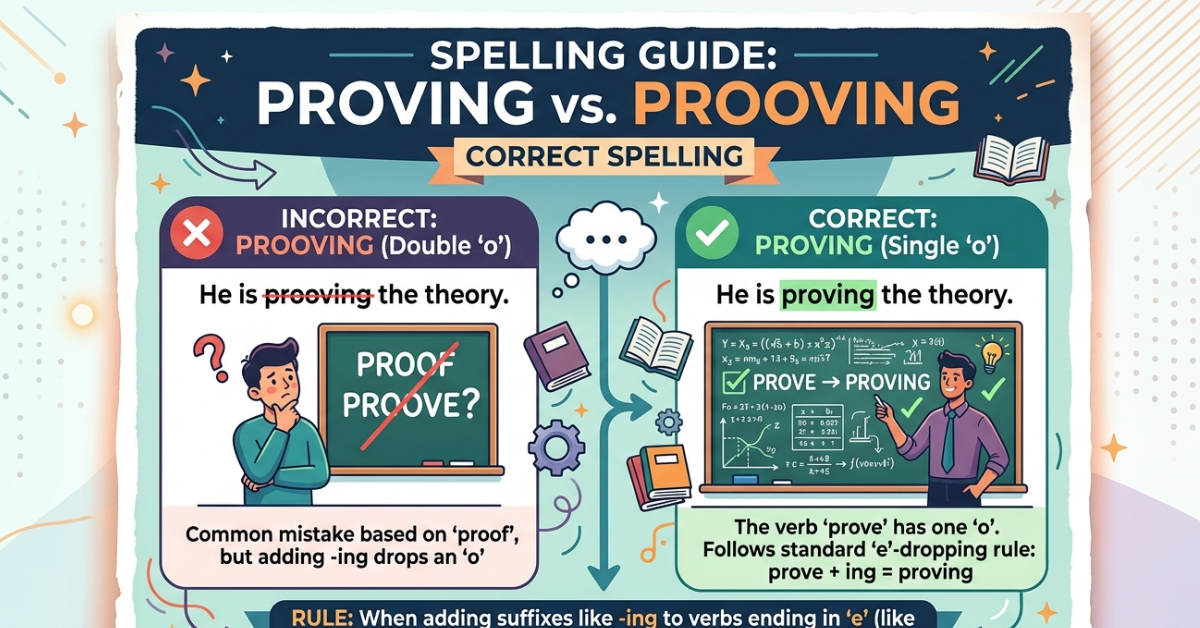
The correct spelling is “proving.” The word “prooving” is incorrect and does not exist in standard English usage.
The confusion in prooving or proving usually happens because many English verbs double their final consonant when forming continuous tense (like running or stopping). However, prove is an exception to that pattern.
Why “prooving” is incorrect
English spelling rules do not require doubling the “o” in prove when forming its present participle. Instead, the word simply drops the “e” and adds “-ing”:
- prove → proving
- proove → prooving
- prooving → incorrect spelling
This is why proving is the only accepted form in dictionaries like the Merriam-Webster Dictionary and Oxford English Dictionary.
Why People Get Confused Between Prooving or Proving
The mistake usually comes from overgeneralizing spelling rules.
Common reasons for the confusion:
- Influence of words like moving → moving and loving → loving
- Mishearing pronunciation (the “v” sound blends softly)
- Typing habits and autocorrect assumptions
- Lack of exposure to formal written English
In reality, English has many irregular verb patterns, and prove is one of them.
Grammar Rule Behind “Proving”
To understand prooving or proving properly, you need to know how verb conjugation works.
The verb prove follows this structure:
- Base form: prove
- Present participle: proving
- Past tense: proved
- Past participle: proved / proven (both accepted depending on context)
Example sentences:
- She is proving her point with strong evidence.
- The theory is still being proven in experiments.
- He proved his innocence in court.
Notice how “proving” stays consistent without any extra “o”.
Common Mistakes People Make
Many learners accidentally write prooving because of speed typing or incorrect assumptions.
Frequent errors include:
- Writing “prooving” instead of “proving”
- Using “prooving” in academic essays
- Mixing it with words like “dropping consonants” rules incorrectly
Understanding the difference in prooving or proving helps improve writing accuracy, especially in academic and professional contexts.
Easy Tips to Remember the Correct Form
If you often struggle with prooving or proving, here are some simple memory tricks:
- Think: “prove → remove the e → add ing”
- Associate it with similar verbs like drive → driving
- Remember: no double “o” exists in “prove”
These small tricks help eliminate spelling hesitation in writing.
Real-World Importance of Correct Spelling
Using the correct form (proving) matters in:
- Academic writing and exams
- Job applications and resumes
- Professional emails
- Content writing and blogging
Even small spelling mistakes can affect credibility, especially in formal communication.
Key Takeaways
- The correct spelling is proving, not prooving
- English verbs don’t always follow doubling rules
- “Prove” simply becomes “proving” by dropping the “e”
- Correct spelling improves clarity and professionalism
FAQs
1. Is “prooving or proving” the same thing?
No, only “proving” is correct. “Prooving” is a spelling mistake and not recognized in English dictionaries.
2. Why do people write prooving instead of proving?
It happens due to confusion with other verbs that double letters before adding “ing,” but “prove” does not follow that rule.
3. Is “proving” grammatically correct?
Yes, “proving” is the correct present participle form of the verb “prove.”
4. Can “proven” be used instead of proving?
Yes, but “proven” is usually used as a past participle, while “proving” is used in continuous actions.
5. How can I avoid spelling mistakes like prooving or proving?
Practice verb patterns and remember that “prove” always becomes “proving” without doubling letters.
6. Is “prooving” ever used in British or American English?
No, “prooving” is not used in any standard form of English.
Conclusion
The confusion between prooving or proving is common, but the rule is simple once you understand it: the correct form is always proving. English spelling can feel tricky, but learning these small patterns makes a big difference in writing accuracy and confidence.
By remembering this rule and practicing regularly, you can avoid one of the most common spelling mistakes in English.