Have you ever looked at a form, invoice, spreadsheet, or shipping document and spotted the word “addt’l”—then paused for a second to figure out what it meant? You’re not alone. Shortened forms of common words appear everywhere in business writing, logistics, note-taking, and administrative documents, and one of the most common examples is the additional abbreviation.
In most cases, the standard additional abbreviation addt’l is used to save space while still conveying the meaning of “additional.” But while it may look simple, there’s a lot of confusion around whether it’s correct, where it should be used, and whether it belongs in formal writing at all. In this guide, you’ll learn what additional abbreviation means, how addt’l is formed, where it commonly appears, alternatives you may encounter, and the best practices for using it clearly and professionally.
What Is the Abbreviation for “Additional”?
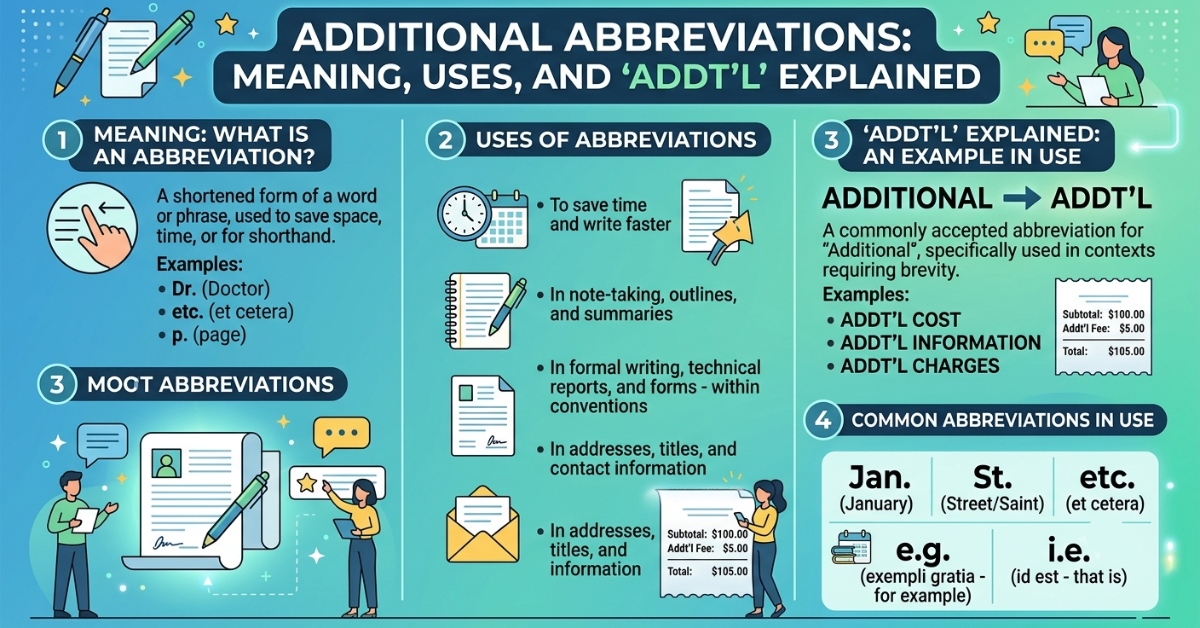
The most widely recognized abbreviation for additional is:
- Addt’l
- Sometimes written as addl. in certain business or internal contexts
Among these, addt’l is one of the most common shorthand forms, especially in forms, invoices, labels, spreadsheets, order documents, and administrative writing where space is limited.
The short answer
If someone asks for the additional abbreviation, the answer is usually:
Additional = Addt’l
That said, abbreviations are context-dependent. Some workplaces, industries, and style systems prefer different shortened forms, while others avoid abbreviiating the word entirely.
What Does “Addt’l” Mean?
Addt’l simply means additional—something extra, added, supplementary, or more than what already exists.
Example meanings in context:
- Addt’l charges = additional charges
- Addt’l information = additional information
- Addt’l documents required = additional documents required
- Addt’l seating available = extra seating available
So if you see “addt’l,” there’s no hidden technical meaning behind it. It’s just a compressed form of the full word additional.
How the Additional Abbreviation Is Formed
Abbreviations often remove vowels, shorten middle syllables, or compress common word patterns. In the case of additional, the abbreviation addt’l is built from key parts of the original word:
- Add → from the beginning of additional
- t → representing the middle consonant sound
- ’l → standing in for the ending sound in the word
This style of abbreviation is similar to older business shorthand and document compression methods where apostrophes replace omitted letters.
Breakdown:
Additional → Addt’l
It looks unusual if you’re seeing it for the first time, but it follows a familiar pattern used in compact written communication.
Why Do People Abbreviate “Additional”?
The main reason is simple: space and speed.
In many settings, especially where character count or layout space is limited, shortening a word like “additional” makes documents easier to fit and quicker to scan.
Common reasons for using an abbreviation:
- Limited space on forms or labels
- Faster data entry in internal systems
- Cleaner spreadsheet column headings
- Shorter invoice descriptions
- Easier note-taking in meetings or fieldwork
- Standardized shorthand in office environments
For example, a narrow invoice column may show “Addt’l fees” instead of “Additional fees” simply because the full phrase doesn’t fit neatly.
Where Is “Addt’l” Commonly Used?
The additional abbreviation addt’l is most common in practical, space-saving writing rather than polished prose. You’ll usually find it in operational or administrative contexts.
Business and Office Documents
Businesses often abbreviate words in internal paperwork, billing documents, and data systems.
Examples:
- Addt’l costs
- Addt’l services
- Addt’l notes
- Addt’l approval needed
This is especially common in:
- invoices
- purchase orders
- packing slips
- internal memos
- service forms
- expense reports
Shipping, Logistics, and Inventory Records
In logistics, every character can matter—especially on labels, manifests, or item descriptions.
You might see:
- Addt’l cartons
- Addt’l handling charges
- Addt’l stock arriving Friday
- Addt’l unit requested
Warehousing and shipping environments often rely on shorthand because systems may have character limits.
Forms and Applications
Paper forms and digital forms frequently shorten words to fit section headings or checkbox descriptions.
Examples:
- Addt’l contact
- Addt’l family member
- Addt’l information
- Addt’l comments
In these situations, the abbreviation is meant to make the form compact without losing meaning.
Personal Notes and Internal Team Communication
Some people use addt’l in handwritten notes, meeting minutes, or quick internal messages.
Example:
- “Need addt’l pricing before approval.”
- “Client requested addt’l revisions.”
- “Ask for addt’l samples.”
In casual internal communication, abbreviations can save time—as long as everyone understands them.
Is “Addt’l” a Standard English Abbreviation?
This is where things get interesting.
Addt’l is widely used in practice, but it is not always treated as a formal dictionary-standard abbreviation in the same way as “etc.” or “e.g.” Instead, it belongs more to the category of practical shorthand or business abbreviation.
That means it’s common, understandable, and useful—but not always ideal in formal writing.
In simple terms:
- Acceptable in internal, business, administrative, and space-limited contexts
- Less suitable in polished academic or formal public-facing writing
- Best used when the audience can easily understand it
So yes, it’s a real and useful abbreviation—but not one you should automatically use everywhere.
“Addt’l” vs “Addl.”: Which One Is Correct?
If you’ve seen both addt’l and addl., you may wonder which one is better. The answer depends on context, company preference, and readability.
Addt’l
Addt’l is often used when someone wants a compact form that still resembles the pronunciation and structure of “additional.”
Pros:
- Common in forms and business shorthand
- Clearly linked to the original word
- Works well in narrow spaces
Cons:
- The apostrophe can look awkward in some digital systems
- Some readers may find it less intuitive than other abbreviations
Addl.
Addl. is another shortened form you may encounter, especially in corporate or administrative notes.
Pros:
- Cleaner visual appearance
- Easier to type
- Looks more like a modern office abbreviation
Cons:
- Slightly less recognizable to some readers
- Not everyone immediately connects it to “additional”
Which should you use?
A practical rule:
- Use addt’l if you’re following an existing business shorthand style or matching a document format that already uses it.
- Use addl. if you want a cleaner, simpler abbreviation for internal notes or spreadsheet headings.
- Use additional in formal writing, customer-facing content, essays, articles, and professional documents where clarity matters more than saving space.
When You Should Use the Full Word “Additional” Instead
Even though the additional abbreviation is useful, it’s not always the best choice. In many cases, spelling out the full word is the better move.
Use “additional” in formal writing
Avoid abbreviating the word in:
- academic essays
- research papers
- professional reports
- website copy
- published articles
- legal documents
- cover letters and resumes
- formal emails to clients or professors
Why?
Because formal writing values:
- clarity
- consistency
- professionalism
- readability for all audiences
For example:
Better in formal writing:
- “Please provide additional supporting documents.”
Less ideal in formal writing:
- “Please provide addt’l supporting documents.”
The second version isn’t wrong in every context, but it feels more compressed and less polished.
When It’s Fine to Use the Additional Abbreviation
There are plenty of situations where abbreviating additional makes perfect sense.
Good use cases:
- internal spreadsheets
- warehouse records
- invoice line items
- handwritten notes
- packing lists
- quick staff instructions
- forms with limited character space
- recurring shorthand in a business system
Example:
If a column header in a spreadsheet needs to stay short, “Addt’l Cost” may work better than “Additional Cost.”
The key question is: Will the reader understand it instantly without confusion?
If yes, the abbreviation is probably fine.
Examples of “Additional” and “Addt’l” in Real-World Use
Seeing the term in context makes it easier to understand when the abbreviation works.
Invoice and billing examples
- Addt’l labor charges may apply.
- Addt’l delivery fee for remote areas.
- Addt’l taxes calculated at checkout.
Office communication examples
- Please send addt’l references by Friday.
- We need addt’l approval before final printing.
- Addt’l edits requested by the client.
Form and admin examples
- Addt’l emergency contact
- Addt’l household members
- Addt’l notes or instructions
Customer service examples
- Addt’l verification may be required.
- Addt’l details can be provided upon request.
- Addt’l support options are available.
These examples show why the abbreviation survives: it’s short, practical, and easy to repeat in systems where space matters.
Is “Addt’l” Appropriate in Academic Writing?
Usually, no—not unless you’re reproducing a source exactly, using shorthand in private notes, or following a specific template where abbreviations are already standardized.
In academic writing, it’s generally better to write additional in full. Style guides in academic and professional settings tend to favor complete words unless an abbreviation is universally recognized or explicitly defined.
Better academic choice:
- “Additional research is needed to confirm the results.”
Less appropriate academic choice:
- “Addt’l research is needed to confirm the results.”
The full word looks cleaner, sounds more formal, and avoids distracting the reader.
Is There an Official Dictionary Abbreviation for Additional?
There isn’t one universally enforced “official” abbreviation that everyone must use across all English writing. That’s why you’ll see multiple versions in practice.
Common forms include:
- Addt’l
- Addl.
- occasionally shortened internal variants depending on a company system
This happens with many office terms. Practical abbreviations often develop through usage rather than through one strict universal rule.
So if you’re asking, “What is the official additional abbreviation?” the safest answer is:
- Addt’l is a common and recognizable abbreviation
- Addl. is also used
- the full word additional is still best in formal writing
How to Decide Whether to Abbreviate “Additional”
If you’re unsure whether to use the abbreviation, this quick checklist helps.
Use the abbreviation if:
- space is limited
- the document is internal
- the audience is familiar with shorthand
- consistency with existing forms matters
- readability won’t suffer
Use the full word if:
- the document is formal
- the audience is broad or external
- you’re writing for publication
- clarity is more important than saving space
- the abbreviation might confuse readers
A good writing habit is to prioritize clarity first, brevity second.
Common Mistakes People Make With “Addt’l”
Because it’s a compressed word, people often misuse it or overuse it.
1. Using it in highly formal writing
Abbreviations like addt’l can make a formal document feel rushed or overly casual.
2. Mixing multiple abbreviation styles
If one section says addt’l and another says addl., the document can feel inconsistent.
3. Using it without considering the audience
Not every reader is used to business shorthand. If your audience includes clients, students, or the general public, spelling out additional is often better.
4. Over-abbreviating everything
A document packed with shorthand can become tiring to read. Abbreviate only where it adds value.
Best Practices for Using “Addt’l” Clearly
If you do choose to use the additional abbreviation addt’l, these guidelines will help keep your writing clean and understandable.
1. Be consistent
Pick one form—addt’l or addl.—and stick with it throughout the same document.
2. Match the tone of the document
If the document is formal, write additional in full. If it’s operational or internal, the abbreviation may be fine.
3. Consider your audience
A warehouse team, accounting department, or internal admin staff may understand addt’l immediately. A customer or professor may not appreciate the shorthand.
4. Don’t abbreviate when clarity is at risk
If a shortened form slows the reader down, it defeats the purpose.
5. Use it mainly in labels, notes, and compact layouts
Column headings, form labels, checklist items, and invoice notes are ideal places for abbreviations.
Additional vs Other Related Words
Sometimes people searching for the additional abbreviation are really looking for a broader sense of the word itself—what it means and what other words are similar.
Related words and synonyms for “additional”:
- extra
- added
- supplementary
- further
- more
- spare
- bonus
- another
Example:
- Additional fee = extra fee
- Additional information = further information
- Additional materials = supplementary materials
These synonyms can be useful if you’re writing content and want to avoid repeating the same word too often.
Quick Comparison Table: Additional, Addt’l, and Addl.
| Form | Meaning | Best Used In | Formality Level |
| Additional | Extra, added, supplementary | Reports, essays, websites, formal emails | High |
| Addt’l | Abbreviation for additional | Forms, invoices, notes, internal docs | Low to medium |
| Addl. | Alternate abbreviation for additional | Spreadsheets, admin shorthand, office notes | Low to medium |
This is the easiest way to think about it: the meaning stays the same, but the best format depends on the writing situation.
Key Takeaways
If you only remember a few things about the additional abbreviation, make them these:
- Addt’l is a common abbreviation for additional
- Addl. is another variation you may see
- The abbreviation is most useful in forms, invoices, notes, and internal documents
- In formal, academic, or public-facing writing, the full word additional is usually the better choice
- Good writing isn’t about shortening everything—it’s about choosing the clearest form for the reader
Frequently Asked Questions
What is the abbreviation for additional?
The most common additional abbreviation is addt’l. You may also see addl. in office documents, spreadsheets, and internal communication.
What does addt’l mean?
Addt’l means additional—in other words, extra, added, or supplementary. It’s simply a shortened form of the full word.
Is addt’l a correct abbreviation?
Yes, addt’l is a commonly used abbreviation in business, administrative, and space-limited writing. However, it’s better suited to internal or practical documents than formal academic writing.
Is addl. also an abbreviation for additional?
Yes. Addl. is another shorthand form of additional. Some workplaces prefer it because it looks cleaner and is easier to type.
Should I use addt’l in formal writing?
In most cases, no. If you’re writing an essay, report, website article, or professional email, it’s usually better to write additional in full for clarity and polish.
Where is the additional abbreviation most commonly used?
The additional abbreviation addt’l often appears in invoices, shipping documents, forms, spreadsheets, internal notes, and administrative records where space is limited.
Conclusion
The word additional may seem too ordinary to need much explanation, but its abbreviated forms show up in more places than most people realize. Whether you encounter addt’l on a form, in an invoice, inside a spreadsheet, or in office communication, the meaning is straightforward: it refers to something extra, added, or supplementary.
The real question isn’t just what the abbreviation means—it’s when it should be used. If you’re writing for a formal audience, stick with the full word additional. If you’re working in a compact business, logistics, or administrative setting, addt’l can be a practical and efficient shorthand. Use it thoughtfully, stay consistent, and always choose the version that makes your writing easiest to understand.