Have you ever read a sentence and paused for a second because two words sounded exactly the same but clearly meant very different things? That’s exactly what happens with oar vs ore. They’re pronounced alike, but they belong to completely different worlds—one belongs on the water, and the other comes from deep inside the earth.
If you’ve ever wondered which word to use, you’re in the right place. In this guide, we’ll break down oar vs ore in plain English, look at their meanings, compare them side by side, explore examples in real sentences, and share simple tricks to help you remember the difference for good.
Why “Oar” and “Ore” Get Confused
The confusion comes down to one thing: they’re homophones.
Homophones are words that sound the same but have different meanings and spellings. English has plenty of them—like pair and pear, sea and see, or right and write. Oar and ore fall into that same category.
Even though they sound identical, they are used in very different contexts:
- Oar is related to boats and rowing
- Ore is related to rocks, minerals, and mining
So while the pronunciation may trick your ear, the meaning becomes obvious once you understand the context.
Oar Meaning: What Does “Oar” Mean?
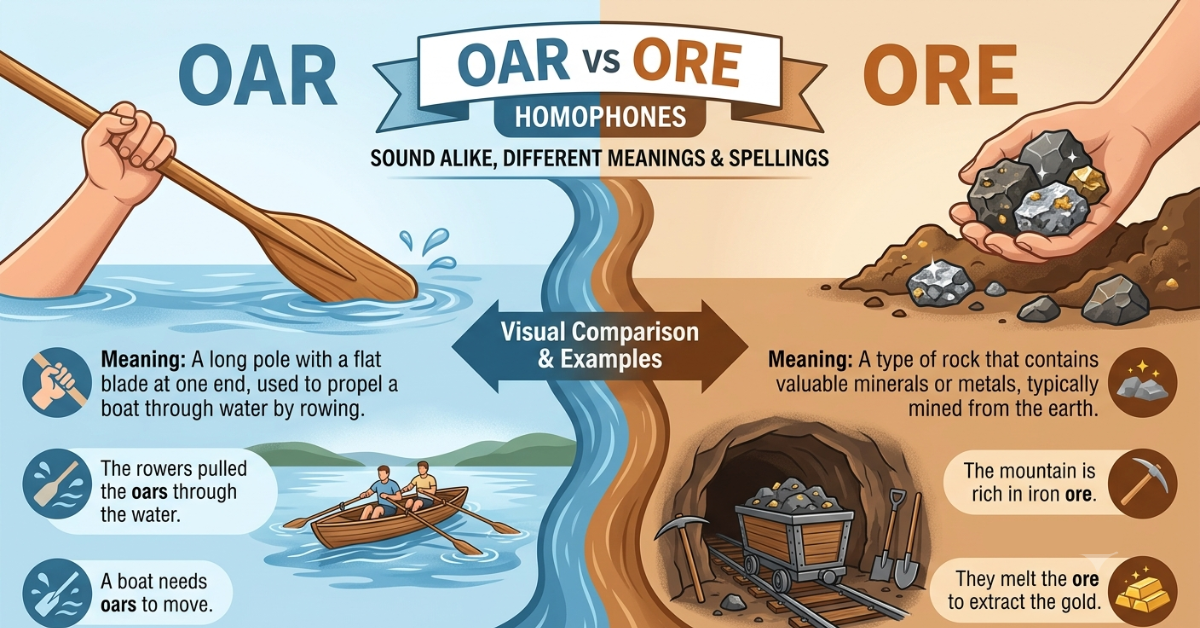
An oar is a long pole with a flat blade at one end, used to row or steer a boat through water. It’s a physical tool that helps move a small boat, canoe, or rowboat.
Simple definition of oar
Oar (noun): A tool used for rowing a boat.
Example sentences with “oar”
- He dipped the oar into the lake and pushed the boat forward.
- One of the rowers lost grip on his oar during the race.
- The fisherman rested his oar across the side of the boat.
Common contexts where “oar” appears
You’ll usually see oar in topics related to:
- Rowboats
- Canoeing
- Kayaking
- Boating and water sports
- Fishing trips
- Crew and rowing competitions
Related words and phrases
- Rowing oar
- Paddle and oar
- Oarlock
- Rowboat
- Crew race
Although oar is most commonly a noun, you may also come across the phrase “to oar” in very old or literary English, though that use is uncommon today.
Ore Meaning: What Does “Ore” Mean?
Ore refers to rock or natural material found in the earth that contains valuable minerals or metals. These materials are extracted and processed so the useful metal can be separated from the surrounding rock.
Simple definition of ore
Ore (noun): Rock or earth containing valuable minerals, often metals, that can be mined and processed.
Example sentences with “ore”
- The company discovered a large deposit of iron ore in the region.
- Copper ore must be refined before the metal can be used.
- Miners spent months extracting gold-bearing ore from the mountain.
Common contexts where “ore” appears
You’ll usually see ore in discussions about:
- Mining
- Geology
- Earth science
- Metals and minerals
- Industrial production
- Natural resources
Examples of common ores
Some well-known ores include:
- Iron ore – used to make steel
- Bauxite – the main ore of aluminum
- Copper ore – source of copper
- Gold ore – rock containing gold
- Hematite and magnetite – major iron-bearing ores
So if the conversation is about the ground, minerals, extraction, or metals, ore is almost certainly the correct word.
Oar vs Ore: Side-by-Side Comparison
Here’s the easiest way to understand oar vs ore at a glance.
| Word | Meaning | Category | Used In | Example |
| Oar | A tool used to row or steer a boat | Boating / Water transport | Lakes, rivers, rowing, fishing | She pulled the oar through the water. |
| Ore | Rock containing valuable minerals or metals | Mining / Geology | Mines, metal extraction, earth science | The mine produced tons of iron ore. |
Quick summary
- Oar = boat tool
- Ore = mineral-bearing rock
That’s the core difference. One helps you move across water; the other comes out of the ground.
Oar vs Ore in Pronunciation
This is where the confusion really starts: oar and ore are pronounced the same in most English accents.
Pronunciation
- Oar = /ɔːr/
- Ore = /ɔːr/
Because they sound identical, you can’t rely on pronunciation alone to tell them apart. You have to use the meaning of the sentence to choose the correct spelling.
Example
- He grabbed the oar and started rowing.
- The miners loaded the ore onto trucks.
Both sound the same when spoken, but the subject of the sentence tells you which word fits.
How to Remember the Difference Between Oar and Ore
If you mix up oar vs ore, a quick memory trick can make it much easier.
Memory trick for “oar”
Think of oar as a word connected to water and rowing.
- Oar has the letter A
- Think: A = Across the water
So if someone is moving a boat across a lake or river, oar is the word you want.
Memory trick for “ore”
Think of ore as something found in the earth.
- Ore sounds like it belongs in a word such as core
- And the earth has a core
That’s not a dictionary rule, of course—it’s just a useful memory shortcut. If the sentence is about mining, metals, or rocks underground, choose ore.
Examples of Oar vs Ore in Sentences
Seeing both words in context is one of the best ways to lock in the difference.
Sentences with “oar”
- The guide handed each tourist an oar before the rafting trip began.
- She leaned on the oar while the boat drifted quietly.
- The old wooden oar had been used for years on the family fishing boat.
- During the race, one team snapped an oar and lost momentum.
Sentences with “ore”
- The region is famous for its rich deposits of copper ore.
- Workers transported the iron ore to a processing plant.
- The geologist examined the rock to determine whether it contained usable ore.
- The country’s economy depends heavily on exporting mineral ore.
Mixed examples
- The rower dropped his oar into the river while the miners below were loading ore into carts.
- One story takes place on a lake with an oar, the other in a mine full of ore.
Common Mistakes People Make With Oar and Ore
Because these words sound alike, mistakes usually happen in writing rather than speaking.
1. Using “ore” in a boating sentence
Incorrect: He picked up the ore and rowed to shore.
Correct: He picked up the oar and rowed to shore.
Why? Rowing requires a boat tool, not a mineral.
2. Using “oar” in a mining sentence
Incorrect: The company extracted gold oar from the mountain.
Correct: The company extracted gold ore from the mountain.
Why? Gold is found in mineral-bearing rock, so ore is correct.
3. Relying on sound instead of context
This is the most common issue. Since oar and ore sound the same, writers often choose the wrong spelling if they’re moving too quickly. The safest fix is simple: stop and ask what the sentence is actually about—water or mining?
Oar vs Ore in Real-World Context
Understanding the difference isn’t just useful for school assignments or grammar quizzes. These words appear in many real-life contexts.
In education
Students often encounter ore in geography, geology, chemistry, and environmental science. Meanwhile, oar may show up in literature, travel writing, or sports-related reading passages.
In business and industry
- Ore appears in mining, metallurgy, construction, and global trade
- Oar appears in boating, recreation, sports, and outdoor tourism
In literature and storytelling
Writers use oar to create visual scenes of rivers, lakes, and journeys. Ore, on the other hand, often appears in historical fiction, industrial writing, and stories involving mountains, mines, and labor.
That’s why knowing oar vs ore matters more than it might seem at first glance—it improves both comprehension and writing accuracy.
Is “Oar” the Same as “Paddle”?
Not exactly. People sometimes use the words casually, but technically an oar and a paddle are different tools.
Oar
- Typically used with rowboats
- Attached to the boat through an oarlock or rowlock
- The rower pulls the oar through the water
Paddle
- Usually not attached to the boat
- Used in canoes, kayaks, and paddleboards
- Held freely in the hands
So while both are used on the water, they are not interchangeable in precise usage.
Is “Ore” Always Metal?
Not always, but it usually refers to material that contains valuable minerals, often metals that can be extracted economically.
Examples
- Iron ore contains iron compounds
- Copper ore contains copper minerals
- Bauxite contains aluminum-bearing minerals
The key idea is that ore has economic value because it can be processed to obtain something useful.
A rock containing tiny traces of metal is not necessarily called ore unless it can be mined and refined in a practical way.
Oar vs Ore: Which One Should You Use?
If you’re stuck choosing between the two, use this quick decision rule:
Use oar if the sentence is about:
- Boats
- Rowing
- Water travel
- Fishing on a lake or river
- Crew or rowing sports
Use ore if the sentence is about:
- Mining
- Metals
- Rocks and minerals
- Geology
- Resource extraction
One-line rule to remember
If it floats, think oar. If it’s mined, think ore.
That single line can save you from a lot of confusion.
Mini Quiz: Test Your Understanding
Try filling in the blank with oar or ore.
- The team practiced rowing with a new carbon-fiber ______.
- Australia exports large amounts of iron ______.
- He pushed the boat away from the dock using a single ______.
- The mine produced copper ______ for export.
Answers
- oar
- ore
- oar
- ore
If you got those right, you’ve already mastered the basic difference.
Key Takeaways on Oar vs Ore
Here’s the short version of everything you need to remember:
- Oar is a boating tool used for rowing or steering a boat.
- Ore is a rock or mineral deposit that contains valuable material, usually metal.
- They are homophones, meaning they sound the same but have different meanings and spellings.
- Oar belongs to the world of water, rowing, and boats.
- Ore belongs to the world of geology, mining, and metal extraction.
- The easiest way to choose the right one is to look at the context of the sentence.
FAQs About Oar vs Ore
1. What is the difference between oar and ore?
The difference between oar vs ore is simple: an oar is used to row a boat, while ore is rock containing valuable minerals or metals. They sound the same but mean completely different things.
2. Is it spelled oar or ore for a boat?
For a boat, the correct spelling is oar. An ore is something found in the ground, not something used on water.
3. What does ore mean in mining?
In mining, ore refers to rock or natural material that contains valuable minerals or metals that can be extracted. Common examples include iron ore, copper ore, and gold ore.
4. Why do oar and ore sound the same?
They sound the same because they are homophones—words with the same pronunciation but different meanings and spellings. English has many pairs like this.
5. How can I remember oar vs ore?
A simple trick is this: oar is for moving across water, and ore comes from the earth. If the sentence is about a boat, use oar; if it’s about mining or metal, use ore.
6. Can ore be something other than metal?
Yes. While ore is often associated with metals, the broader idea is that it contains a valuable mineral that can be extracted and processed. The material must have enough value to be worth mining.
Conclusion
At first glance, oar vs ore seems like one of those tiny English problems that shouldn’t matter much. But once you look closer, the difference is actually very clear. Oar belongs to boats, rowing, and water. Ore belongs to mines, minerals, and metal extraction. Same sound, completely different meaning.
The easiest way to remember it is to focus on the setting of the sentence. Is someone rowing across a lake? Use oar. Is the topic about iron, copper, or mining? Use ore. Keep that distinction in mind, and you’ll use both words correctly with confidence. If you enjoy breaking down tricky word pairs like this, it’s worth exploring more commonly confused words—you’ll sharpen both your writing and your grammar instincts at the same time.