Have you ever wondered whether you should say an upcoming event or an incoming event? Although these words may seem similar because they both relate to something happening in the future, they carry very different meanings. Using the wrong one can make your writing sound awkward or even incorrect.
This guide explains upcoming vs incoming in clear, simple language. You’ll learn what each word means, when to use it, common mistakes to avoid, and plenty of real-world examples that make the difference easy to remember.
What Does “Upcoming” Mean?
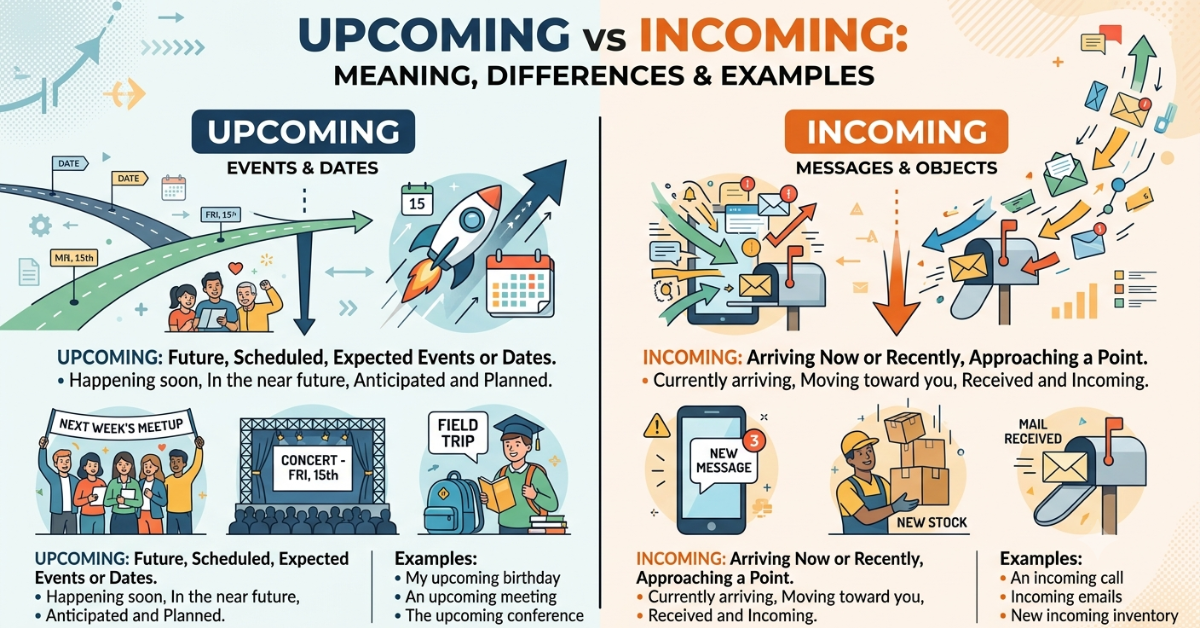
The word upcoming is an adjective that describes something that will happen soon in the future. It refers to scheduled or expected events, activities, releases, or occasions.
Simple Definition
Upcoming = Happening soon
Examples
- Our upcoming meeting starts at 10 a.m.
- She is excited about her upcoming vacation.
- The company announced its upcoming product launch.
- Students are preparing for the upcoming exams.
- The upcoming football season begins next month.
In each example, the event hasn’t happened yet, but it is planned or expected.
What Does “Incoming” Mean?
Incoming describes something or someone that is arriving, being received, or moving toward a destination.
It often refers to messages, calls, shipments, people arriving, or newly appointed individuals.
Simple Definition
Incoming = Arriving or coming toward you
Examples
- I received an incoming phone call.
- The airport handled several incoming flights.
- The warehouse is expecting incoming deliveries.
- The incoming president addressed the media.
- Please check your incoming emails.
Here, the focus is on arrival rather than future scheduling.
Upcoming vs Incoming: The Key Difference
Although both words involve something that hasn’t fully happened yet, their meanings are different.
| Feature | Upcoming | Incoming |
| Meaning | Happening soon | Arriving or being received |
| Focus | Future event | Arrival or movement |
| Common Uses | Events, holidays, meetings, releases | Calls, emails, flights, shipments, people |
| Part of Speech | Adjective | Adjective |
Easy Way to Remember
Think of it this way:
- Upcoming = Time
- Incoming = Movement
If something is simply scheduled for the future, use upcoming.
If something is physically or digitally arriving, use incoming.
When to Use Upcoming
Use upcoming whenever you’re talking about something that is planned or expected in the near future.
Common Situations
- Conferences
- Meetings
- Holidays
- Exams
- Product launches
- Movies
- Events
- Sports seasons
- Concerts
Examples
- Our upcoming conference will be held in July.
- The upcoming movie has received excellent reviews.
- Everyone is preparing for the upcoming election.
- The school announced its upcoming science fair.
When to Use Incoming
Use incoming whenever something is arriving, approaching, or being received.
Common Situations
- Phone calls
- Emails
- Flights
- Packages
- Data
- Students
- Presidents
- Freshmen
- Weather systems
Examples
- Your phone has an incoming call.
- We monitored incoming traffic on the network.
- The airport delayed several incoming flights.
- The company welcomed its incoming CEO.
Real-Life Examples of Upcoming vs Incoming
Consider these examples:
Example 1
✅ We are excited about the upcoming festival.
❌ We are excited about the incoming festival.
A festival is scheduled to happen—not arriving physically.
Example 2
✅ An incoming package is expected today.
❌ An upcoming package is expected today.
Packages arrive rather than occur.
Example 3
✅ The upcoming exam starts next Monday.
❌ The incoming exam starts next Monday.
Exams happen in the future; they don’t “arrive.”
Example 4
✅ The airport welcomed several incoming flights.
❌ The airport welcomed several upcoming flights.
Flights arrive at airports.
Common Mistakes People Make
Many English learners confuse these words because both relate to future situations.
Here are the most common errors.
Mistake 1
Incorrect: Incoming meeting
Correct: Upcoming meeting
Meetings happen at a scheduled time.
Mistake 2
Incorrect: Upcoming email
Correct: Incoming email
Emails arrive in your inbox.
Mistake 3
Incorrect: Incoming birthday party
Correct: Upcoming birthday party
Birthday parties are planned events.
Mistake 4
Incorrect: Upcoming shipment
Correct: Incoming shipment
Shipments are transported and received.
Upcoming vs Incoming in Business Communication
Both words appear frequently in professional settings.
Use Upcoming For
- Upcoming meeting
- Upcoming deadline
- Upcoming webinar
- Upcoming presentation
- Upcoming project
- Upcoming interview
Use Incoming For
- Incoming emails
- Incoming orders
- Incoming payments
- Incoming inventory
- Incoming customer calls
- Incoming shipments
Choosing the correct word improves clarity and professionalism.
Upcoming vs Incoming in Technology
Technology uses both words differently.
Upcoming
- Upcoming software update
- Upcoming feature release
- Upcoming maintenance
Incoming
- Incoming message
- Incoming data
- Incoming connection
- Incoming request
- Incoming notification
Software developers and IT professionals commonly use incoming to describe data entering a system.
Upcoming vs Incoming in Education
Upcoming
- Upcoming assignment
- Upcoming examination
- Upcoming semester
- Upcoming workshop
Incoming
- Incoming freshmen
- Incoming students
- Incoming class
Notice that incoming students refers to students arriving at a school, while upcoming semester refers to a future academic period.
Upcoming vs Incoming in Sports
Examples include:
Upcoming
- Upcoming match
- Upcoming tournament
- Upcoming season
Incoming
- Incoming transfer
- Incoming coach
- Incoming player
Sports news often uses incoming for new team members joining a club.
Memory Trick
Here’s a simple way to remember the difference.
Remember:
Upcoming = Upcoming on the calendar
Think of dates marked on your calendar.
Incoming = Coming in
Think of something entering your house, office, phone, or inbox.
This trick helps you choose the correct word instantly.
Practical Tips for Using These Words Correctly
- Ask yourself whether it’s an event or an arrival.
- If it is scheduled, choose upcoming.
- If it is arriving, choose incoming.
- Read your sentence aloud to see if it sounds natural.
- Learn common word pairings like “upcoming event” and “incoming call.”
Quick Comparison
| Upcoming | Incoming |
| Upcoming event | Incoming call |
| Upcoming conference | Incoming email |
| Upcoming exam | Incoming shipment |
| Upcoming vacation | Incoming flight |
| Upcoming release | Incoming message |
| Upcoming deadline | Incoming payment |
Key Takeaways
- Upcoming means something will happen soon.
- Incoming means something is arriving or being received.
- Upcoming usually refers to events, plans, and schedules.
- Incoming usually refers to calls, emails, people, deliveries, and movement.
- Choosing the correct word makes your writing clearer and more professional.
Frequently Asked Questions
Is it upcoming or incoming meeting?
The correct phrase is upcoming meeting because meetings are scheduled events that happen in the future rather than arrive physically.
Can I say incoming event?
Generally, no. Upcoming event is the standard and natural expression. “Incoming event” is rarely used except in specialized technical contexts.
Is an email upcoming or incoming?
An email is incoming because it arrives in your inbox. You would say, “I have an incoming email.”
Why are students called incoming students?
Schools use incoming students because the students are arriving to begin a new academic year or program.
Can a product launch be incoming?
Normally, you would say upcoming product launch. However, marketers may occasionally use “incoming” creatively, but it is not standard English.
How can I remember upcoming vs incoming?
Think of upcoming as something on your calendar and incoming as something coming toward you, such as a phone call, package, or email.
Conclusion
Understanding upcoming vs incoming is easier once you focus on the main distinction: upcoming refers to events or activities that are scheduled to happen soon, while incoming refers to people, objects, messages, or information that are arriving.
Whether you’re writing emails, preparing business documents, studying English, or simply improving your communication skills, using these words correctly will make your writing more natural and accurate. Keep the simple rule in mind—time equals upcoming, arrival equals incoming—and you’ll rarely confuse them again.