Cancelation vs Cancellation: Correct Spelling Guide

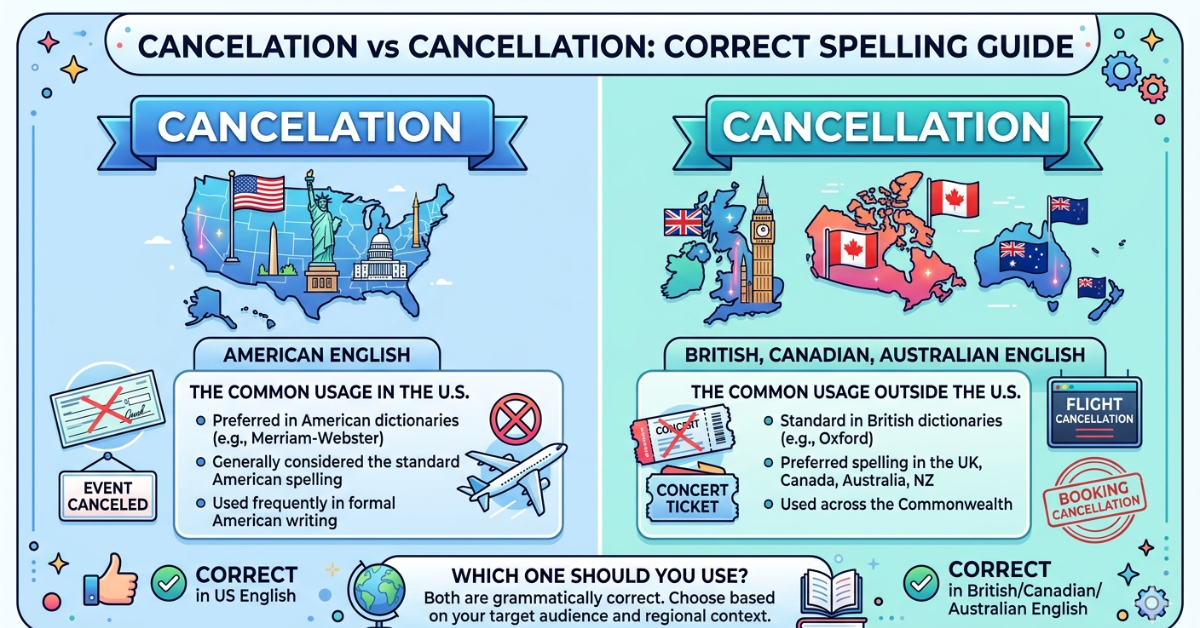
If you’ve ever paused while writing the word “cancellation,” you’re not alone. The confusion between cancelation vs cancellation is one of the most common spelling doubts in English, especially for learners, writers, and professionals.
The main keyword cancelation vs cancellation often appears in searches because both versions look correct at first glance. However, only one is widely accepted in standard English. In this article, we’ll break it down in a simple, practical way so you never mix them up again.
Understanding Cancelation vs Cancellation
The debate around cancelation vs cancellation comes down to spelling variations in English, especially between American and British usage.
The correct standard spelling
- Cancellation (with double “l”) is the correct and widely accepted spelling in both British and American English.
The incorrect or rare form
- Cancelation (single “l”) is considered a misspelling in most formal contexts, though it occasionally appears in older texts or informal writing.
In short, if you’re unsure, always go with cancellation.
Why “Cancellation” Has Two Ls
To understand cancelation vs cancellation, it helps to look at word formation rules.
When we turn the verb cancel into a noun, English usually doubles the final consonant before adding suffixes like “-ation”:
- cancel → cancellation
- travel → travelling (British English example)
- signal → signalling
This doubling rule helps maintain pronunciation and consistency in spelling.
Cancelation vs Cancellation in American and British English
One reason people get confused about cancelation vs cancellation is regional spelling differences.
British English
- Always uses cancellation
- No accepted use of cancelation
American English
- Standard spelling is also cancellation
- “Cancelation” is extremely rare and not considered correct in formal writing
So, across both varieties of English, cancellation remains the preferred form.
Common Usage Examples
Here’s how the correct spelling is used in real sentences:
- The cancellation of the flight caused delays.
- Please confirm your subscription cancellation request.
- The event was announced after sudden cancellation.
If you try replacing it with cancelation, it will look incorrect in formal writing.
Quick Grammar Tips to Remember
To avoid confusion in the future, keep these simple tips in mind:
- Double “l” usually appears before suffixes like “-ation”
- Trust dictionaries—“cancellation” is always listed as correct
- When in doubt, choose the longer spelling
A quick mental trick: “More letters = more correct in formal English.”
Why People Still Search “Cancelation”
Even though cancellation is correct, the misspelling cancelation still appears because:
- People type it the way it sounds
- Auto-correct mistakes in older devices
- Regional variations in informal writing
- Lack of grammar awareness
This is why the search term cancelation vs cancellation remains popular online.
FAQs About Cancelation vs Cancellation
1. What is the correct spelling: cancelation or cancellation?
The correct spelling is cancellation with double “l”.
2. Is “cancelation” ever correct?
No, cancelation is generally considered incorrect in modern English.
3. Why is cancellation spelled with two Ls?
It follows English spelling rules when forming nouns from verbs ending in “l”.
4. Do British and American English differ here?
No, both prefer cancellation in formal writing.
5. Why do people still write cancelation?
Because it sounds natural when spoken, but it is a common spelling mistake.
Conclusion
The confusion around cancelation vs cancellation is understandable, but the rule is simple: always use cancellation in both academic and professional writing. The single “l” version is widely considered incorrect and should be avoided.
Mastering small spelling differences like this improves your writing clarity and credibility. If you found this helpful, you can explore other commonly confused English words to strengthen your grammar even further.