Ment or Meant? The Correct Word Explained

Have you ever paused while writing and wondered, “Is it ment or meant?” You are definitely not alone. This is one of those small spelling questions that can make a big difference in how polished your writing looks.
The answer is simple: in most everyday English, “meant” is the correct word, while “ment” is usually not used by itself. In this article, we will clear up the confusion, explain the meaning of each form, show real examples, and help you remember the difference for good.
What Does “Meant” Mean?
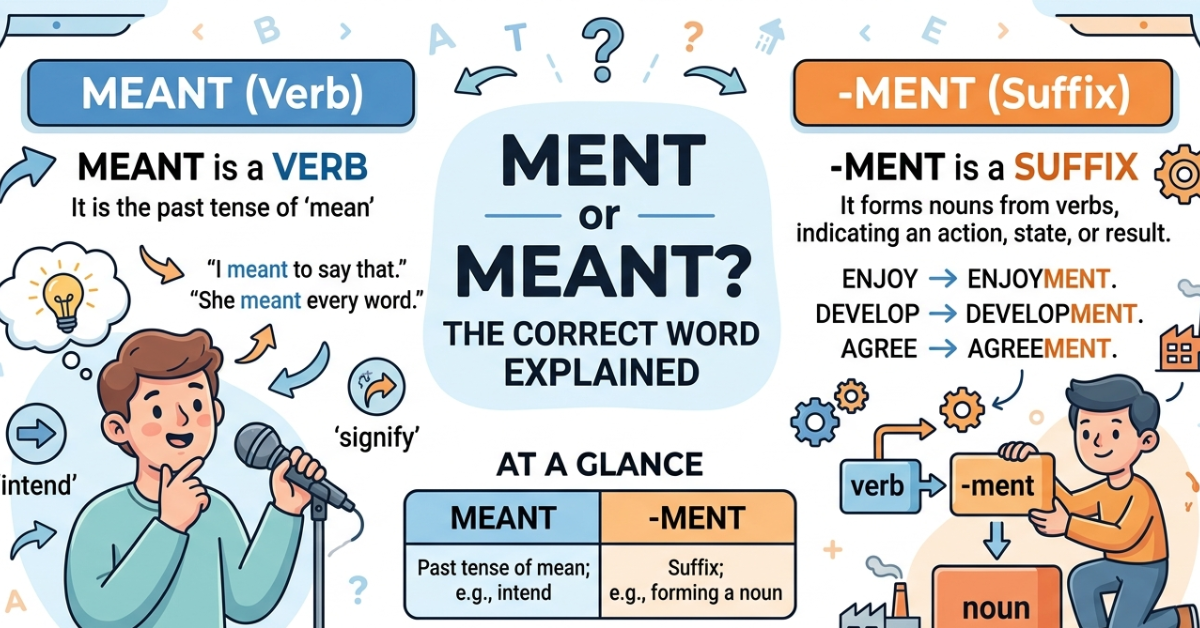
Meant is the past tense and past participle of the verb mean.
It is used when you want to talk about something that had a purpose, intention, or definition in the past.
Examples:
- I meant to call you yesterday.
- What did she mean by that comment?
- This sign meant a lot to him.
In all of these sentences, meant refers to intention, meaning, or explanation. That is why, when people ask “ment or meant”, the correct choice is almost always meant.
Is “Ment” a Word?
In standard English, ment is usually not a word on its own. It is more commonly seen as a suffix at the end of other words.
Examples of words ending in “-ment”:
- development
- agreement
- payment
- excitement
- government
In these cases, -ment helps turn verbs into nouns. For example:
- develop → development
- agree → agreement
- pay → payment
So when someone writes ment or meant, they are usually confusing a suffix with a real standalone word. That is where the mistake happens.
Why People Confuse “Ment” and “Meant”
This spelling mistake happens for a few simple reasons:
- They sound similar in casual speech.
When spoken quickly, “meant” can sound shortened or blurred. - Texting and social media typing.
People often type fast and miss letters. - The word “ment” appears inside many English words.
Since it shows up in words like movement and encouragement, some people assume it can stand alone. - Spelling confusion with pronunciation.
English spelling is not always logical, so this is a very common error.
Understanding this makes it easier to remember why is it ment or meant has only one correct answer in most cases: meant.
How to Use “Meant” Correctly in a Sentence
The best way to avoid mistakes is to understand how meant works in real sentences.
1. Talking about intention
- I meant to send the message earlier.
- He meant no harm.
2. Talking about meaning
- What did you mean by that?
- Her words meant something different to me.
3. Talking about purpose or significance
- The gift meant a lot to her.
- This moment meant everything.
Whenever the sentence involves intention, meaning, or emotional value, meant is the right form.
Easy Trick to Remember the Difference
Here is a simple memory tip:
“Meant” has an “ea,” just like “mean.”
Since meant comes from mean, the spelling keeps that connection. If you can remember that relationship, you will avoid most of the confusion.
Another helpful shortcut:
- If you can replace it with “intended” or “was supposed to”, use meant.
- If you are thinking of a noun ending like agreement or payment, you are dealing with the suffix -ment, not the word meant.
Common Mistakes With “Ment or Meant”
Here are a few incorrect and correct examples:
Incorrect:
- I ment to reply.
- She ment to help.
- What do you ment?
Correct:
- I meant to reply.
- She meant to help.
- What do you mean?
Notice the pattern: ment is almost always an error when used alone, while meant is the correct past tense form.
“Meant” vs. “Mean”: A Quick Comparison
It also helps to compare mean and meant side by side.
Mean
Present tense:
- I mean what I say.
- What does this word mean?
Meant
Past tense:
- I meant to say that.
- That comment meant a lot.
This is one of the easiest grammar patterns to remember. If the action is happening now, use mean. If it happened earlier, use meant.
Real-World Relevance: Why This Small Error Matters
A tiny spelling issue can change how people see your writing. In school, work, emails, and social media, correct spelling makes you look more careful and credible.
For example:
- In a job email, writing “I ment to attach the file” can look unprofessional.
- In a caption or comment, using the wrong form can distract readers from your message.
- In academic writing, small errors can weaken the overall impression of your work.
That is why learning the difference between ment or meant is useful far beyond grammar quizzes.
Practical Tips to Stop Making the Mistake
Here are a few easy habits that help:
- Read your sentence aloud before sending it.
- Ask yourself whether you are talking about intention or meaning.
- Replace the word with “intended” to test it.
- Use spell check, but do not rely on it completely.
- Save a few common examples in memory.
These small habits make a big difference, especially if you write a lot online.
Key Takeaways
- Meant is the correct word in most cases.
- Ment is usually not used alone in standard English.
- -ment is a suffix found in words like development and agreement.
- The phrase is it ment or meant almost always points to meant.
- Remember the connection: mean → meant.
FAQ: Ment or Meant
1. Is it ment or meant?
It is usually meant. Ment is not normally used as a standalone English word.
2. What does meant mean?
Meant is the past tense of mean. It can refer to intention, meaning, or significance.
3. Can I ever use ment by itself?
In standard English, ment is generally not used by itself. It is more commonly seen as a suffix in words like payment and movement.
4. What is the difference between mean and meant?
Mean is present tense, while meant is past tense. For example, “I mean it” becomes “I meant it.”
5. Why do people search for ment or meant?
People often confuse the spelling because the words sound similar and are easy to mistype. It is a very common grammar question.
6. How do I remember the correct spelling?
Think of mean and meant as a pair. If you are talking about the past, use meant.
Conclusion
The confusion around ment or meant is common, but the rule is straightforward: in everyday English, meant is the correct word. It carries the idea of intention, meaning, or purpose, while ment usually appears only as part of another word.
Once you understand the relationship between mean and meant, the spelling becomes much easier to remember. Keep practicing with real sentences, and this mistake will disappear from your writing quickly.