Treet vs Treat: Meaning, Difference & Common Confusion

Have you ever paused while writing a simple word like “treat” and wondered if it could also be spelled as “treet”? You’re not alone. The confusion around treet vs treat is surprisingly common, especially among English learners and fast typists.
Within the first look, the issue seems minor—but spelling mistakes like this can change meaning, affect writing clarity, and even impact professional communication. In this guide, we’ll break down treet vs treat, explain why the confusion happens, and help you always choose the correct spelling with confidence.
What Does “Treat” Mean in English?
To understand, we first need to look at the correct word: treat.
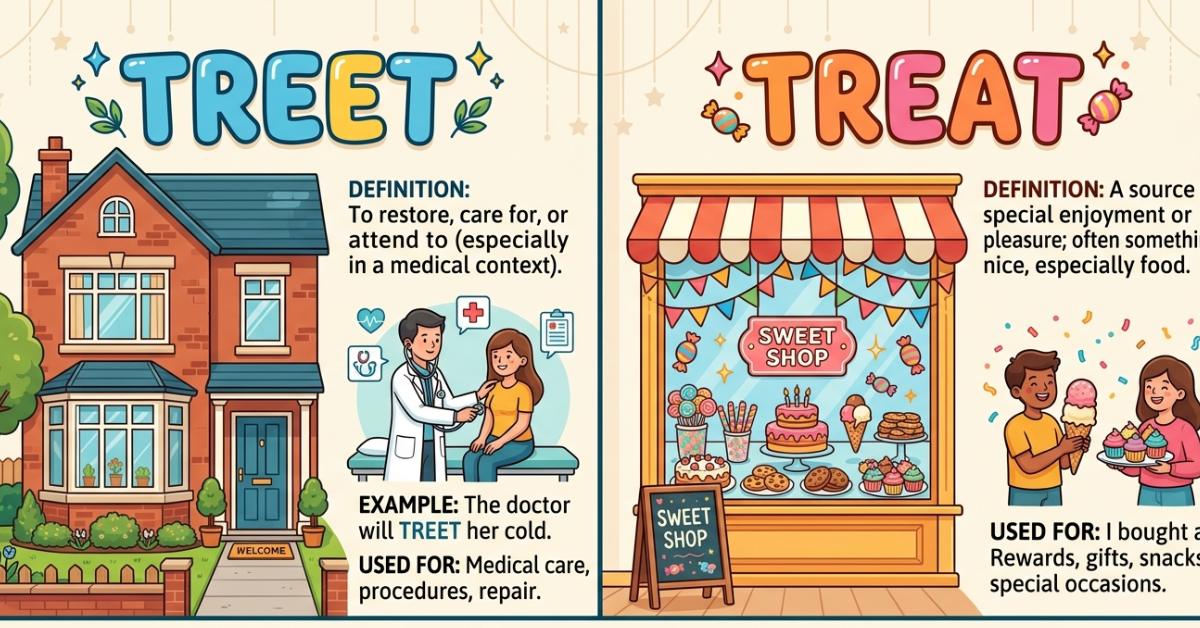
The word “treat” has several meanings depending on context:
- As a verb: to behave toward someone in a certain way
- Example: She treats everyone with kindness.
- As a noun: something enjoyable or special
- Example: Ice cream is a sweet treat.
- As a reward or surprise:
- Example: I’ll treat you to dinner.
Common Uses of “Treat”
- Treat someone nicely
- Give someone a treat
- Medical treatment (to treat a disease)
- Special occasion reward
So, treat is a valid and widely used English word in everyday speech and writing.
Is “Treet” a Real Word?
Here’s where the confusion around treet vs treat becomes clear.
The word “treet” is not a standard English word. It is generally considered:
- A misspelling of “treat”
- A typing error (common on keyboards)
- Occasionally used as a brand name or slang in rare contexts, but not grammatically correct in standard English
Why People Type “Treet” by Mistake
There are a few simple reasons:
- Keyboard proximity of letters R and E
- Fast typing without proofreading
- Autocorrect errors on mobile devices
- Lack of familiarity with spelling rules
So when comparing treet vs treat, only treat is correct in standard English usage.
Treet vs Treat: Key Differences Explained
Let’s break it down clearly so you never mix them up again.
| Feature | Treat | Treet |
| Correct word? | Yes | No (misspelling) |
| Meaning | Reward, care, behave | No standard meaning |
| Usage | Everyday English | Rare / incorrect |
| Dictionary | Included | Not recognized |
Simple Rule to Remember
If you are writing in English, always choose treat. The spelling treet vs treat is not a real competition—only one is valid.
Why the Confusion Between Treet vs Treat Happens
Language confusion like treet vs treat is common because English is full of similar-sounding words (homophones).
Other examples include:
- their / there / they’re
- meet / meat
- sweet / suite
With treet vs treat, the issue is mostly visual and typing-based rather than pronunciation-based.
Psychological Factor
Our brains often “auto-correct” unfamiliar spelling patterns, which leads to errors like:
- Dropping or swapping vowels
- Repeating letters incorrectly
- Guessing spelling based on sound alone
Real-World Impact of Spelling Mistakes Like “Treet”
While it may seem minor, incorrect spelling in treet vs treat situations can affect:
- Professional writing (emails, resumes, reports)
- Academic work (essays, assignments)
- Online communication (social media, captions)
Even small spelling mistakes can reduce clarity and credibility.
Practical Tips to Always Spell “Treat” Correctly
Here are some easy ways to avoid confusion:
1. Think of “treat” as a reward
Whenever you hear “something nice or special,” associate it with correct spelling: treat.
2. Break the word down
T-R-E-A-T → Remember the “EA” in the middle.
3. Use spelling tools wisely
Grammar tools and autocorrect can help catch errors instantly.
4. Practice with examples
- I will treat myself today.
- That dessert is a treat.
Repetition builds memory.
Key Takeaways
- Treat is the correct English word
- Treet is a misspelling or typo
- The confusion in treet vs treat comes from typing and spelling errors
- “Treat” can be a verb or noun depending on context
- Practice and awareness help eliminate this mistake
FAQs About Treet vs Treat
1. What is the correct spelling: treet or treat?
The correct spelling is treat. “Treet” is not a recognized English word and is usually a typing mistake.
2. Why do people write treet instead of treat?
Most people accidentally type treet vs treat due to keyboard errors or fast typing without checking spelling.
3. Is “treet” used in any language?
No, “treet” is not a standard word in English or most other languages. It may appear only as a brand name or typo.
4. What does “treat” mean in English?
“Treat” can mean a reward, something enjoyable, or the act of behaving toward someone in a certain way.
5. How can I avoid spelling mistakes like treet vs treat?
You can avoid mistakes by practicing spelling, using grammar tools, and proofreading your writing before submitting it.
6. Is treet vs treat a homophone problem?
Not exactly. It’s more of a spelling error issue rather than a pronunciation-based homophone confusion.
Conclusion
Understanding the word is simple once you break it down: only treat is correct, while treet is just a common spelling mistake. This confusion usually comes from typing habits rather than language rules.
By practicing correct spelling and paying attention to word structure, you can easily avoid such errors and improve your writing clarity. Whether you’re writing casually or professionally, using the correct form helps you communicate with confidence and accuracy.