Have you ever finished writing an important email and paused at the closing line, wondering whether “i await your response” sounds professional, polite, or perhaps a little too formal? You’re not alone. This phrase appears frequently in business emails, job applications, customer service communications, and formal correspondence. Yet many people are unsure about when to use it and whether there are better alternatives.
In this guide, you’ll learn the exact meaning of the phrase, its tone and implications, when it is appropriate to use, common mistakes to avoid, and modern alternatives that can make your communication more effective.
What Does “I Await Your Response” Mean?
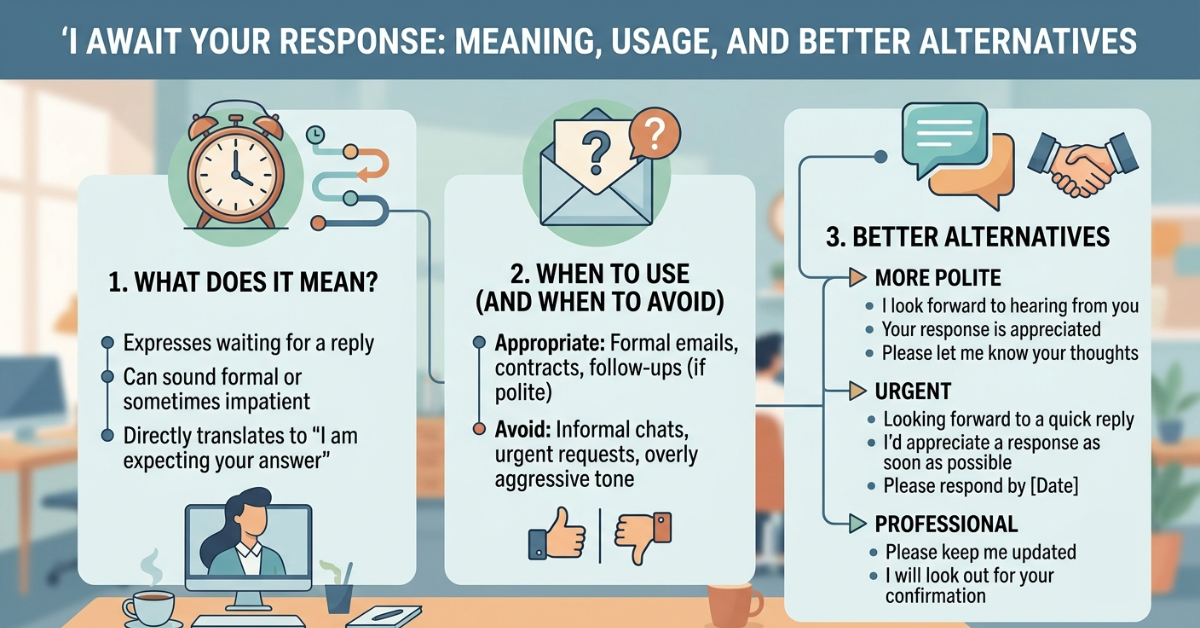
The phrase “i await your response” means that the sender is expecting or looking forward to receiving a reply from the recipient.
At its core, it communicates two things:
- You are waiting for a response.
- You consider the response important enough to mention explicitly.
The phrase is generally used at the end of a message, particularly in professional or formal communication.
Simple Example
Thank you for reviewing my proposal. I await your response.
In this example, the sender is politely indicating that they expect feedback regarding the proposal.
The Origin and Formal Nature of the Phrase
The word await comes from older forms of English and has long been associated with formal writing. Historically, letters often used highly structured language, and phrases like:
- I await your response.
- I await your reply.
- I await further instructions.
were common in business and official correspondence.
Today, the phrase still carries a formal tone, though modern workplace communication often favors more conversational alternatives.
Is “I Await Your Response” Professional?
Yes, the phrase is professional. However, its effectiveness depends on the context.
In highly formal settings, it sounds appropriate and respectful. In casual workplace communication, it may sound slightly stiff or old-fashioned.
Suitable Situations
The phrase works well when:
- Applying for a job
- Contacting government agencies
- Communicating with legal professionals
- Sending formal business proposals
- Following up on official requests
- Corresponding with academic institutions
Less Suitable Situations
It may feel overly formal when:
- Messaging coworkers
- Sending internal team emails
- Communicating with close clients
- Using chat platforms like Slack or Microsoft Teams
In these situations, a friendlier alternative often works better.
Understanding the Tone Behind the Phrase
Language does more than convey information—it communicates attitude and intention.
The phrase can be interpreted as:
Polite and Respectful
Many recipients see it as a courteous way to indicate that a reply is expected.
Formal
The wording creates a professional tone that fits official correspondence.
Slightly Demanding (In Some Cases)
Depending on the context, some readers may interpret it as subtly pressuring them to respond.
For example:
I await your response regarding this matter.
This sounds more urgent than:
I look forward to hearing from you.
Because of this nuance, many communication experts recommend choosing alternatives based on the relationship and situation.
When Should You Use “I Await Your Response”?
Job Applications
After submitting an application or attending an interview, the phrase can demonstrate professionalism.
Example:
Thank you for considering my application. I await your response regarding the next steps.
Business Proposals
When sending proposals, quotations, or partnership opportunities, the phrase can indicate that feedback is expected.
Example:
Please review the attached proposal at your convenience. I await your response.
Customer Service Escalations
If an issue requires resolution, using the phrase may emphasize the importance of receiving an update.
Example:
I appreciate your assistance and await your response regarding the status of my request.
Academic Communication
Students often use formal language when emailing professors, admissions offices, or university administrators.
Example:
Thank you for your time and consideration. I await your response.
Common Alternatives to “I Await Your Response”
Modern business communication often favors warmer, more natural language.
I Look Forward to Your Response
This is perhaps the most popular alternative.
Example:
I look forward to your response.
Benefits:
- Professional
- Friendly
- Widely accepted
I Look Forward to Hearing From You
This version sounds slightly more conversational.
Example:
I look forward to hearing from you soon.
Please Let Me Know
A straightforward option that works in many situations.
Example:
Please let me know if you require any additional information.
Thank You in Advance
Useful when requesting assistance or information.
Example:
Thank you in advance for your help.
I Appreciate Your Time and Feedback
This alternative emphasizes gratitude.
Example:
I appreciate your time and feedback regarding this matter.
Comparing Common Email Closings
| Closing Phrase | Formality Level | Tone |
| I await your response | Very formal | Direct |
| I look forward to your response | Professional | Friendly |
| I look forward to hearing from you | Moderately formal | Warm |
| Please let me know | Neutral | Conversational |
| Thank you in advance | Professional | Appreciative |
This comparison shows why many professionals prefer alternatives that sound collaborative rather than directive.
Examples in Different Situations
Formal Business Email
Thank you for reviewing the proposal. I await your response and would be pleased to answer any questions.
Job Application Email
I appreciate your consideration and await your response regarding the next stage of the hiring process.
Customer Complaint
I trust this issue can be resolved promptly and await your response.
Academic Inquiry
Thank you for your assistance. I await your response concerning the application requirements.
Common Mistakes to Avoid
Sounding Too Demanding
Repeatedly emphasizing that you are waiting for a response can appear pushy.
Instead of:
I await your response immediately.
Try:
I would appreciate an update when convenient.
Using It in Casual Conversations
The phrase may sound unnecessarily formal among colleagues or friends.
Overusing Formal Language
Combining multiple formal expressions can make an email feel rigid.
For example:
Dear Sir, I humbly await your esteemed response.
This sounds outdated in most modern professional environments.
Best Practices for Professional Email Communication
Whether you use the phrase or an alternative, follow these communication principles:
Be Clear
State exactly what you need from the recipient.
Be Concise
Avoid lengthy explanations when a short message will suffice.
Show Appreciation
Express gratitude for the recipient’s time and effort.
Match the Relationship
Use language that fits your audience and communication style.
Consider Timing
If a response is urgent, politely specify a deadline rather than relying solely on formal wording.
Why Communication Style Matters
Research in workplace communication consistently shows that tone influences response rates and relationship quality. Messages that are respectful, clear, and approachable tend to receive faster and more positive responses.
While “i await your response” remains grammatically correct and professional, many modern communicators prefer language that feels collaborative rather than authoritative.
The best choice depends on:
- Your audience
- The level of formality required
- The purpose of the communication
- The relationship between sender and recipient
Key Takeaways
- “I await your response” means you are expecting a reply.
- The phrase is professional and grammatically correct.
- It carries a formal tone that may feel old-fashioned in some settings.
- It works best in official, academic, legal, and business communications.
- Friendlier alternatives often fit modern workplace communication better.
- Matching your tone to the audience improves communication effectiveness.
Frequently Asked Questions
Is “I await your response” grammatically correct?
Yes. The phrase is grammatically correct and commonly used in formal written communication to indicate that a reply is expected.
Is “I await your response” rude?
Not usually. However, depending on context and tone, it can sound more demanding than softer alternatives like “I look forward to hearing from you.”
What is a better alternative to “I await your response”?
Many professionals prefer “I look forward to your response” because it sounds both professional and approachable.
Can I use “I await your response” in a job application?
Yes. It is appropriate in job applications, cover letters, and interview follow-up emails where formal communication is expected.
Is “I await your reply” the same as “I await your response”?
Yes. Both phrases communicate the same basic meaning, although “response” may feel slightly broader than “reply.”
Should I use this phrase in everyday workplace emails?
Usually not. For routine workplace communication, more conversational phrases such as “Please let me know” or “I look forward to hearing from you” often feel more natural.
Conclusion
The phrase “i await your response” remains a professional and grammatically correct way to end formal correspondence. It clearly communicates that you expect a reply and can be effective in business, academic, legal, and official settings. However, modern communication trends increasingly favor warmer and more conversational alternatives that maintain professionalism while sounding approachable.
Ultimately, the best closing depends on your audience, relationship, and purpose. By choosing the right tone and wording, you can improve your communication, encourage timely responses, and leave a positive impression on your readers.